• The move to the new server is done. There are some software and database maintenance updates in process. This has us passing the hat around to help out. We appreciate any donations. Seriously, even a dollar helps. The payment page may be found here - https://www.audiokarma.org/support.html

What is the upside?

Ken Boyd

Super Member
Subscriber
Currently I am working on my first scratch build project and as I progress, I can see I doubt I will be able to keep the budget to where it will be less than what I can buy a nice condition used really nice amp. So all said I am wondering what is the upside of scratch building an amp. I can buy amps that are used that need work and stay within a good margin in most cases. But starting fresh, buying the chassis, transformers, OPT's tube sockets, turrets, tubes, caps, resistors, chokes, and all the other little items needed, I can go out and buy a really nice pair of amps that hardly need any work on the used market. And then you have to take into account will the project sound as good. I am still going to go forward, but this might be the last of this kind of projects for me. I think I would be better off just buying an old used amp that has good iron and repurpose it.

So I am wondering what is the upside of building a new amp from scratch? Am I missing something?
 
Register to hide this ad
Currently I am working on my first scratch build project and as I progress, I can see I doubt I will be able to keep the budget to where it will be less than what I can buy a nice condition used really nice amp. So all said I am wondering what is the upside of scratch building an amp. I can buy amps that are used that need work and stay within a good margin in most cases. But starting fresh, buying the chassis, transformers, OPT's tube sockets, turrets, tubes, caps, resistors, chokes, and all the other little items needed, I can go out and buy a really nice pair of amps that hardly need any work on the used market. And then you have to take into account will the project sound as good. I am still going to go forward, but this might be the last of this kind of projects for me. I think I would be better off just buying an old used amp that has good iron and repurpose it.

So I am wondering what is the upside of building a new amp from scratch? Am I missing something?
IMO....the satisfaction of knowing you did it yourself. I am a tinker kind of person, and knowing I took it from a pile of parts to a nice finished product would satisfy me. Now, that being said, if you are just looking for good sound from any source, buying one that needs work, or plays just fine would be the way to go.
 
^^ exactly this. Anyone can spend money, it takes skill to do it yourself, even if its not the cheapest way of getting it done. Also you get complete control over every single thing that went in there.

I tend to build around recycled parts for budget reasons. The transformers tend to be the costly part so when I find decent deals on good iron I pick it up. Other bits and bobs are accumulated when they show up for cheap. The down side there is I end up with quite a hoard of "stuff" for those "one of these days" projects.
 
Pride and competence !
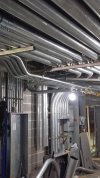
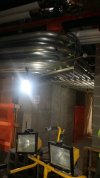
I worked as an electrician in building construction for 31 years. My favorite task was bending and installing pipework. By the end of a day, you are proud to see enormous progress was accomplished. You started with a semi-empty space and soon achieved craftsmanship displayed20151020_113710.jpgView attachment 3834397.
Building audio gear keeps your brain focused and can help you achieve pride and satisfaction in your craft. From a pile of nothing to a working amplifier or preamplifier is definitely a proud feeling...
20151110_114130.jpg
 
Last edited:
Agree with all that's been said above. With current transformer prices, a scratch build using new parts is rarely going to be cheaper than buying something used. One way to look at it: the vast majority of vintage tube amplifiers are quite cheap for what they are. If you adjust for inflation, they cost much less to buy used today than they cost new. New parts, on the other hand, cost roughly the same now as they did in the golden era when adjusted for inflation (transformers are labor and materials intensive).

Gadget is right that one way to make scratch builds drastically cheaper is to use vintage parts. I troll ebay for output transformers on a weekly basis and pick up nice push-pull iron regularly for less than $100/pair. In contrast, new transformers are exceeding $300/pr at current prices. Power transformers and chokes can be really cheap used.

Another justification for new builds is employing technologies and techniques not available or widely used in the golden era. Of course this is somewhat a question of taste, but using modern constant current sources, regulation, transistor followers, LED bias, choke loads, parafeed, etc. Or, using technologies from the early days of tube audio that fell out of favor for mass production amplifiers (single-ended output stages, directly heated tubes, inter-stage and input transformers, low NFB, etc.).
 
Last edited:
Pride and competence !
I worked as an electrician in building construction for 31 years. My favorite task was bending and installing pipework. By the end of a day, you are proud to see enormous progress was accomplished. You started with a semi-empty space and soon achieved craftsmanship displayedView attachment 3834396View attachment 3834397.
Building audio gear keeps your brain focused and can help you achieve pride and satisfaction in your craft. From a pile of nothing to a working amplifier or preamplifier is definitely a proud feeling...
Yes I have worked on many a projects like that, mostly on big skids and components for turbine engines in power plants.
 
@Ken Boyd ,
The satisfaction of building from scratch, or even restoring a very vintage audio amp, cannot be under-estimated.
Every time the system warms up, you smile. As the music plays, you know you "created" or restored the amplifier(s).
It is a great feeling !
 
I am still going to go forward, but this might be the last of this kind of projects for me. I think I would be better off just buying an old used amp that has good iron and repurpose it.

So I am wondering what is the upside of building a new amp from scratch? Am I missing something?
For one thing, you are constrained by whatever that amp was, it's design layout and living with that. I see these "console pulls" people repurpose and know I would never enjoy looking at something like that. I enjoy being able to design from a fresh slate and not being forced to work within an existing design. But if cost is the main objective, "buying an old used amp", especially something that's not popular or ugly is usually going to be cheaper.
 
I don't do tubes but could probably find half what's needed in my 50-year-old stash of stuff. Starting from scratch would be expensive unless I could find parts on Alibaba or similar.
 
I have a full set of Mac MA-230 NOS transformers power and output. I told myself for years I would build something out of them. I hope they're still in my Father's basement. I've never scratch built an amp but have built a couple kit amps.
 
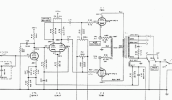
That would be pretty nice to build around, though I might make some tweaks to use 6L6GC vs a 7591 purely for availability reasons.

1789136791159.png

other than the cathode feedback its a pretty conventional amp design, pretty nearly the same as what I did for my 6L6 and my 6P3SE amps. The 6L6 is 12ax7/6CG7 and the 6P3SE is 12ay7/6cg7 but same topology, direct coupled long tail pair inverter, pentode mode output, etc. 6CG7 is similar enough to a 12AU7, and I get plenty of voltage swing despite running them from a slightly lower voltage supply. I would expect no problems with it in this circuit, basically drop the 6L6GC in, tweak the bias supply to give some extra negative voltage as needed, and maybe a slight tweak to the HF stability stuff in case the 6L6 changes it a bit.
 
Depends what you build and what you want. In some cases you won't be very far ahead, others you will. No one is going to scratch build a Fisher 500C equivalent with the same capabilities for less than the cost of a real one. On the other hand I built my power amps for 1/10 of the price the commercial version sells for.

If exactly what you want is available with quality and price that you want, you're probably not going to beat it. But I see lots of people spend tons of money on tubes and caps and mods after they buy something to get it closer to what they want. So that needs to be factored into the cost.
 
Currently I am working on my first scratch build project and as I progress, I can see I doubt I will be able to keep the budget to where it will be less than what I can buy a nice condition used really nice amp.
My DIYs usually end up costing more, in parts, than I first estimated. I tend to add more $$$ parts, figuring, "well, since I'm already soldering..."

And one never really includes the labor time, which should be added to the final cost. :idea:

But fun and learning are the things! Not saving money over a pre-built, similar item. At least, to me.
 
Depends what you build and what you want. In some cases you won't be very far ahead, others you will. No one is going to scratch build a Fisher 500C equivalent with the same capabilities for less than the cost of a real one. On the other hand I built my power amps for 1/10 of the price the commercial version sells for.
yeah power amps are comparatively easy. Preamps or preamp sections get more involved, tuner from scratch you may as well forget about. Not impossible, but the parts are expensive, difficult to find, and if you're doing it with tubes it basically means NOS or used pulls from something for coils, transformers, and the tuning cap if you aren't going to go full hardcore and wind your own. If that was the path I'd probably do variable reluctance tuning rather than building a tuning cap.

even talking preamps, it depends what you're doing. Dead simple triode gain stage, plus possibly a cathode follower is really easy. If you want tone controls it gets more difficult. If you want something with a feature set like a Citation 1 or a Marantz 7 or whatever, thats a big jump.
 
Back
Top Bottom