

-
Feeling lucky? Check out the AK 24th Anniversary Giveaway thread and join in the fun!
You are using an out of date browser. It may not display this or other websites correctly.
You should upgrade or use an alternative browser.
You should upgrade or use an alternative browser.
what kind of capacitors are these
- Thread starter Mike Mag
- Start date

Register to hide this ad

The dielectric of these capacitors exhibits very low distortion. For audio or low/medium RF frequencies they are often used, and they would be used more often but for their size vs capacitance ratio (poor compared to others), and/or their sensitivity to heat or solvent damage. The radial construction of the ones in your picture minimises the effects of lead inductance, which is another consideration.Yes I would guess polystyrene but wanted some expert info. I had no plans to change them just understand them.
Enough?

Last edited:
Probably to protect them from the aforementioned solvent damage, I wouldn't lose any sleep over them - just leave them alone.I am curious why they seem to be enclosed in something like a blue glass drop


Mike Mag
Active Member
I am very impressed with this Adcom GFT-555MK2 tuner, lots of quality components, sounds excellent on the local jazz station and well built. the only flaw is the trimmer caps in the tuning circuit are not at the highest reliability level
I do not know why most people condemn Adcom tuners, maybe they are prejudiced against them and wont give them a chance. I thought they were bad because of what I read until I gave one a chance and it really impressed me.
I do not know why most people condemn Adcom tuners, maybe they are prejudiced against them and wont give them a chance. I thought they were bad because of what I read until I gave one a chance and it really impressed me.


Polystyrene caps are made with a polystyrene film, ie they are film caps.You see them in phono stages also. In an old thread, someone replaced them with film caps. And yes chastising did occur by some.

whoaru99
Epic Member
FWIW -
Polystyrene as a Capacitor Dielectric
The polystyrene capacitor was the device of choice for precision-tuned circuits due to the extreme stability in the 0°C thru +50°C range as well as long-term stability. The major drawback of this dielectric was the maximum operating temperature of +85°C, the glass transition temperature of ~95°C, and a fluid temperature of +100°C, making applications for this device limited.

Yes, I too thought polystyrene capacitors were no longer manufactured. They're very good caps for audio but the small capacitances available mean they can't be used often. Very good in RIAA EQ filters though. Be careful with flux cleaning solvents though - the caps melt!I just today replaced a bad one in a Sanyo receiver RIAA phono stage. Luckily I had some in my stash, very hard to find today and if you do find them they're back ordered like everything else. I don't even think polystyrene for capacitors is made anymore.
Craig

Polystyrene caps are made with a polystyrene film, ie they are film caps.
"film" covers several dielectrics but people rarely seem to be specific about which one exactly. I'm guessing they usually mean polypropylene but who knows really.
Yes, "film" is about as specific as saying "stuff". Similarly "poly". Poly-what?"film" covers several dielectrics but people rarely seem to be specific about which one exactly. I'm guessing they usually mean polypropylene but who knows really.


audiodummy
Well-Known Member
Poly = Solid Polymer (polarized!) Electrolytic of course!
Agreed, people shouldn't say simply "film" (are we talking a photo capacitor?!) or "poly" caps, spell out whole word polystyrene, polypropylene, polyethylene terephthalate (mylar), solid polymer, etc., etc. Technically I'm okay with mixing all the plastic capacitors together as they're still fairly similar to each other compared to ceramics or electrolytics, but once the solid polymer electrolytics came on the scene I got up in arms.
BTW they still make paper capacitors right? Think so...at the very least I think aluminum electrolytics still use paper as the mechanical separator.
Agreed, people shouldn't say simply "film" (are we talking a photo capacitor?!) or "poly" caps, spell out whole word polystyrene, polypropylene, polyethylene terephthalate (mylar), solid polymer, etc., etc. Technically I'm okay with mixing all the plastic capacitors together as they're still fairly similar to each other compared to ceramics or electrolytics, but once the solid polymer electrolytics came on the scene I got up in arms.
BTW they still make paper capacitors right? Think so...at the very least I think aluminum electrolytics still use paper as the mechanical separator.
audiodummy
Well-Known Member
Appears that Kemet still makes paper capacitors (not counting liquid electrolytic).
Yep, paper-in-oil or PIO capacitors are highly prized in some audiophile circles.If you mean paper in the vintage tube gear paper cap sense, one can only hope they do not.
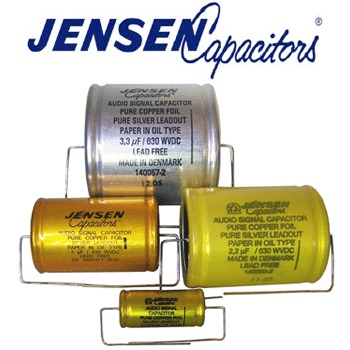
https://www.hificollective.co.uk/components/jensen_copperfoil_in_aluminium_can.html
They're also made for commercial, non-audiophile applications such as class X2. These are made by Kemet (as mentioned above).
https://uk.farnell.com/kemet/pme271md6330kr30/cap-0-33-f-10-paper-radial/dp/2495783


