• The move to the new server is done. There are some software and database maintenance updates in process. This has us passing the hat around to help out. We appreciate any donations. Seriously, even a dollar helps. The payment page may be found here - https://www.audiokarma.org/support.html

What SE to build

So I'm dropping in on this as I'm a big fan of Mr. Gillespie's modified 8600 Maggie, or DG-SE1 as I 'dubbed' it back at it's inception. I've built this circuit no less than 50 times since 2015 when Dave first shared it with the general public. I say that rather Tonge-in-cheek as all but about 8 or maybe 10 have been 'other' deviants of the way DSG originally posted. Even my very first attempt was an 'alternate' as I didn't have an 8600 to start with, the P-T31s, or the specified Hammond Choke. But, after some initial consultation and help from Dave, I was off and running. Since then I've used his design to build the amp using multiple different power transformers, different rectifier including both 'tube' and 'solid state', different driver tubes, different output tubes versions ranging from going 'up' in power with 7591s and even going 'down' in power to about 1 WPC using a 6EH5 output tube. I've even built a set of Mono-blocks using the 6AV6 as a driver, but still true to the original schematic in almost every way. Building these has delighted me, not just as related to their basic simplicity and ease of construction, but the rewards of listening to them when completed just never ceases to amaze me. Even the little 1-W version has an amazing clarity, depth, tonality, and 'reach' for being about as small an amp as you can build and still drive a set of speakers!!! Anyway, I'm not sure what is meant by 'version 1' vs 'version 2' unless you're referring to the addition of the bias controls and minor changes in the power supply dropping resistors. If that's it, then I'd stick with the V2, as having the ability to 'adjust' the OPT bias is a really nice feature. That said, in building the amp with anything OTHER that an actual 8600 you're probably going to run into some variables with power supply 'adjustments' based on what PT you start with and how it's rectified. The good news is that as long as your PS is capable of a 100ma constant current supply, then adjustments to get the amp dialed in to the basic specs as shown on the output tube isn't really all that difficult. Just a matter of massaging some dropping resistors along with any filter choke resistance as well as the DC resistance in the output transformers used. I found that most larger sized OT generally had a bit more DC resistance so 'upping' the B+ from 265 to 275 was pretty common. That then required the dropping resistor at B+1 to be of an increased resistance level since you were now moving the B+1 from 265 to 255, to 275 to 255. IIRC, the resistor in the circuit at that point is shown as 1K, and I think I had to go to something like 1.5K or there abouts.

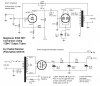
Anyway, I gotta ask about the circuit shown above: Maybe I'm missing something, but in looking at that circuit I'm seeing what appears to be what I've been told is considered a 'triode-strapped' EL34, which I'm sure is nice output section! BUT, what I don't 'get' up there is just how the driver stage is powering the plate of what I'd call V1A (.... the 'input' half of the 12AV7, with V1B being the second half and what feeds the input of the EL34)? I see the PS has notation 'B', 345VDC going directly to the plate of V1B (which seems excessive?). But there's no PS connection to the plate of V1A?.....or am I missing something there? Honestly, that whole PS seems 'odd' to me; 3 PTs in one version, 2 in the other, not sure what the little random circuit is in the lower right corner, nor do I get the concept of feeding what looks like 75VDC back to the virtual center tap of the filaments (unless this has to do with the 'float the cathode over ground' thing.....which I sort of understand, but not completely). Anyway, I'm sure a triode-strapped EL34 amp would sound great, but in having compared the DG-SE1 builds to actual 2A3 and 300B amps in the past, my experience with the results of these comparisons is that the DG-SE1 has caused substantial trauma with the 300B and 2A3 owners. I've left some people's homes with them becoming sadly disappointed in their gear after hearing what the 'Single Ended Pentode' performance of the EL84 can deliver!! Not to mentions the 'price of build' comparison, which is about 1/5th or less than the cost to build a SET amp at the same level.

So, just tossing my thoughts into this thread as I am a big fan of 'flea' amps of the tube type! My plan this winter is to do a Single Ended Parallel version of the DG-SE1 using a 12AU7 in parallel as the output. Should be about 1.5 watts or so......and will be 'interesting' to see the results. Good luck to the OP!!

Tom D.
 
Anyway, I gotta ask about the circuit shown above: Maybe I'm missing something, but in looking at that circuit I'm seeing what appears to be what I've been told is considered a 'triode-strapped' EL34, which I'm sure is nice output section! BUT, what I don't 'get' up there is just how the driver stage is powering the plate of what I'd call V1A (.... the 'input' half of the 12AV7, with V1B being the second half and what feeds the input of the EL34)? I see the PS has notation 'B', 345VDC going directly to the plate of V1B (which seems excessive?). But there's no PS connection to the plate of V1A?.....or am I missing something there? Honestly, that whole PS seems 'odd' to me; 3 PTs in one version, 2 in the other, not sure what the little random circuit is in the lower right corner, nor do I get the concept of feeding what looks like 75VDC back to the virtual center tap of the filaments (unless this has to do with the 'float the cathode over ground' thing.....which I sort of understand, but not completely). Anyway, I'm sure a triode-strapped EL34 amp would sound great, but in having compared the DG-SE1 builds to actual 2A3 and 300B amps in the past, my experience with the results of these comparisons is that the DG-SE1 has caused substantial trauma with the 300B and 2A3 owners. I've left some people's homes with them becoming sadly disappointed in their gear after hearing what the 'Single Ended Pentode' performance of the EL84 can deliver!! Not to mentions the 'price of build' comparison, which is about 1/5th or less than the cost to build a SET amp at the same level.

Tom D.

The 12AV7 is configured as an SRPP or totem pole amplifier. A common audio amp configuration. The two halves of the tube only see one half of the total B+ voltage. The voltage at the cathode end of C2 is approximately half of B+ as indicated on the schematic.

The power supply section in the original amp is a single transformer, but I don’t have that symbol in my circuit library so I drew other transformer sections to illustrate the entire transformer. The other schematic with the Edcor power transformer is an alternate circuit because it is highly unlikely someone will find a transformer like the one that came in the amp from Music Angel.

The random circuit is a circuit illustrating connecting signal ground and chassis ground together for low noise and safety.

The 75 volts is the elevated heater voltage due to the SRPP stage. Actually, I need to lower B+ to the driver stage to about 325VDC instead of 345VDC because the heater to cathode max voltage is 90V. I thought it was 100V.

Although this amp sounds quite good, I would consider it an entry level build for people to get their feet wet. I haven’t seen or read about Dave’s SE amp. I’ll have to check it out.
 
THD, thanks for your explanations. I kinda figured that on the PTs, but just wasn't sure. I've had to use separate 5V PTs for use with 5V rectifiers before, so, wouldn't have surprised me if you had found a stand-alone HV PT and then added filament PTs as needed. A very interesting build! I'm intrigued with the strapped EL34! Could you 'adapt' that circuit to run in Pentode mode and be closer to about 10 WPC?

Lavane, Yea, I'm up to about 45 of them by now, and have seriously run out of steam! Of course, I do that every spring, when the weather gets nice and I start boating, fishing, and getting into 'mechanical' projects in the garage....not to mention just riding my motorcycle! But, after the holidays I'll break out the soldering iron again. And your comment about Parallel EL84 DG amp has crossed my mind as well. I'm just not sure if 1/2 a 12AX7 has got the drive capability to push 2 of those tubes to saturation. I have a feeling it might not, but perhaps you know better? Some time back I had a set of Antique Sound Labs mono-blocks that were SE Parallel EL84s, and to be honest about it, they didn't sound nearly as good as virtually any of my Push-pull EL84 amps. As I recall DSGs comments about attempting to wrench more power out of his circuit, mostly as related to trying to build it to do 8 to 10 WPC or so, he basically said '...just go Push Pull and be done with it!'....or there abouts. That said, I've had some communications in the past with Kward here on AK, and he has a circuit using (IIRC) a KT88 that I think he said will do about 15 Watts in a SE circuit......and do so with really stellar results on the scope patterns. I've planned to build that one myself, but just keep getting distracted....plus the iron cost is upwards of $500 if you include the chokes!! But, I've got most of the stuff to go the other way using the 12AU7 in parallel. I'll give credit to the Guitar Amp crowd for turning me on to this. A gent by the name of Rob Robinette has a 'micro-bassman' circuit out there, as well as a Micro Deluxe, both of which use the 12AU7, but I believe the micro bassman does it in SE Parallel, where the micro deluxe does it in Push Pull using either side of the 12AU7. I believe Jeff Bober, formerly of Budda amp fame and now the Chief of 'East Amplification' also has a mini head out using these same concepts, as does the Blackstar company with their HR-1. May be others...... I dunno! But...... kinda a fun way to build 'light' guitar amps that play well in home 'practice' environments or can be carried to a gig and mic'd

Anyway...... I prattle on! My apologies to the OP. Didn't mean to gank the thread! I'm out! Tom
 
@Wharfcreek , I've built a version of the Bassman micro Rob Robinette designed, mine is the EF80 version but it's a PP design.... Fantastic amp.... and has had me thinking about a stereo hifi version for quite some time.

Sorry OP...
 
I've read about the 12AU7 guitar amps. The Fender 12AX7 is supposed to be junk if I remember right? Your right though, the bigger the output tube, the more expensive the iron can get.
 
That Lundahl schematic looks interesting. The cathode of the output tube drawing current through the secondary like that is quite an interesting way to get local NFB. Can't say I've seen that before, although admittedly I stay away from SE designs, and obviously that wouldn't work with a P-P OPT. I would be tempted to make the NFB global if I built the amp, but obviously that could give you stability issues.
 
although admittedly I stay away from SE designs

Back in the late 90's after years of hearing and seeing SE amps on the early forums and web sites, I had to see what all the fuss was about, so I built a pair of 2A3 mono amps. If you have the right speakers, a SE low power amp will make them "sing". At last I knew why people liked them. Even the simplest SE amp, if designed well can sound good.

For me, they do their best at low level intimate listening.
 
I did just buy a Magnavox 8605 as a treat, and I'm planning to do all the dcgillespie mods (but I think I'll leave the original OPTs). Part of the issue is that I don't have sensitive speakers.
 
If your speakers are 8 ohms, then the original output transformers will yield half the output power you'd get if you change OT's. You might to re-think 'not' changing OTs, as the feedback is designed for the 8 ohm output as well.
 
I’m a fan of a modified Mikhail Abdullah KT88 with LED bias on the input tube. You can do switchable triode UL. Lots of input tube rolling options too. Lots of ways to tweak it.
 
If your speakers are 8 ohms, then the original output transformers will yield half the output power you'd get if you change OT's. You might to re-think 'not' changing OTs, as the feedback is designed for the 8 ohm output as well.
Not sure if it's half (?) but it will certainly be less, although distortion also drops a bit too, I think.
I did just buy a Magnavox 8605 as a treat, and I'm planning to do all the dcgillespie mods (but I think I'll leave the original OPTs). Part of the issue is that I don't have sensitive speakers.
If you want to keep the stock OTs, use the amp with 8 ohm speakers and get about the same power output as you would with the replacement OTs, the solution is to change the output tubes to 12BH7s.

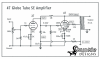
If you read through the link I posted above (post #20) you'll see that this version is essentially designed by Dave, too. Or, perhaps more accurately, it's based almost entirely on his advice, since I don't think he ever built one himself. Here's the schematic:
Maggie 12BH7 Full Schematic.jpg
 
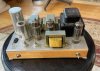
If someone wanted to build something really different, this 80 27 47 globe tube amp sounds amazing! Probably in part due to using a direct heated pentode output tube wired in UL. Plus I do think it looks super cool. When I was researching this project, I really didn't find anything on using these tubes in a DIY amp, so can't imagine many people have.

https://www.skunkiedesigns.com/47-globe-tube-amp

47-amp-front.jpg

47se-final.png 47SE-PS-Final.png
 
FlaC, I like the idea of a twin-triode run in parallel like that. However, the schematic posted shows an 8 ohm load for the output but no primary impedance on the OT. If I recall, the 'optimum' PI for a 12BH7 when run in parallel mode like shown above is more like 22.5K. The OE Maggie OT is roughly 5K at 4 ohms. So even at 8 ohms of load it seems it would still be lacking as related to proper 'match'. Further, as mentioned by someone in your thread, even a parallel little triode like that or the 12AU7 is still not going to match the output power of a pentode like the 6BQ5. My research shows the parallel 12BH to put out about 1.5 watts when running into a 22.5K PI / 8 ohm spkr, less than half of the nearly 4 watts from the 6BQ5. Finally, if you look at the power band with the pentode, it's pretty impressive. I can't find any actual testing data that really documents just what the results are of a 12BH7 paralleled build produce. Again, I like the idea of it, and had planned to do something similar myself. But my plan still included the need to use an alternate OT. The Fender amp Reverb Driver transformer seems to be a 'cheap' starting point for that as it's 22.5K @ 8 ohms. Anyway, if you have any actual test data on the 'OE' OT paired with a 12BH7 in parallel I'd like to see it!!
 
Yeah, on the datasheets I'm seeing the 12BH7 has a substantially lower combined plate dissipation than the EL84/6BQ5. Haven't actually done the loadlines for both, but it seems unlikely a 12BH7 could match the output power of the EL84.
 
@Wharfcreek Tom . . . Early in the build thread that I linked earlier I said:

"According to the links above, SE should, potentially, be somewhere between 1.5 and 2.5 wpc. Obviously, it's not about getting maximum power output."

In some of the early posts in Dave's thread he says that, in stock form, he measured only 1.35 wpc into 8 ohms and that, after replacing the OTs with ones that had an 8 ohm tap, he was getting 2.3 wpc. Apparently he got more as he refined the circuit further.

As the thread continues, Dave says:

"The original OPTs will present a good load for a paralleled 12BH7 if loaded with an 8Ω load. Given the scenario presented below, the required load per section is 21,500Ω, or 10,750Ω per tube. An 8Ω load on the original OPT reflects 11,400Ω to the tube, so the match offered is very good when loaded as suggested. The transformer will perform better in this scenario than in the original as well. . . . . usable power output should be about 1.75 watts RMS per channel."

The whole point, besides the fact that I like to take the "road less traveled" by building things that are different, is to be able to use the stock OTs. To me, that means it also retains more of its Magnavox heritage.

As I said earlier in this thread, I didn't suggest this amp to @invaderzim (the OP, who hasn't been back to comment on any of these many fine suggestions) because he specified a minimum of 3w. I only included it because @AlexHempel expressed interest in building his Maggie using the original OTs.

If that's the plan, switching to 12BH7s is the way to go. If you're going to buy new OTs and build on the original chassis, then use the ones Dave uses. There's probably not much else that will physically fit.

I suspect there are much better choices than the ones Dave uses if you're building on a larger chassis, however. Which is what @Hyakuya is contemplating.
 
Last edited:
FlaC, OK, I'm 'with' you now! I'd read the part about the 1.5 to 2.5 Watts of output. My concern with that was that this was without any real evaluation of the distortion level associated with the output at that level. And, as I stated, I was also wondering about the PI issue. As I mentioned, I did quite a bit of reading on the 'Mini-Bassman' and 'Mini-Deluxe' from Rob Robinestte's shop, as well as threads and posts from people who had built it or something close. Interestingly, the little 6EH5 version that I had constructed a couple years ago, that measured out to be less than 2 watts, remaining relatively undistorted, and with a band-width of about 100 to about 16K or so. I'd guess it probably wouldn't sound much different than doing this with a SE-Parallel 12BH7. Might be kinda fun to just do it and find out!

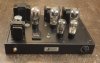
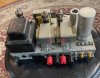
As to the 8600 build ON the 8600 Chassis, this was my last 'build for me' effort that I completed maybe 2 years ago? It's 'almost' dead on to DSG's build specs except for the use of some Asian OTs I found on ebay I believe. They are a 4/8 ohm secondary, so I was able to build the amp to the 8 ohm design as per use of the P-T31s, AND....they 'fit' the chassis having almost the same basic dimensions. But, the ability to switch between 4 and 8 ohms seemed like a modern-day option that might be worth having. After completed I ran some tests to the best of my ability and I found that the performance was almost a identical to use of the AES OTs. In just 'listening' to it, I really heard no difference at all, and peak SPL was imperceptibly the same as well. These OTs were something around $25 each as I recall...... a bit more than the AES units, but I like the closed frames and wanted the dual secondary.

Anyway, fun stuff....... and I do intend to do something with that 12BH7 program. Not sure if it will be a 'stereo' power amp or a 'micro-bassman/champ' yet. One way or another, it'll happen eventually! FlaC, I'll keep you posted when I do. As always, I appreciate your input! I'll be interested to hear what the OP decides in the way of making his choice for a 'build' project!!

Tom
 

Attachments

  • DG1E.jpg
    DG1E.jpg
    48.2 KB · Views: 21
  • DG2E.jpg
    DG2E.jpg
    56.9 KB · Views: 20
  • DG3.jpg
    DG3.jpg
    112 KB · Views: 21
FlaC, OK, I'm 'with' you now! I'd read the part about the 1.5 to 2.5 Watts of output. My concern with that was that this was without any real evaluation of the distortion level associated with the output at that level. And, as I stated, I was also wondering about the PI issue. As I mentioned, I did quite a bit of reading on the 'Mini-Bassman' and 'Mini-Deluxe' from Rob Robinestte's shop, as well as threads and posts from people who had built it or something close. Interestingly, the little 6EH5 version that I had constructed a couple years ago, that measured out to be less than 2 watts, remaining relatively undistorted, and with a band-width of about 100 to about 16K or so. I'd guess it probably wouldn't sound much different than doing this with a SE-Parallel 12BH7. Might be kinda fun to just do it and find out!

As to the 8600 build ON the 8600 Chassis, this was my last 'build for me' effort that I completed maybe 2 years ago? It's 'almost' dead on to DSG's build specs except for the use of some Asian OTs I found on ebay I believe. They are a 4/8 ohm secondary, so I was able to build the amp to the 8 ohm design as per use of the P-T31s, AND....they 'fit' the chassis having almost the same basic dimensions. But, the ability to switch between 4 and 8 ohms seemed like a modern-day option that might be worth having. After completed I ran some tests to the best of my ability and I found that the performance was almost a identical to use of the AES OTs. In just 'listening' to it, I really heard no difference at all, and peak SPL was imperceptibly the same as well. These OTs were something around $25 each as I recall...... a bit more than the AES units, but I like the closed frames and wanted the dual secondary.

Anyway, fun stuff....... and I do intend to do something with that 12BH7 program. Not sure if it will be a 'stereo' power amp or a 'micro-bassman/champ' yet. One way or another, it'll happen eventually! FlaC, I'll keep you posted when I do. As always, I appreciate your input! I'll be interested to hear what the OP decides in the way of making his choice for a 'build' project!!

Tom
I'm going to use those Asian OPT's on mine. I like the idea of using a switch for the secondary taps. I'll be using a little larger aluminum plate though. My fat fingers have a hard time with those small cramped chassis. I like the wide open space of a flat metal plate.
 
Back
Top Bottom