

You are using an out of date browser. It may not display this or other websites correctly.
You should upgrade or use an alternative browser.
You should upgrade or use an alternative browser.
What's the difference between an AR XA and XA-91?
- Thread starter Z4N5H1N
- Start date


beatcomber
AK Member
Interestingly, AR's 1970s address (10 American Drive, Norwood, Mass 02062) no longer exists, according to online maps.
Unlike the Norwood AR-XAs in the above database, my AR (which I believe is from 1977) has a smooth grey masonite(?) top plate, not textured brown like the others.
Unlike the Norwood AR-XAs in the above database, my AR (which I believe is from 1977) has a smooth grey masonite(?) top plate, not textured brown like the others.

12ax7
Super Member
Many XAs also had a date stamp on the bottom edge of the rear base panel (May 1967):

This one (Ser.# XA88642) doesn't seem to follow the pattern above. It's a single motor 2 speed with a hole for the second motor, walnut veneer and has (had) the textured (rotting avocado) finish with gray underneath.
This one (Ser.# XA88642) doesn't seem to follow the pattern above. It's a single motor 2 speed with a hole for the second motor, walnut veneer and has (had) the textured (rotting avocado) finish with gray underneath.

loquatious
village elder
Interestingly, AR's 1970s address (10 American Drive, Norwood, Mass 02062) no longer exists, according to online maps.
Unlike the Norwood AR-XAs in the above database, my AR (which I believe is from 1977) has a smooth grey masonite(?) top plate, not textured brown like the others.
what is the serial number on yours? all early tables had a smooth gray top, but metal, not masonite. i've never come across a masonite top. i did come across a table with birch veneered top, but it wasn't factory.
one thing about AR turntables is a lot of them get rebuilt with parts from others. you can't take evidence from a single table as gospel, unless you can document its entire history. that is rare. otherwise, you need to take info from a lot of tables, hence the database i started. i know its boring, but you can learn a lot from it. that is just a 6 month sampling, a year or more would yield more data.
you'll note that AR offered a service that retrofitted early two motor units to be one motor. even after the "official" change from two motors to one, there were still some two motor units being produced to use up inventory. there were also "universal" 50hz/60hz models offered for international sales. some of these had 2 speed motors, others had a one speed motor with a two different sized pulleys.
during the 6 month sampling, i only saw one TX come up. of course, it had the lowest serial number in the sampling.
TX 25703 (ebay, nj)
motor: double
base: solid walnut
headshell: gray
plinth top: smooth gray
plinth bottom: ?
base bottom: slot vents, waxed
address: 24 thorndike st. cambridge, mass 02141
warranty: 1 year
.
beatcomber
AK Member
what is the serial number on yours? all early tables had a smooth gray top, but metal, not masonite. i've never come across a masonite top. i did come across a table with birch veneered top, but it wasn't factory.
Here are the details:
TX-19826 (Craig's List, Massachusetts)
model: "XA MODEL"
motor: double
base: veneer?
headshell: gray (replaced with black later)
plinth top: smooth gray masonite
plinth bottom: ??
base bottom: masonite, no vents
address: Norwood
warranty: unknown (label missing)
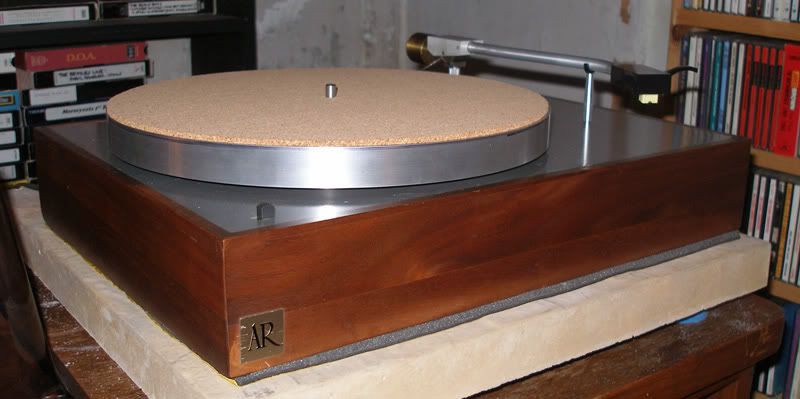
Last edited:
loquatious
village elder
thanks for sharing that. very pretty table! hard to beat an AR for looks if you ask me, but then i'm a form should follow function kind of guy. interesting spec's too. if your serial number is TX19826 then your table is not an XA. it is a TX. yours is the earliest serial number i've documented for a TX. you are lucky to have a very rare table, and showing so little abuse. you said you thought the table dated from '77. that can't be. all TXs predated the XAs (and TAs) and were made in the 60s. two motor tables were also all from the 60s. i'd say your table has to be pre '67. i'd guess closer to 1963 or 64.
my first AR had the smooth top. been wanting another one since. all my current ARs have the textured top. i know the texture was a dampening agent, which is good, but the smooth top looks so much better and is so much easier to keep clean.
i like the looks of the cork mat. are you happy with it? was thinking of trying one on my modded XA. i'm lucky enough to have original foam mats on my tables now, but know they can't possibly last. i experimented with various rubber mats but wasn't happy with the extra weight or the sound.
looks like you've got a swapped armrest and a headshell from an XB. is that an M91ed i see? with either a very early stock stylus or maybe a SAS?
the top deck looks just like the smooth metal ones did. have you ever taken the bottom off? that would tell you if your cabinet is veneered or not, and i'm curious how the masonite top is attached. the metal ones were thin and had tabs spotwelded onto them to allow screwing into the wood cab.
to my eye, the platter seems to be riding awfully close to the top deck. just my 2¢, but it looks like the suspension needs adjusting. my TA and XAs all seem to balance out best with about a 3/8" gap between platter and deck. might give you an excuse to take the bottom off and snap some pics…
.
my first AR had the smooth top. been wanting another one since. all my current ARs have the textured top. i know the texture was a dampening agent, which is good, but the smooth top looks so much better and is so much easier to keep clean.
i like the looks of the cork mat. are you happy with it? was thinking of trying one on my modded XA. i'm lucky enough to have original foam mats on my tables now, but know they can't possibly last. i experimented with various rubber mats but wasn't happy with the extra weight or the sound.
looks like you've got a swapped armrest and a headshell from an XB. is that an M91ed i see? with either a very early stock stylus or maybe a SAS?
the top deck looks just like the smooth metal ones did. have you ever taken the bottom off? that would tell you if your cabinet is veneered or not, and i'm curious how the masonite top is attached. the metal ones were thin and had tabs spotwelded onto them to allow screwing into the wood cab.
to my eye, the platter seems to be riding awfully close to the top deck. just my 2¢, but it looks like the suspension needs adjusting. my TA and XAs all seem to balance out best with about a 3/8" gap between platter and deck. might give you an excuse to take the bottom off and snap some pics…
.

marcmorin
RIP 1953-2020
thanks for sharing that. very pretty table! hard to beat an AR for looks if you ask me, but then i'm a form should follow function kind of guy. interesting spec's too. if your serial number is TX19826 then your table is not an XA. it is a TX. yours is the earliest serial number i've documented for a TX. you are lucky to have a very rare table, and showing so little abuse. you said you thought the table dated from '77. that can't be. all TXs predated the XAs (and TAs) and were made in the 60s. two motor tables were also all from the 60s. i'd say your table has to be pre '67. i'd guess closer to 1963 or 64.
my first AR had the smooth top. been wanting another one since. all my current ARs have the textured top. i know the texture was a dampening agent, which is good, but the smooth top looks so much better and is so much easier to keep clean.
i like the looks of the cork mat. are you happy with it? was thinking of trying one on my modded XA. i'm lucky enough to have original foam mats on my tables now, but know they can't possibly last. i experimented with various rubber mats but wasn't happy with the extra weight or the sound.
looks like you've got a swapped armrest and a headshell from an XB. is that an M91ed i see? with either a very early stock stylus or maybe a SAS?
the top deck looks just like the smooth metal ones did. have you ever taken the bottom off? that would tell you if your cabinet is veneered or not, and i'm curious how the masonite top is attached. the metal ones were thin and had tabs spotwelded onto them to allow screwing into the wood cab.
to my eye, the platter seems to be riding awfully close to the top deck. just my 2¢, but it looks like the suspension needs adjusting. my TA and XAs all seem to balance out best with about a 3/8" gap between platter and deck. might give you an excuse to take the bottom off and snap some pics…
.
If the picture of the XA in Beatcombers post is the same table that I did a little work to, it would appear that it is a put together table. The subchassis is from a XA-91, which is the same subchassis found on an XB with the area machined to accept the lift device found on the XB, it also has the deeper tone arm well found on the XB. The tonearm pivot post (pictured) would have been one of mine, since replaced with his original. (due mostly to length of post) Also his original delrin pivots are in impeccable shape. Round, clean, and smooth. Most AR's of this age have horribly worn pivots and pins.
setting the suspension ride height: setting the height 1/4" from top plate is the factory norm. Setting to 3/8" and the subchassis gets pretty close to hitting the top plate on the under side. If your particular soundstage improved with the higher height, that would be related more to where the drive belt now rides on the subplatter.
loquatious
village elder
If the picture of the XA in Beatcombers post is the same table that I did a little work to, it would appear that it is a put together table. The subchassis is from a XA-91, which is the same subchassis found on an XB with the area machined to accept the lift device found on the XB, it also has the deeper tone arm well found on the XB. The tonearm pivot post (pictured) would have been one of mine, since replaced with his original. (due mostly to length of post) Also his original delrin pivots are in impeccable shape. Round, clean, and smooth. Most AR's of this age have horribly worn pivots and pins.
setting the suspension ride height: setting the height 1/4" from top plate is the factory norm. Setting to 3/8" and the subchassis gets pretty close to hitting the top plate on the under side. If your particular soundstage improved with the higher height, that would be related more to where the drive belt now rides on the subplatter.
beatcomer, can you confirm this? interesting observations marc. always interesting to follow a tables history. did it have a masonite top when you worked on it? beatcomer said he got his table off craigslist. he's in mass. where are you marc?
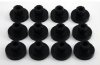
i've been fortunate to have very good luck with the delrin pivots on my tables arms, but my tables saw very little use by previous owners, and i don't think the arms went on an off more than once or twice before i got the tables. re: ride height and soundstage, i agree with what you say. in my case, i swapped out the hard rubber spring locators for sorbothane units that have a durometer rating of 50, and that has factored (positively) into the equation.
.
Attachments
beatcomber
AK Member
Considering I live less than 20 miles from AR's Norwood factory, and less than 10 miles from Cambridge, anything is possible! The bottom plate has the Norwood address and an "XA" model designation, but maybe it was sent to the factory for some work and a new label was applied? I'll take a closer look at the top plate when have a chance.
It came to me with a very old white-body Shure M44-7 attached, so maybe it is earlier than I think.
The cartridge I'm using is an M91ED with JICO SAS.
It came to me with a very old white-body Shure M44-7 attached, so maybe it is earlier than I think.
The cartridge I'm using is an M91ED with JICO SAS.
12ax7
Super Member
one thing about AR turntables is a lot of them get rebuilt with parts from others. you can't take evidence from a single table as gospel, unless you can document its entire history. that is rare. otherwise, you need to take info from a lot of tables, hence the database i started. i know its boring, but you can learn a lot from it. that is just a 6 month sampling, a year or more would yield more data.
What you say is, of course, correct. People gather all the parts and pieces they can to resurrect these tables. Also, I do admire all the research and time that you're putting into your database. It should prove to be very useful.
However, the example I mentioned a few posts ago has this serial number sticker...
...glued to the bottom of this steel deck:
These are old pics of the table as I received it. It's doubtful that any restoration work had ever been performed on it and there is no evidence that a second motor had ever been present, although the hole is there. The serial number would seem to match the date stamp on the base. The "avocado" finish was clearly original. There was no bottom cover or headshell present so I can't offer that information.
What do you think? As I mentioned earlier, it doesn't seem to follow the pattern.
Last edited:
marcmorin
RIP 1953-2020
beatcomer, can you confirm this? interesting observations marc. always interesting to follow a tables history. did it have a masonite top when you worked on it? beatcomer said he got his table off craigslist. he's in mass. where are you marc?
i've been fortunate to have very good luck with the delrin pivots on my tables arms, but my tables saw very little use by previous owners, and i don't think the arms went on an off more than once or twice before i got the tables. re: ride height and soundstage, i agree with what you say. in my case, i swapped out the hard rubber spring locators for sorbothane units that have a durometer rating of 50, and that has factored (positively) into the equation.
.
I'm in Columbus Ohio. Regarding the rubber grommets.......I use something a little different as well. Mine force the spring to be centered and square to the stud.
loquatious
village elder
What you say is, of course, correct. People gather all the parts and pieces they can to resurrect these tables. Also, I do admire all the research and time that you're putting into your database. It should prove to be very useful.
However, the example I mentioned a few posts ago has this serial number sticker...

...glued to the bottom of this steel deck:

These are old pics of the table as I received it. It's doubtful that any restoration work had ever been performed on it and there is no evidence that a second motor had ever been present, although the hole is there. The serial number would seem to match the date stamp on the base. The "avocado" finish was clearly original. There was no bottom cover or headshell present so I can't offer that information.
What do you think? As I mentioned earlier, it doesn't seem to follow the pattern.
well, that table is certainly an anomaly. the number is low enough to be a two motor unit, which would account for the second motor hole. as i said before AR retrofitted a number of two motor tables to be one motor, as a service to their buyers. this was also common practice for owners to do when a motor failed on a two motor table.
one thing that jumps out at me in the serial number photo is it sure looks like the "X" in XA does not match the type in the rest of the serial number. its also darker. like the X had been added later. perhaps covering a faded T, (which would make sense with the numeral portion of the serial being so low).
what really makes me scratch my head is the textured top. never seen that on a two-holer. hmmm...
so many frankensteined AR tables out there anything can turn up. part of their charm, but it sure makes research more difficult.
.
beatcomber
AK Member
The more I think about it, the more I believe that my AR-XA (AR-TX!) is an early model that was returned to the nearby Norwood factory for refurbishing in the '70s, with a new label applied with a handwritten s/n. I took a closer look tonight, and I do believe the smooth grey top plate is indeed metal; it was cool to the touch. Also, the UL label under the platter seems older than the '70s.
beatcomber
AK Member
if your serial number is TX19826 then your table is not an XA. it is a TX. yours is the earliest serial number i've documented for a TX. you are lucky to have a very rare table, and showing so little abuse.
The funny thing is, the table was in sad shape when I got it. Covered in filth, messed up belt, dead headshell. Fortunately, despite all the decades of neglect, it's a solid machine that just needed some TLC.
I like the looks of the cork mat. are you happy with it? was thinking of trying one on my modded XA.
It seems to work just fine, much better than the felt mat I previously used. Marc Morin suggests using a deerskin mat for best results, but being a vegetarian, I can't go there.
This has been a fascinating topic, thanks for all of the valuable info, loquatious.
I noticed some further evidence that my c.1963-64 AR-TX was sent to the Norwood factory for refurbishing in the '70s. Not only does the top plate have an empty hole for the second motor, but the Norwood label on the bottom cover has a handwritten serial number.
loquatious
village elder
that is interesting info about your table going back for a factory refreshening. it makes sense. i suspect a similar explanation of 12ax7's table anomalies, as he is not too far from the factory either. out here in the west, we seldom see factory rehabs. mostly DIY mods.
thanks for the input on the cork mat. i've heard a lot of people are liking leather mats. i'm vegetarian as well and can understand your position on that. not wanting to get involved in ethical, or political, or environmental, or spiritual arguments about what people put in their bodies, i don't tell others how they should eat (though i do have strong personal convictions on the subject). but, since billions of animals are killed a day for food anyway, it seems like not putting the skins (and every other part) to some use is just more waste. so i don't take particular issue with a leather mat, though i don't use one. it seems to me a thin piece of leather will tend to dry out (especially here in the desert southwest). that means, like all leathers, it needs to be treated with oils to preserve its suppleness. i wouldn't want oils coming in contact with my vinyl.
so i guessed right about the M91ed and the jico SAS as well. i'm a big fan of the M91ed. especially on an AR table. i use only first generation genuine shure N91ed styli on my carts, the ones with the very thin cantilever. i pick up NOS ones whenever i can find one. i stay away from the later ones and the ones made in mexico which used progressively thicker cantilevers, and won't even consider a generic. i find the first generation N91ed made in ohio give vastly superior sound to the later incarnations. i see the SAS uses a very thin cantilever as well (and many other improvements in technology). i've been very curious about them. as a long time user, how do you like the sound?
.
thanks for the input on the cork mat. i've heard a lot of people are liking leather mats. i'm vegetarian as well and can understand your position on that. not wanting to get involved in ethical, or political, or environmental, or spiritual arguments about what people put in their bodies, i don't tell others how they should eat (though i do have strong personal convictions on the subject). but, since billions of animals are killed a day for food anyway, it seems like not putting the skins (and every other part) to some use is just more waste. so i don't take particular issue with a leather mat, though i don't use one. it seems to me a thin piece of leather will tend to dry out (especially here in the desert southwest). that means, like all leathers, it needs to be treated with oils to preserve its suppleness. i wouldn't want oils coming in contact with my vinyl.
so i guessed right about the M91ed and the jico SAS as well. i'm a big fan of the M91ed. especially on an AR table. i use only first generation genuine shure N91ed styli on my carts, the ones with the very thin cantilever. i pick up NOS ones whenever i can find one. i stay away from the later ones and the ones made in mexico which used progressively thicker cantilevers, and won't even consider a generic. i find the first generation N91ed made in ohio give vastly superior sound to the later incarnations. i see the SAS uses a very thin cantilever as well (and many other improvements in technology). i've been very curious about them. as a long time user, how do you like the sound?
.
12ax7
Super Member
Wouldn't the two motor XA have had some sort of mounting lugs or screw holes for the second motor underneath? As I mentioned, there is no evidence of a second motor ever having been there. The wiring harness looked original with all the fiber tape and staples unmolested and no provision for another motor. I've read that AR continued using the two-holer deck until it's inventory depletion after switching to the single motor models.
loquatious
village elder
Wouldn't the two motor XA have had some sort of mounting lugs or screw holes for the second motor underneath? As I mentioned, there is no evidence of a second motor ever having been there. The wiring harness looked original with all the fiber tape and staples unmolested and no provision for another motor. I've read that AR continued using the two-holer deck until it's inventory depletion after switching to the single motor models.
i've never been under the hood of a two motor model, but it seems there should be some provision for mounting the starter motor. no doubt AR used up inventory until it was gone, but yours still doesn't make sense. by the time your serial number was produced, the two hole top inventory should have been long gone. the highest # table i found with two motors was 64333.
your serial number is odd. i mentioned the X looks like it was added later and does not match the rest of the characters. also, the gap between the letters and numbers is unusual. usually there would be no space there. the only time i've run across that was a label that had a missing digit written in by hand, like there was a misprint of the label that had to be hand corrected. if your serial # is 88642 it should be a single motor table with a smooth top and one hole. if it is missing a digit (the space) on the label and is really supposed to be 188642, it should be a one motor unit with a textured top and one hole.
the only scenario i can imagine that makes sense of what you have is your table had a misprint label that was supposed to be corrected to read XA188462. the X was added but the missing 1 was not. it was a one motor unit with a textured top (which it should be for that #), and someone later drilled the extra hole for some reason (which would account for no motor mounting provision).
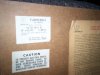
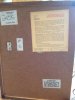
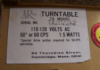
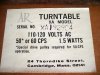
i attached a few pics of some labels for reference. most are bottom cover labels, but one is an interior, and one is the hand corrected label.
.
Attachments
Last edited:
12ax7
Super Member
188642 'kinda sorta' makes sense as a possible serial number from 1967. I noted in your list a serial number of 121508 with a 1969 notation and a 193199 number with a mention of '67 docs.. I remember cleaning the textured finish out of the second hole, it came that way. There were some numbers hand written in pencil by the tonearm wire terminal block. I'll dig the table out in the morning and try to get some better pictures.
loquatious
village elder
188642 'kinda sorta' makes sense as a possible serial number from 1967. I noted in your list a serial number of 121508 with a 1969 notation and a 193199 number with a mention of '67 docs.. I remember cleaning the textured finish out of the second hole, it came that way. There were some numbers hand written in pencil by the tonearm wire terminal block. I'll dig the table out in the morning and try to get some better pictures.
one thing about the '67 documents mentioned. every post-'67 TA or XA table i've ever seen that still had its original AR docs, had '67 print dates on the docs (TA tables had the same docs as XAs). looks like they just kept reprinting them. so all a '67 dated doc proves is the table was made after '67. only doc that can give a true idea of year of manufacture would be an original sales receipt.
.
beatcomber
AK Member
so i guessed right about the M91ed and the jico SAS as well. i'm a big fan of the M91ed especially on an AR table..
As far as I'm concerned, the M91ED is THEE cartridge for this table. I've never heard another cart sound as good on the AR-XA, and the M91ED has never sounded as good on any other table I've tried it on.
i use only first generation genuine shure N91ed styli on my carts, the ones with the very thin cantilever. i pick up NOS ones whenever i can find one. i stay away from the later ones and the ones made in mexico which used progressively thicker cantilevers, and won't even consider a generic. i find the first generation N91ed made in ohio give vastly superior sound to the later incarnations. i see the SAS uses a very thin cantilever as well (and many other improvements in technology). i've been very curious about them. as a long time user, how do you like the sound?
You're right, the Mexican styli pretty much stink, although the EVG generics (possibly made by JICO) are surprisingly good. I also have a nearly new USA Shure stylus that I keep for comparison purposes, but the JICO SAS is king in my world.