• The move to the new server is done. There are some software and database maintenance updates in process. This has us passing the hat around to help out. We appreciate any donations. Seriously, even a dollar helps. The payment page may be found here - https://www.audiokarma.org/support.html

What's the purpose of a small wirewound resistor in series with all drivers?

refoamwizard

New Member
I've owned both the Philips AH-475 and AH-476 speakers in years past and have a chance to work on the crossovers of another set of AH-475s. These speakers are overly bright and could benefit from an L-Pad on the tweeter (and installation of new binding posts instead of those horrid screw terminals).
But I'm stumped as to why Philips would add a 0.255 ohm wirewound resistor to these crossover circuits. Does anyone have a guess? I'm inclined to take it out...
Thanks!
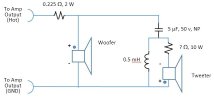
Philips AH-475 crossover corrected.JPGPhilips AH-476 crossover.jpg
 
Last edited:
Register to hide this ad
In the second picture, they're to attenuate the midrange depending on the room and environment the speakers are in. Some have several resistors on a switch for the tweeter also. Some crossovers don't have switches with multiple reaistors, but fixed resistors for a midrange and or tweeter.
I'm not sure what's going on with the resistor in the first picture.
 
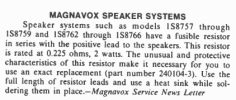
Rick, I did some more digging and your "fuse" guess is correct. I dug out a photo of the crossover and googled the part number of the resistor and found this in Radio Electronics, May 1973, p. 100:
1708998906264.png

Thanks for your help!
 
In the second picture, they're to attenuate the midrange depending on the room and environment the speakers are in. Some have several resistors on a switch for the tweeter also. Some crossovers don't have switches with multiple reaistors, but fixed resistors for a midrange and or tweeter.
I'm not sure what's going on with the resistor in the first picture.
The resistor in question in both circuits serves the same function. He only asked about the .225 ohm resistor.
 
Back
Top Bottom