• The move to the new server is done. There are some software and database maintenance updates in process. This has us passing the hat around to help out. We appreciate any donations. Seriously, even a dollar helps. The payment page may be found here - https://www.audiokarma.org/support.html

When running A & B speakers, it wattage divided or multiplied? *note

AstarOfDavid

New Member
Over the years I've used many receivers and amps... I almost always use A & B speakers at the same time (so quad speakers). In some lower tier receivers I've noticed when using A speakers the moment I switch on B speakers the A speakers get quieter (implying wattage is shared between both A & B). But on some higher end receivers/amps it seems the A speakers remain the same volume when I turn on B speakers. I've looked up possibly 100+ receiver and amp manuals over the years, and they never explain what happens when you drive both A & B. Is wattage multiplied or divided? Does anyone know if it's common that for example if an receiver/amp claims it's 150w per channel that when running A & B it's 150w x 4? While other receivers/amps it's divided to 75w per channel? Has anyone tested wattage outputs on multiple receivers/amps?
 
Register to hide this ad
Speaker impedance makes a difference is all I really know. Most of my speakers are 8 ohm but I do have a set of 4 ohm speakers , I have run both 8 & 4 ohm together off the same receiver and noticed maybe a bit more output when I push the speaker switch to add the 8 ohm may come in louder.
 
The normal way of driving speaker pairs simultaneously is in parallel. That means e.g. 4 Ohm speakers add up to a load of 2 Ohms, 8 Ohm speakers to 4 Ohms. That means: same output voltage assumed the currents the amp has to provide is doubled.

Theoretically an amplifier would have the doubled power with a half of the number of Ohms at the output. Normally this is too much for the power supply and the heat sink of the amp. In the first case the output voltage breaks down at high volume setting, in the second case the amp could overheat. To prevent this according protection is built into most amps. An amp that has 100 W at 8 Ohms normally has about 160 W instead of 200 at 4 Ohms.

Sometimes the supply voltage for the end amp circuit is diminuished via a switch if 4 Ohms have to be driven. Then a drop in volume may be observed. Other amplifiers like the Denon PMA 1700NE have double the power at 4 Ohm compared with 8 Ohms. This is because the power supply is well dimensioned and the cooling is sufficient.

Others, especially small receivers, switch the speakers not to parallel operation, but to serial. So the signals flows first through one speaker, then through the other. 8 Ohms x 2 gives a load of 16 Ohms. In this case the volume of the single speakers will decrease audibly.
 
As @Thorsten R. stated, it depends on how the amplifier’s output is designed, there are several variations the main ones being transformer/direct and the speaker switch is designed being series/parallel. The vast majority of speaker switches/terminals is parallel, although there are some (primarily low-end models with little power and the inability to drive low-impedance loads) that are series.

Output volume/SPL is voltage, the voltage/size of the output wave is directly relative to the excursion of the speaker driver. If you put two identical speakers in series you will get roughly half of the voltage to each speaker, which will mean reduced excursion/SPL.

If different (primarily impedance) speakers are connected the higher impedance will likely get more voltage, and therefore more excursion.

In parallel, the speakers are all getting the same voltage as in the case of one speaker, so each will produce as much SPL, the combination of the two should sound “louder” (presuming they’re in-phase). This would be within the limitation of course of the amplifier to produce this voltage at now twice the current (which would mean twice the wattage roughly). Most amplifiers can do this at low volume settings, but as you turn up the volume, some amplifiers will hit their current limit sooner and this can limit your volume (they will clip, distort basically fall flat as you increase gain).

As @Thorsten R. Mentioned above it depends a lot on whether the amplifier is designed with a robust enough power supply, adequate heat-sinks, and an output topology that includes either transformers or high-current transistor arrays to be within their ability to pass this current and not overheat internally.

A, B, and C speaker system terminals on receivers and amplifiers are largely a convenience so that you can have more than one pair of speakers on your system, but you need a high-power amplifier typically to drive more than one set at a time, especially if you drive them hard. Growing up I remember my father’s system connected to the living-room floor-standing speakers as A system, the dining room bookshelf speakers as B system, and the only time they were driven together was as background music. This (Sansui) receiver worked well in this scenario, but when driven hard with A+B (dad wasn’t home, brother having a party) it promptly blew its outputs. If you want to drive more than one pair of speakers, be sure that the amplifier is rated for the load, both the impedance as well as the output wattage, more power output rating is usually a good thing in this case.

 
I've looked up possibly 100+ receiver and amp manuals over the years, and they never explain what happens when you drive both A & B. Is wattage multiplied or divided?

Power is ALWAYS divided between the speakers when multiple speakers are connected to a single amp/receiver channel.

A+B can be either parallel or series connection of the speakers. Parallel is more common. Regardless though, power is always divided between speakers in A+B.

If A+B is parallel power may increase by some amount (amount totally depends on the specific amp) but still that power is divided.

If A+B is series, total power typically goes down some amount but, again, whatever the resulting amount, power is divided.

Let's use an example based on a Yamaha M-80 amp, one of the amps I have. I'm purposely keeping this very basic using nominal numbers so the fundamental concept is not lost/obfuscated by minutiae of detail.

8 ohm power rating = 250 watts per channel
4 ohm power rating = 330 watts per channel

If one pair of 8 ohm speakers is used, each speaker could receive 250 watts.

A+B on this amp is parallel.

If two pair of 8 ohm speakers is used in A+B, the amp will see 4 ohm load. So, the output per channel would be 330 watts. But, that 330 watts is divided between A and B, so each speaker could receive 165 watts.
 
Last edited:
As I wrote this depends. The M-80 has a "soft" power supply. The aforementioned Denon PMA 1700NE has a hard one:
Rated Output Power70W + 70W
(8ohm,20Hz-20kHz,THD0.07%)
140W + 140W
(4ohm, 1kHz, THD0.7%)

I would prefer the latter.
 
As I wrote this depends. The M-80 has a "soft" power supply. The aforementioned Denon PMA 1700NE has a hard one:
Rated Output Power70W + 70W
(8ohm,20Hz-20kHz,THD0.07%)
140W + 140W
(4ohm, 1kHz, THD0.7%)

I would prefer the latter.

None of point is really about individual amplifiers. It was about the concept that power always divides between multiple connected speakers, regardless what that power is.


That said, the numbers you list are not apples to apples comparisons.

1KHz single point and 10x THD vs. the 20Hz to 20KHz numbers.

The Yamaha numbers listed previously are both 20Hz to 20KHz numbers at low distortion.
 
Last edited:
I wouldn't say that the difference is a "soft" or "hard" power supply in power ratings, ... it's a lot more than that.

The output transistors for example, will need to pass twice as much current, dissipate twice as much power, and the junction temperature inside the transistor might or might not creep too high to handle this also.

Next is ratings, which have changed over the years, how the power is required to be measured. One might notice that many amplifiers/receivers in the '70s dropped their 4 Ohm ratings, probaby because the rating system changed.

Next again, distortion. The power rating is typically 1kHz (not music power), after conditioning, and tied to a distortion %. Manufacturers decide what they want to use for marketing and if they're okay with .5%THD they will likely be able to produce more power within that .5% than if they were to rate power at .003% THD.

If a manufacturer really wants to show twice the power available at 4 Ohms than what is available at 8 Ohms (same gain, twice the current), a lot can be manipulated to get there. Yes, generally in a direct-coupled amplifier it is a good rule-of-thumb to look for an amplifier that comes close to "doubling down" the watt rating at 4 Ohms vs 8 Ohms, but it clearly isn't the only metric that is important, and there are some VERY GOOD amplifiers out there that have the same max. power spec at 1 Ohm, 2 Ohms, 4 Ohms, and 8 Ohms, ... which doesn't mean that the power supply is "soft".
 

When running A & B speakers, it wattage divided or multiplied? *note​

"More or less" divided, often not equally... Depending on the amp's abilities to handle the load, speaker impedances variations and speakers sensivities (as mentioned by @BmWr75)

T
 
Always divided. Not really any more or less about it.

Amp's ability is not really a factor in the basic context that power will divide. The power is always divided regardless of capability.

Yes, differing speaker impedance properties will change the distribution of the divided power. Different speaker sensitivities will not change the distribution of divided amplifier power, but could/would change the acoustical results.
 
As I'm sure you've realized by the different responses you've gotten, the answer is complicated.

In a theoretical system, with a power supply capable of infinite current:

If you connect two equivalent speakers in series, each speaker will receive 1/4 the power of a single speaker. The total output of the amp into both speakers will be half that of a single speaker.

If you connect two equivalent speakers in parallel, each speaker will receive the same amount of output that a single speaker would receive. The total output of the amp into both speakers will be twice that of a single speaker.

Here's why: When you connect the speakers in series, you double the impedance (say from 8 ohms to 16). Whenever you double the impedance load of an amp, you halve the power. And since that power is split evenly between both speakers, each one gets 1/4 of the original power.

When you connect the speakers in parallel, you halve the impedance (say from 8 ohms to 4). Whenever you halve the impedance load of an amp, you double the power (remember, this is still speaking theoretically). When that doubled power is split between two speakers, each speaker gets the same amount as the original single speaker would have.

The reason this is theoretical is that there are very few home audio amps that are capable of doubling their power into 4 ohms. And very few speakers are ideal loads. But when listening at a reasonable (i.e. the amp is nowhere near its maximum output), this is more or less what happens.
 
Jumping in on this convo because I previously posted the same question before.

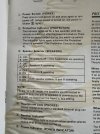
But recently I found my original owners' manual, which has a subtle but important "note," which suggests, as implied, that guessing how your amp *may* be wired for A+B may not be a good approach.

Amp is an Onkyo M5150.

whoaru99 - I believe you previously stated this amp ran in series for A+B, which looks correct!

I ran A+B driving 2 sets of identical 4-ohm speakers and the Onkyo did not fry. But because of the uncertainty, I was worried it dropped the pull down to 2-ohm, so I stopped running both pairs (and I actually moved on to other amps).

Was I correct about the 2-ohn draw, or was I wrong and the load on the amp is 8-ohm?

IMG_4165.jpeg

IMG_4162.jpeg

IMG_4163.jpeg
 
I ran A+B driving 2 sets of identical 4-ohm speakers and the Onkyo did not fry. But because of the uncertainty, I was worried it dropped the pull down to 2-ohm, so I stopped running both pairs (and I actually moved on to other amps).

Was I correct about the 2-ohn draw, or was I wrong and the load on the amp is 8-ohm?
It would be 8 ohms nominal, from two 4-ohm speakers in series.

It would be 2 ohms nominal if the amp had A+B in parallel but it clearly says A+B is series connection, so 8 ohms.
 
Back
Top Bottom