• The move to the new server is done. There are some software and database maintenance updates in process. This has us passing the hat around to help out. We appreciate any donations. Seriously, even a dollar helps. The payment page may be found here - https://www.audiokarma.org/support.html

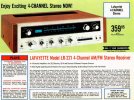
Where to start on my Lafayette LR-221

DG_lite

New Member
Hi all, as the title says, I have a couple small but annoying problems with this rare quadraphonic receiver. I think I know what the issues are but this is my first time trying to track down and rectify such problems. I'd like some guidance on where to look for my problems and what to replace.

Problem 1: There is a low hum present in all channels that increases with volume. I think that this has to do with an aging filter cap. Not very noticeable until I turn the volume up to at least halfway or 75%. This also changes based on the channel mode knob (i.e.- SQ decoder and Composer B is louder than discrete). Hum is present on all inputs. Let me know if this assumption is correct.

Notes: After it warms up for a while (2+ hours), sometimes there is a loud pop from the speakers and the hum either goes away or comes back if not present. I'm not sure whether this is a transistor or cap issue, but I don't like it either way. Seems like something is eventually gonna blow up imo.

Problem 2: There is a buzzing noise coming from the rear right speaker channel. This is always present even when the volume is all the way down and doesn't change with volume. I thought this was a grounding issue at first but it seems very strange that it's only the one channel. I'd like some clarification on whether it's a ground-related or not.

These problems have been observed with an external sound card plugged into the back (Creative Audigy 2 NX) and with nothing plugged into the receiver at all except 1 speaker. No changes in either case

I tried a surge protector and using an outlet with nothing else plugged into it with no change. Trying to run a cable from the turntable grounding screw into the ground of an outlet didn't do anything either (as I expected).

I'm aware that a receiver of this vintage (1974) should be recapped regardless, but I don't have the funds to let a tech handle this or even buy every cap myself. I know how to solder pretty well and know enough about safety as to not die/hurt myself doing this by making baseless assumptions and being ham-fisted lmao. I just want to know the bare minimum I'll need to make these problems stop. A full recap/servicing will be done way down the line when I'm out of college, but not now.
 
Register to hide this ad
Bare minimum is probably going to be a power supply recap.

If not the individual output boards, at least the power supply electrolytics will need replacing because there is hum.

It sounds like the capacitors are starting to break down. It's not a matter of if they are going to break down, it's a matter of when they are going to break down.
 
Yeah, the thing is about 51 years old now so a total recap is down the road for sure. Not denying that at all. I just can't spend that much for all the caps right now. My first order of business is replacing the big filter cap. I have a few replacements scouted out.

You don't think any of the issues have anything to do with transistors? If so, that's a relief.
 
It's not a rare 4-channel receiver. We sold a lot of them. Didn't have many returned for service as I did Lafayette's service for a number of their NJ stores. Before considering a total recap, which in most cases isn't required, find and fix the immediate problems. The complete manual would be very helpful. It's better then working in the dark. Having a scope to trouble shoot the various amplifier, preamp, and decoder sections is very useful in finding the defective or failing part(s) and saves guessing as to which parts are the culprits.
 

Attachments

  • Laf_LR221.jpg
    Laf_LR221.jpg
    161.7 KB · Views: 13
I wish I had a scope and cap tester, but I don't. I'll get those soon when I go for more fixes. I'm gonna save up a bit before I do a more thorough replacement/testing job.

As far as the manuals go, I can't find any online for free and I'm not paying $16+ for one. No one's shared scans with me either on Reddit so far.
If anyone has scans of the service manual and wants to share that would be greatly appreciated.

I'm curious as to why Lafayette dropped this model from their catalogues after less than a year if it sold well? I looked at the scans on Radiomuseum and it's only in the 1st and 2nd 1974 catalogues. Not in the 3rd.
 
I'm curious as to why Lafayette dropped this model from their catalogues after less than a year if it sold well? I looked at the scans on Radiomuseum and it's only in the 1st and 2nd 1974 catalogues. Not in the 3rd.
The model was introduced in the full 1974 catalog which actually was released in the Fall 1973. It sold well in the quad family of receivers during the period it was around but, over all, conventional stereo receivers and amplifiers were far more in demand. As far as why it was dropped, after, most likely, one manufacturing run, the Lafayette Radio Director of Audio Marketing probably consulted his "magic 8-ball" for future demand answers.

Quad was a fad destined to fail. Conflicting decoder schemes didn't sit well with customers and retailers. Customers didn't like having to now have four speakers instead of just two. Additional speakers ate up too much typical floor space. And customers didn't like having to sit somewhat in the middle of a room, to get the 4-channel experience. And, they didn't like staring a wall or ceiling to listen. Quad might have had a life in the 70's if audio manufacturers got together with TV manufacturers and developed a way to merge the two technologies but that didn't happen. Down the road a few years "surround sound" would be the new hook.

Most of the Lafayette quad receivers and amplifiers were manufactured by Planet Research/Pioneer and the various future models were probably conceived and committed to manufacture and dollars several years before quad started to tank. By latter 1975 and 76, we were dumping whatever we had left in quad for cheap just to get rid of the inventory.
 
Thank you for the history behind the receiver, it was a very interesting read. As much as I don't like saying this, it was a good idea they didn't make more of these for long. Would've likely lost more money in the future than they did. I knew most mid 70s models were made by Planet Research, but not Pioneer. Makes sense, mine has an overall quality feel to it. Definitely not an empty box.

As far as the repair goes, I bought a 3300uF 160V capacitor to replace the original Matsushita one rated for 50V 3300uF on eBay. I've heard about capacitor scams so when/if I get it I will thoroughly inspect it. I also bought a pack of 30 LED bulbs that fit in the lamp sockets for dirt cheap. I currently have 12V automotive lamps in there and they're kinda dim.

In the original Matsushita cap, there is a little play in the top covering, like there is some air/gas under there. It's a very small amount, but noticeable when you press down on top with your finger. It doesn't have any visible swelling. Is this indicative of a failing cap or is this just how they're manufactured?
 
Thank you for the history behind the receiver, it was a very interesting read. As much as I don't like saying this, it was a good idea they didn't make more of these for long. Would've likely lost more money in the future than they did. I knew most mid 70s models were made by Planet Research, but not Pioneer. Makes sense, mine has an overall quality feel to it. Definitely not an empty box.
There were other quad models that were already committed to manufacture and purchase after the LR-221, so it didn't make much model difference in how money was "lost". Pioneer had a large financial interest (some believe even a controlling interest) in Planet Research. Physical designs of Pioneer, Lafayette, and several other manufacturers had very similar look, feel, and design.
 
Alright, an update.

The replacement filter capacitor came in and I subbed it in. The humming is still there unfortunately.

However, I found that when the tops of the smallest electrolytic caps (circled) in the amplification stage are touched, that introduces a hum in the channels they're part of. They even do that with the volume turned all the way down. None of the other caps do that.

I'm wondering if this has to do with a grounding issue in the amplification board, maybe due to bas solder joints? I came across a couple bad/loose connections already, so it wouldn't surprise me to find more.
Circled Capacitors.jpg
 
Nope, an audible buzz when touching the tops of those caps seems normal.
The only free service manual I can find for ANY Lafayette quad receiver is for the LR-441 on HifiEngine but I don't have an account and you still can't register. Could someone please slide it my way? :)
 
Those small capacitors that buzz when you touch the tops is normal. They are in the input signal path and the buzz you get is because you are touching the outer metal can of the capacitor with your finger or meter probe.

If your hum is in both channels, then it most likely a power supply issue or capacitor. Is the new replacement capacitor in the power supply? Pics of the entire unit would help.
 
I'll get some pics tomorrow since it's very late right now for me. The replacement filter capacitor isn't in view, and it didn't change the humming at all. Fair warning, how I have the capacitor in place will look very sketchy in the photo, but it's temporary. I will attach a pic comparing the new Nippon Chemi-Con (blue) cap with the original Matsushita (grey) cap.

I looked inside the unit and there doesn't seem to be a dedicated power PCB in there. It seems like AC power from the transformer just gets fed thru the rectifier, filter cap, and a voltage step-down(?) unit before being fed everywhere else.

I saw what looks like the preamp sharing a PCB with the volume/tone/balance pots with some fat caps like ones in the amplifier stage. Those are 220uF 50V. That board is very hard to get to for cap jobs and is not worth the trouble right now. I'd have to take the entire face off the unit and all this other ugly stuff I don't even want to think about.

Edit: Apparently the attachment didn't finish loading on this comment before I sent it. Image below.
 
Is the new replacement capacitor in the power supply? Pics of the entire unit would help.
I just realized what you asked, sorry. I'm pretty tired today.

Yes I had put the cap in temporarily and even compared it against the old cap. No difference. Maybe that means something needs to be replaced in the preamp stage?

Either way, it's still preventative maintenance and was pretty cheap at that. I'll just keep the old cap around as a spare.
 
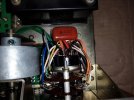
Pictures as promised. These are from the underside of the receiver. In the first picture the input selector knob assembly is out of frame I think.
 

Attachments

  • IMG_20250710_172909.jpg
    IMG_20250710_172909.jpg
    152 KB · Views: 4
  • IMG_20250710_172842.jpg
    IMG_20250710_172842.jpg
    154.7 KB · Views: 4
  • IMG_20250710_172827.jpg
    IMG_20250710_172827.jpg
    184.7 KB · Views: 4
  • IMG_20250710_172816.jpg
    IMG_20250710_172816.jpg
    182.7 KB · Views: 4
  • IMG_20250710_172801.jpg
    IMG_20250710_172801.jpg
    184.1 KB · Views: 4
  • IMG_20250710_172922.jpg
    IMG_20250710_172922.jpg
    147.9 KB · Views: 4
Topside views. Some areas of this receiver are really cramped and hard to get at the components. Not like my Kenwood KR-4070 at all.
 

Attachments

  • IMG_20250710_173046.jpg
    IMG_20250710_173046.jpg
    142 KB · Views: 1
  • IMG_20250710_173054.jpg
    IMG_20250710_173054.jpg
    128.4 KB · Views: 1
  • IMG_20250710_173114.jpg
    IMG_20250710_173114.jpg
    121.6 KB · Views: 1
  • IMG_20250710_173212.jpg
    IMG_20250710_173212.jpg
    116.3 KB · Views: 1
My capacitor tester came in and stupidly I ordered the one that only goes up to 200uF. Can't measure the big filter caps since it maxes out the tester. Serves me right for not looking closer. At least I have it for other caps now.

Anyway, testing revealed that the new cap discharges faster than the old cap. I'm talking when I turn the receiver off and monitor the voltage in the cap while still connected to the circuit, the new one discharges faster than the old one. Which is better for the purposes of filter caps?
 
Well, there's a new problem with the receiver that I think I accidentally made.

When I set this up in my college dorm, I didn't have enough speaker wire cut at first to connect the front speakers to the subwoofer that I use, and then the subwoofer to the receiver. So instead, I wired the sub in parallel with the front speakers at the same time the rear speakers were connected to the receiver. The volume from the rear channels were significantly lower than the fronts and I didn't have it in this config for long. I just cut new wire and put it back to how I normally used it.

However, after the receiver warms up for a while there are crackling sounds around low frequencies that weren't there before. Hitting the output transistors with freeze spray doesn't have a dramatic effect. Maybe slightly less crackling when cooled?

Anyway, I'm wondering if I slightly fried them with the sub in parallel with the speakers config?
 
Honestly, dump it and find a newer 2-channel amp, they are available used on Ebay for around $100, or a brand new D-class amp for about the same, AND enjoy listening to music!!!

Or check your local thrift shops and get one for $20.

That old Lafayette was only rated at 1% THD when NEW, so just not worth it imo.

I spent 6 months on/off fixing a 25 yrs old NAD 317, fixed one problem, then a month or two later another problem. Learned a lot!, know how to desolder*solder now, and enjoying music with a new integrated amp.
 
Last edited:
Back
Top Bottom