• The move to the new server is done. There are some software and database maintenance updates in process. This has us passing the hat around to help out. We appreciate any donations. Seriously, even a dollar helps. The payment page may be found here - https://www.audiokarma.org/support.html

Which tube tester to trust.

Quick Cal

Active Member
My tubes have been tested with 3 different testers with varying results.

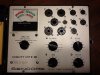
The first 2 pics are testers borrowed from a friend that my repair friend Tom used. These are called manual testers I think. And these testers have not been used for many years. Kinda crusty and stink like mildew.

All my tubes tested week with one 6bq5 testing bad. Tom said he didn't need a tester to tell it was bad since it was glowing red. From the plate maybe?? I can't remember what he said exactly. But it was bad.

But he said since they all tested the same, week, they were probably good.

Then I found another semi local guy that had some used tubes for $2 each and said he would test my tubes for free. I went there expecting to buy a few tubes.

His tester was a Sencore Mighty Mite IV. And it was in constant use. He said his tester was an automatic tester. It gave a percentage reading. All my tubes tested around 107-113 percent. Except for the one bad 6bq5 of course. He said he was surprised that they were all THAT good. They looked like the original RCA's to him.

Tom called bs on this guys automatic tester , saying they all were over 100%

I put in a used $2 6bq5 and had great improvement. Tom is showing up today to go through the caps.

So what tester do I trust.

20170309_111147[2].jpg
20170309_111218[1].jpg
m9hntuu0y8mzekupbrhu.jpg
 
Register to hide this ad
The old Mitey-Mite is a fairly basic tester. I had a Mitey-Mite II a while ago, and basically tubes all tested very bad or better than 100%. There was rarely anything in between.
 
Any tester that hasn't itself been calibrated or checked for proper function is just as bad as any other piece of electronic equipment that has not been tested.

A tester must be tested to know if it is doing its job.

How well it does the job is another matter. I've read a lot of posts that said its how the tubes work in the actual use is what really matters.

I have a couple testers that I checked the calibration and so I trust them pretty much.
I have a couple other testers that I did some updating on and the results between the testers indicate that they are all giving me a "GOOD" on a good tube and "WEAK" on a bad tube.

Over the years, I've found that most tubes test "good enough" if they are not output tubes.
Output tubes work hard and get weak, but even weak tubes will work. They may strain the system, but they will work.

Red plating on tubes, I thought was a circuit problem and not a tube problem, I may be wrong there.

Dead tubes are dead and don't work at all.

There is no way to answer your question.
You trust a tester that is working correctly.
There is no way to tell if either of those testers is working correctly.
 
B&K 650 _seems_ to be a transconductance tester, as is the Mercury, better than theMitey Mite, which is a basic emission tester, testing only cathode function. It DOES have a good grid leakage test, as does the B&K (at least my 707 does!). Red plating can indicate grid leakage, not uncommon with used 6BQ5s. Still, I have three working, calibrated testers, and consider their readings to be opinion, not fact. Any tester should find dead, worn-out or shorted tubes. In-circuit performance can be the best way to find weak or marginal tubes (in-circuit voltage readings for preamp tubes, output power for output tubes).
 
What those guys said.

If a tube is red plating and the replacement does too, power supply caps.
 
A red plating tube can be caused by a few things: a) a leaking interstage coupling capacitor. b) an internal grid short.
c) a loose tube socket that allows the control grid to become disconnected.
As far as testers go, the best are called Mutual Conductance testers. The B&K reads, "Dynamic" Mutual Conductance. This word means a less than ideal test. Read this for more info: http://www.radiolaguy.com/info/Mutual-Emission.htm
Also note that different testers use differently set bias levels. For instance, my Heathkit / Weston TT1-A is a true Mutual Conductance tester (plus I can calibrate it myself using the interior cal. controls). But I may get a Gm of 2000 and my friend's Hickok M.C. tester would read it at 1700. But every time we compare readings, his is always proportional to mine (because of different bias test levels) so we trust them both.
Emissions testers (to me) are a waste of money and bench space.
 
Radiolaguy's comments are interesting to say the least. He makes a big distinction between Mutual Conductance and Transconductance testers, yet these terms by definition -- as they apply to the commercial tube testers of this conversation, are virtually one and the same, and are commonly used interchangeably in text and discussion. To unmask the proper definition of these terms:

1. Conductance is defined as specifying one electrode within a tube. If a change in current drawn by a given electrode is divided by the change in voltage applied to that electrode that produces the change in its current draw, with the voltage of all other electrodes within the tube being held constant, then the result will be the Conductance of that tube as it relates to that element in that tube, under the operating conditions used. The term Conductance is assigned the letter g, and because conductance is considered the electrical opposite of resistance, it is stated in units of Mhos, which is Ohms spelled backwards. And who says that the early engineers didn't have humor?

2. If you take the above scenario, yet make it include two separate electrodes within a tube, so that the change in current of one electrode is now divided by the change in voltage of another electrode (all else being equal), then the prefix "Trans" is added to the term conductance, so that now the term becomes Transconductance. The term transconductance itself does not specify any specific combination of electrodes, so it is a general term which can be used to specify the performance relationship between any two electrodes within a tube.

3. Because the relationship between the grid and plate of a tube is so important not only to designing a circuit to operate properly with it, but also in terms of testing its basic amplification performance, the grid-plate transconductance of a tube is also and specifically assigned the term "Mutual" (assigned the letter m), giving the defining term Mutual Conductance, identified by the letters "gm". Therefore, the terms "Grid-Plate Transconductance" and Mutual Conductance, are in fact, one and the same.

These terms are invariably used interchangeably by tube tester manufacturers, because the term Transconductance in their world (and indeed in most instances) virtually always refers to the performance relationship between the grid and the plate. Therefore, when it comes to tube testers, the defining terms grid-plate are simply dropped when it comes to the general term Transconductance, with those defining terms being understood.

Lastly, when you add the term Dynamic to this bag of terms, it means that the voltage and current elements being measured relative to Transconductance measurements are of the AC type, as opposed to the DC type. Do not confuse this to mean that the operating voltages applied to the tube under test are AC in a Dynamic test. They are of course DC, as that is the only kind of voltage that an amplifier tube can operate from. Rather, it is the change in applied voltage, and the resulting change in current that is of an AC nature. This is always a much more accurate test, since this type of test covers a complete portion of a tube's characteristic curve, rather than statically jumping the operating point from one point, directly to another. In that case, the Transconductance is defined by just those two points on the curve, whereas in a Dynamic test, it is defined by a combination of ALL of the points within the excursion of the applied AC voltage. Dynamic testing is always more accurate than static testing.

This may be getting too much into the weeds for some, but if you really want to understand what type of tube tester you have (or need), then it begins with having an accurate understanding of the terms (and therefore the tests) used to describe it.

Dave
 
1. Conductance is defined as specifying one electrode within a tube. If a change in current drawn by a given electrode is divided by the change in voltage applied to that electrode that produces the change in its current draw, with the voltage of all other electrodes within the tube being held constant, then the result will be the Conductance of that tube as it relates to that element in that tube, under the operating conditions used. The term Conductance is assigned the letter g, and because conductance is considered the electrical opposite of resistance, it is stated in units of Mhos, which is Ohms spelled backwards. And who says that the early engineers didn't have humor?

Dave
I was wondering what that word meant Thanks! "Mhos"
 
I would like to add :
any tube that does not measure the tube in question at it's nominal conditions ( voltage current etc) is questionable.
Which rules out all of the above testers for anything but a simple shorts test.
 
The advantage of a Mutual Conductance tester, is that at least it makes the tube amplify -- invariably not at normal operating voltages as peter said, but it does amplify none the less. An Emission tester does not. It simply measures how much of a preset current level can flow from the cathode to the plate. Therefore, if a tube had an open internal connection to the grid, the emission tester wouldn't know it, and would therefore give its indication as if nothing were wrong, with the indication being little changed from that of a good tube of the same type that had no such defect. On the other hand, the Mutual Conductance tester would give no indication for the grid challenged tube at all. It would give a dead indication, which is surely the way that tube would operate in the piece of equipment it came from.

Dave
 
My opinion - an emissions tester just picks out obviously shorted and dead (or nearly so) tubes, no more. Mutual Conductance testers are a much better indication of the tube's condition - but it is still a approximation.

I just re-capped and calibrated a Mercury 1000 (circuit same as the above 2000, but no transistor testing). It's a handy little tester that gives consistent results. Not so before re-capped/calibrated. I also have a Hickok 532, that consistently tests 10% lower than the Mercury over a wide range of tubes (for tubes that they both can test). Neither is right or wrong, but since they trend together, I'm comfortable with both. Like triode17 said above.

I test ALL tubes before I put them in circuit, and the circuit is the ultimate test of the tube.
 
Amplitrex AT 1000(no affiliation).. Don`t leave home without it !! No more concerns about reliability and accuracy on pretty much all audio based tube testing and has a usb computer link with software + headphone jack with level control for microphonic tube sensitivity checking.. Expensive ? Yes.. But so was wasting my time with two old & tired work horses(B&K 707(purchased used in 1974), Eico 6 something, something) for years or using working chassis of the tube type(still the best and final test IMHO !).. After my fellow "Audiophool" & tube amp "geetar/base" playing friends found out I bought it, they started bringing me all their boxes/bags of tube pulls, and even brand new tube purchases for checking... That and thirty eight plus years of my tube amp repair questionable pulls that I had laying around .. I`m sure glad I paid extra for the common/popular testing socket, "socket savers" option.. No more questions, doubts or concerns in my 2 cell brain about tube quality.. Some of the best investment in brand new test gear I`ve ever made.. All audio tube testing information & results in a little over 2 minutes, less after setup for tube type.. And all tested at real world voltages... My 57 year old house keeper was even accurately testing tubes within 10 minutes of showing her how to set it up and test different tube types.. Just my .02 worth input.. Not purchased to sort tubes for sale on ePray or anywhere else !! FWIW. Gentleman.. Regards, OKB
 
Amplitrex is quite good and certainly the best 'modern' tester. I use maximatchers which I would rate second to the AT 1000. Good, consistent results everytime.
 
Amplitrex is quite good and certainly the best 'modern' tester. I use maximatchers which I would rate second to the AT 1000. Good, consistent results everytime.
Yes I agree x3workshop, I`ve owned a Maximatcher since 2003 with optional adaptors and it does a great job too and is well built.. Also it`s great for burning in a quad of whatever before final install and bias set, though a quad of 6550/KT88s will get it pretty warm after a few hours, which is why I lift it up a inch or so at the corners with some wooden blocks while doing burn in.. Thanks for your interest and kind reply.. Take care. Regards, OKB
 
In addition to the differences in test methods (emission vs. some form of transconductance), AND whether the machine has been calibrated:

All tube testers have resistors in them which can drift out of spec, and most (all?) have at least a cap or two which are almost certainly bad after half a century. Personally I would trust a transconductance tester over an emissions tester, given otherwise equal conditions (recapped but not calibrated for example), just because it's a more realistic test. But if those old moldy testers your friend has have not been recapped and any tubes inside them checked, I wouldn't put TOO much stock in the results.
 
This may be more than you want to know, but it's how tube testers are/were calibrated for a given tube.
http://www.alltubetesters.com/articles/bogey_tube_facts.pdf

IMO, if you want hard numbers, a high dollar Hickock is probably the way to go. If you're looking for a more casual test, any one of a number of testers will get the job done. I like the Eico 666/667 because that's what was plentiful when I was looking for a tube tester. Rarer than hens teeth, it would be really cool to have a Tektronix 570.
 
Back
Top Bottom