


While exploring the Sansui SP-1200/1700/2500 crossover family I somehow got sidetracked into SP-3000 land, who's crossover proved unrelated to the aforementioned group. But before resuming the original mission this oddity caught my eye and piqued my curiosity.
SP-3000 is a typical "kabuki" 5-way comprised of woofer, lower midrange, upper midrange horn, twin tweeters and a super tweeter. Switches on back separately select "Clear," "Natural" or "Soft" settings for "High Range" and "Mid. Range."

This looks identical to many vintage Sansui models. But a peek behind the curtain reveals the unexpected surprise. Whereas High Range switch changes series-to-parallel inductive ratios for both tweeter and upper midrange driver filters, Mid. Range switch just changes series inductance in the woofer circuit. The actual Low Midrange filter is fixed, offering no adjustment options.
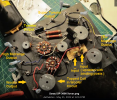
( I marked up this pic reposted by @Aethelstan of original post at Tapeheads.Net )
Schematic looks like this:

Not hard to see what's going on here; varying series inductance changes low pass roll-off frequency, influencing amount that upper woofer response extends into the low midrange. Haven't seen this before in my limited experience. Is this Sansui exclusive? Any other speaker makers do this?
Sansui of that era were deeply vested in their tapped-transformer type crossover networks and must have explored every clever way to utilize that technology. But it no longer seems to be a thing. Were they brilliant but not cost effective in the long haul? Or perhaps just lack the versatility of other methods at hand?
SP-3000 is a typical "kabuki" 5-way comprised of woofer, lower midrange, upper midrange horn, twin tweeters and a super tweeter. Switches on back separately select "Clear," "Natural" or "Soft" settings for "High Range" and "Mid. Range."
This looks identical to many vintage Sansui models. But a peek behind the curtain reveals the unexpected surprise. Whereas High Range switch changes series-to-parallel inductive ratios for both tweeter and upper midrange driver filters, Mid. Range switch just changes series inductance in the woofer circuit. The actual Low Midrange filter is fixed, offering no adjustment options.
( I marked up this pic reposted by @Aethelstan of original post at Tapeheads.Net )
Schematic looks like this:
Not hard to see what's going on here; varying series inductance changes low pass roll-off frequency, influencing amount that upper woofer response extends into the low midrange. Haven't seen this before in my limited experience. Is this Sansui exclusive? Any other speaker makers do this?
Sansui of that era were deeply vested in their tapped-transformer type crossover networks and must have explored every clever way to utilize that technology. But it no longer seems to be a thing. Were they brilliant but not cost effective in the long haul? Or perhaps just lack the versatility of other methods at hand?
Last edited: