• The move to the new server is done. There are some software and database maintenance updates in process. This has us passing the hat around to help out. We appreciate any donations. Seriously, even a dollar helps. The payment page may be found here - https://www.audiokarma.org/support.html

Why Do I Keep Blowing JBL 033 Tweeters?????

kwape

AK Subscriber
Subscriber
on my JBL L110 I have taken out 2 033 tweeters and both have been in the left cabinet. After finally finding a pair of 033 tweeters off bt (only needing 1) I recently blew the seconded tweeter after it was working fine for about a week. They're very difficult to find working and expensive so you can understand my frustration. I no longer have any spares, if one goes out again they will be sitting idle for another 6 months or however long it takes to find replacement. So I've discontinued playing them till I'm sure nothing is wrong with the crossover. I'm pretty sure nothing is wrong with my solid state gear. I'm running them with a restored SAE Mark IIIA with a dc offset in high 30s low 40s mv. None of my other speakers had any issues with blowing tweeters, just the L110.

The bad tweeters will still play, but will distort on high frequencies such as screaming guitar or high vocal tones. I do like to play them loud at times but I am well within the power handling capabilities.

I am posting to see if possibly there's something wrong in the crossover. Not sure what I need to check. They have been recapped with solen films by the previous owner. thanks if anyone can help this.
 
Register to hide this ad
Several decades ago I blew an 075 radiator in my JBL 030 system. Back then JBL still honored the Lifetime Warranty, so I sent it back to California. They returned it with a new voice-coil saying in their opinion I must have a high-frequency oscillation in my amplifier. I dumped my Kenwood receiver and switched to a Fisher SA1000 amp and later to Crown solid-state amps. I haven't blown a tweeter since.

It seems there are several technical papers from JBL referencing tweeter damage not from too much power, but from too little producing a distorted signal causing the damage. You didn't mention the electronics in your system but I'd start looking there and not blame the JBLs.
 
Ultrasonic oscillation and clipping are the usual culprits. But it can sometimes be white noise from tuners or peculiar signals to which amplifiers badly react. Amplifiers also generate high-frequency ringing from the transformer or diodes. The diodes have internal capacitance (aka Qrr) which must be dumped each AC cycle, causing high-frequency spikes. The power transformer has parasitic inductance and capacitance causing ringing. (I have been researching oscillation issues for a tube amp rebuild, so have recently read a fair bit about this.)

The solution is doing all of these:
1) Adding snubbers to the transformer and diodes. This removes a LOT of the ringing signal bouncing around amplifiers. In tube amps add Grid-Stop Resistors to get rid of high-frequency oscillation which results from internal tube capacitance called Miller Capacitance. Snubbers are generally omitted as a cost-savings measure.
2) Adding simple RC filters to remove high-frequency components (about 18KHz) from the output signal, whether from amplifier oscillation or harmonics, without affecting the rest of the audible signal. These need to have steep slopes to get everything.
3) Using an amplifier with enough power to not clip or not distort.​

But it might be possible get by with just (2) or (3). Sometimes just (3) is what does it. Some tweeters are more sensitive to high frequency oscillation than others. Limiting tweeter power with a fuse or non-linear semiconductor device may not help because this isn't a tweeter-power issue, it is a frequency quality issue.

This problem is so well-known that JBL has a short whitepaper on the subject, complete with diagrams (NB: I manually cleaned up the OCR and may not have gotten all errors):
www.jblpro.com/catalog/support/getfile?docid=246&doctype=3
Danger: Low Power
Technical Note JBL PRO 7013

Too Little Amplifier Power Can Produce Too Much
We occasionally hear of JBL owners who damage the high frequency components of their loudspeaker systems using amplifiers that are rated at less-rather than more-power output than recommended. Understandably, they often find It difficult to comprehend how such an amplifier can actually burn out JBL components when they have been told, by our dealers and in our literature, that JBL loudspeakers can handle large amounts of power and will also deliver big sound with relatrvely little Input power. These statements are true, provided the amplifier is not overdriven. To understand this more clearly, it IS necessary to understand the nature of music as it relates to amplifier power and distortion.

Here’s The Killer Distortion Generally Affects High Frequency Drivers

The additional power generated by overdriving the amplifier is rich in harmonics (distortion). These harmonics can be particularly dangerous to high frequency drivers. Harmonics are higher frequency multiples of the original signal; therefore, the high frequency component of a loudspeaker system must bear the brunt of the distortion-even though the original signal may have been generated by a bass guitar.
 
It seems there are several technical papers from JBL referencing tweeter damage not from too much power, but from too little producing a distorted signal causing the damage. You didn't mention the electronics in your system but I'd start looking there and not blame the JBLs.


this is interesting. I have a scope and would like to check this if possible with some instruction. Do I jus need to inject a high frequency sine wave, 15,000-20,000 Hz perhaps, into the amp and look for crossover distortion?

I have checked the amp @ 1khz sine wave into 8 ohms and produces around 118wrms as I remember.

I'm using SAE Mark IIIA (replaced every component except for transformers and 2 transistors), Emotiva usp-1, Emotiva erc-3
 
Be careful how you read those Tech Notes. All it really is saying is don't crank your 30 watt amp.

Adding an RC filter to remove high frequency inaudible components will have an affect on the audible components. This is exactly what the whole argument over CD fidelity v High bit rate sampling is about. If you take a square wave at 18khz, for instance, and pass it through your filter you're going to lose all the odd harmonics over 18KHz. Since a square wave consists of a fundamental sine wave and all odd harmonics (these harmonics are not distortion if they were in the original signal. That tech sheet makes it sound like all harmonics are distortion), you no longer have what you started with even though the fundamental was below your cutoff frequency. While a square wave is an extreme example, music is made up of all sorts of complex waves all of which have components at inaudible frequencies.

Getting a more powerful amplifier is a better solution then adding circuitry to your speakers.
 
While I believe in over powering speakers for head room that would not mean giving them all the power the amp has.

I was thinking clipping till I check the specs, do you like loud music?
 
as I mentioned, amp is sae mark IIIA, @ 1khz sine wave into 8 ohms puts out 118wrms. amp is rated @ 120wrms per channel. I usually set the gain pots on the amp @ 3/4s volume. Never turned my pre amp past 1/3 volume with this amp. The emotiva usp-1 dose not have tone controls.

I do like loud music. But there shouldn't be a problem with the volume as I am within power handling capabilities here. Something must have gone awry with either the amp having some kind of distortion or the crossover in the speaker.

on the jbl l110 speakers, I had the pots for mid and tweeter set in neutral or middle.
 
or it just a coincidence I keep blowing tweeters in the left cabinet?????

I have a scope and can inject a signal. Should I just play around with different frequencies and look for distortion/oscillation? I only ask because I am a novice with the scope.
 
Don't know if this is relevant, but I had a RS optimus 70w receiver go into oscillation (I think) and kill a Baby Advent II tweeter @ moderate volume. Was playing a cassette on a onkyo ta-2026 and when I would turn the volume knob (on the optimus) approaching 11 o'clock, the FL peak meters would peg, occasionally. Resulted in a new pair of tweeters. I suspect brown glue became semi- conductive. Plausible? I can only guess.
 
Last edited:
Adding an RC filter to remove high frequency inaudible components will have an affect on the audible components.

If the speakers can't reproduce sound above 20KHz, and the ear can't hear them, how does filtering ultrasonics that can't be detected by the listener have any effect on audible sound? Let alone that below 20KHz, assuming the filter has appropriately chosen rolloff so it doesn't function in the audible range?

Most adults can't hear past 16KHz, anyway! Which is why the mosquito buzz played to prevent loitering by teenagers in parking lots doesn't bother adults.

This is exactly what the whole argument over CD fidelity v High bit rate sampling is about. If you take a square wave at 18khz, for instance, and pass it through your filter you're going to lose all the odd harmonics over 18KHz. Since a square wave consists of a fundamental sine wave and all odd harmonics (these harmonics are not distortion if they were in the original signal.

Errr, not quite. MP3 is a lossy technique, just like JPEG, and this is a separate issue than filtering ultrasonic (i.e. inaudible) components. The issue in any lossy compression technique is how much signal can be thrown away before it becomes detectable.

A tube amp has Grid-Stop Resistors to remove high-frequency oscillation caused by the tubes. It does not affect sound quality, but it does affect amplifier oscillation and stability. Better amps have snubbers to remove high frequency ringing. All of this is going on all the time, and it doesn't degrade the audio, it improves it.

Getting a more powerful amplifier is a better solution then adding circuitry to your speakers.

Even a powerful amplifier can pass ultrasonic frequencies to the speaker.
 
or it just a coincidence I keep blowing tweeters in the left cabinet?????

I have a scope and can inject a signal. Should I just play around with different frequencies and look for distortion/oscillation? I only ask because I am a novice with the scope.

Forgot to ask if if was one channel vs. the other. You may have oscillation only in one channel because of the amplifier's design. This tells you which channel has a bigger problem.

Hook up the scope and look for frequencies > 20KHz.

Some of this may be high-frequency ringing noise.
 
Retrovert - I meant that CD samples at 44.1KHz. Now days people argue that sampling at 44.1KHz is not high enough even though Nyquest says that you only need to sample at twice the frequency of the highest frequency component in the signal. 44.1 is used because thats twice 22. Human hearing is supposed to top out at around 20Khz. Below the 22. So at 44.1 we should be able to sample any audible signal and reproduce it. But sampling at 44.1 is not high enough to sample all of the harmonics that are generated by a 22KHz fundamental. Thats why sampling at rates as high as 192KHz. and even higher, is common now.

Your filter solution creates the same problem of throwing away harmonics.
 
Passing along some DC?

Good suggestion. That likely would cook everything in the box, not just the tweeter. Although tweeters are more sensitive...

Another possibility is a bad tweeter crossover cap which allows too much low frequency to pass. I would, however, call that unlikely. But possible.
 
I would suspect the amp. The fact that the same amp destroyed a few 033s makes me highly suspecious.
I would get the amp checked out before continuing to use it.
 
Retrovert - I meant that CD samples at 44.1KHz. Now days people argue that sampling at 44.1KHz is not high enough even though Nyquest says that you only need to sample at twice the frequency of the highest frequency component in the signal. 44.1 is used because thats twice 22. Human hearing is supposed to top out at around 20Khz. Below the 22. So at 44.1 we should be able to sample any audible signal and reproduce it. But sampling at 44.1 is not high enough to sample all of the harmonics that are generated by a 22KHz fundamental. Thats why sampling at rates as high as 192KHz. and even higher, is common now.

Ahh. I see what you're trying to convey. Ok. Sampling losses are a separate issue from filtering out inaudible high-frequency noise.

The issues is that lossy compression, whether it is MP3 or anything else, throws away data. Literally removes bits of the input signal so when it is reconstituted it is an approximation to the original. So the resulting waveform, when uncompressed, isn't the same anymore. Signal has been tossed in the dumpster. Not just higher-order harmonics which you can't hear. Actual signal that you can hear, or in the case of a JPEG, can see.

The question is whether or not the approximation is close enough that the ear doesn't complain.

When you use 320K as opposed to 192K you get a lot less signal discarded so there is less corruption of the signal. It isn't about frequency response in an absolute sense, it's about frequency degradation.

Suppose you are sampling at 44.1K. Then the WAV file has: 44,100 samples/sec x 16 bits x 2 channel stereo = 1,411,200 bits/second

Now compress that stream of data by sampling at 192,000 samples per second vs. 320,000 samples/second. You see how much data you're missing in this sampling? You're looking at 1 part in 4.41 of it at high rate (which you can't distinguish from the original) versus 1 part in 7.35 of the signal (which you can hear on decent gear, but probably not on headphones). So you're missing bits of the waveforms that distort them. So 192K has 60% what you have at 320K. Now go down to 128,000 samples per second. Which is looking at 1 part in 11. Whoah, that's a lot of data being ignored, which is why those MP3s sound TERRIBLE unless it is on a phone, in which case you can't hear a lot of it because the earphones are so awful and the DAC is cheap (as in shoddy).

This is why VBR—Variable Bit Rate—is popular. It combines the best of small file size (lots of data discarded) with better quality (less data discarded where it matters).

The compression isn't about harmonics that you can hear, so it isn't the same issue as removing unwanted signal which causes amplifier instability or which arises from internal amplifier issues.

Your filter solution creates the same problem of throwing away harmonics.

Only the ones humans that can't hear, and which (likely) weren't part of the original input signal, but which are dangerous for tweeters.

This is done on high-quality amplifiers. You'll see those filters in the output circuits and in the power supply circuits. Even the lowly chipamps do it.
 
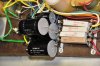
Hi Ken, sorry to hear this! I can assure you when I had them, they saw some pretty high power levels on a couple of occasions from my 2325 and never detected and problems. I am including a couple pics of the xover work I performed, maybe someone might see something. It is a coin toss which serial this was, but both were done identical.


xover half done.jpg

recapped xover.jpg

and here is a shot from before any recap work

xover_board.jpg
 
Back
Top Bottom