• The move to the new server is done. There are some software and database maintenance updates in process. This has us passing the hat around to help out. We appreciate any donations. Seriously, even a dollar helps. The payment page may be found here - https://www.audiokarma.org/support.html

Why do Onken & other old enclosures sound so different?

GregOgil

New Member
There are all these antique Altec, Onken, Jensen & other bass reflex enclosures that sound so different & have a certain magic with their huge & very shallow ports. Something has been lost as everyone has shrunk the openings & lengthened the bass reflex ports to increase bass. Some of these old enclosures seem to have some of the sound of an open baffle, but without being quite so fussy when it comes to room placement.

One example is my pair of 1950s Stephens Trusonic 15" full range with super tweeter. The ports on these old enclosures are large & very shallow, roughly a 4" x 17" opening that is about 4" deep. This of course allows considerable bass cancelation. The speakers start dropping off around 250 Hz & I bi-amp them alongside a sealed woofer to meet today's expectations, but somehow this enclosure does wonders for the midrange. For jazz or orchestra I use another pair of speakers, but particularly for vocals this combination of driver & enclosure is fantastic.

Someone has come up with formulas for calculating the depth of the ports when putting a modern woofer in an Onken enclosure, but can anyone help me understand what the magic is in the old enclosures that operate in midrange? Ideally I'd love to find someone else's design to copy, but barring that I'd like to understand how to design an enclosure & find appropriate drivers to capture some of this magic.
 
Register to hide this ad
It isn't just about materials and measurements. Your 1950s cabinets have aged for 60 years. They've been subjected to musical vibrations for 60 years. It alters the structure of the wood. You could duplicate materials and measurements exactly but it wouldn't be the same.
 
but can anyone help me understand what the magic is in the old enclosures that operate in midrange?
The magic is in the high sensitivity, well mechanically damped drivers engineered to be used with high output impedance amplification.

The magic in the enclosures is mostly in any balanced bass extension you get.
 
It isn't just about materials and measurements. Your 1950s cabinets have aged for 60 years. They've been subjected to musical vibrations for 60 years. It alters the structure of the wood. You could duplicate materials and measurements exactly but it wouldn't be the same.

That's very interesting. How is the structure of the wood altered?
 
Maybe its a new way to make money from audiophools?.... Acoustically aged wood
I wonder if I can get the Amish to pump some music into their drying kilns. :deal:
Hmmmm...:idea:... Mozart or Metallica?

But, back to topic. I have a pair of cabs with shallow wide ports.
They're nothing special as far as name brand but I do love their sound.
Definitely something different about them.
 
There are all these antique Altec, Onken, Jensen & other bass reflex enclosures that sound so different & have a certain magic with their huge & very shallow ports. Something has been lost as everyone has shrunk the openings & lengthened the bass reflex ports to increase bass. Some of these old enclosures seem to have some of the sound of an open baffle, but without being quite so fussy when it comes to room placement.

One example is my pair of 1950s Stephens Trusonic 15" full range with super tweeter. The ports on these old enclosures are large & very shallow, roughly a 4" x 17" opening that is about 4" deep. This of course allows considerable bass cancelation. The speakers start dropping off around 250 Hz & I bi-amp them alongside a sealed woofer to meet today's expectations, but somehow this enclosure does wonders for the midrange. For jazz or orchestra I use another pair of speakers, but particularly for vocals this combination of driver & enclosure is fantastic.

Someone has come up with formulas for calculating the depth of the ports when putting a modern woofer in an Onken enclosure, but can anyone help me understand what the magic is in the old enclosures that operate in midrange? Ideally I'd love to find someone else's design to copy, but barring that I'd like to understand how to design an enclosure & find appropriate drivers to capture some of this magic.

>>Something has been lost as everyone has shrunk the openings & lengthened the bass reflex ports to increase bass.

Maybe I am out of my element here, are you saying there are new cabinets designed for the same old drivers but with completely different port configurations? If so then you are actually comparing apples to apples (it took me a few minutes to get hold of this so bear with me).

>>The ports on these old enclosures are large & very shallow, roughly a 4" x 17" opening that is about 4" deep. This of course allows considerable bass cancelation.

I don't quite follow this. It sounds like a reflex enclosure to me, why and how is there cancellation?

>>Ideally I'd love to find someone else's design to copy, but barring that I'd like to understand how to design an enclosure & find appropriate drivers to capture some of this magic.

Why not just recreate the original cabinet? Because of the aforementioned 'cancellation'?


I doubt music is doing anything substantial to the cabinet, but wood certainly dries out and becomes more brittle with time all by itself, when kept in a reasonably dry environment.
 
The enclosure design you are referring to is called aperiodic. It damps out the resonance frequency rather than trying to use the backwave, either as a spring (acoustic suspension) or for bass reinforcement (ported, etc.).

Some links from googling: aperiodic woofer enclosure

http://diyaudioprojects.com/Technical/Aperiodic/
http://aperiodic-enclosures.blogspot.com
http://www.diyaudio.com/forums/multi-way/56705-aperiodic-alignment-speaker-design-gurus.html
http://techtalk.parts-express.com/f...ous-how-does-one-design-an-aperiodic-enclosur
 
The magic is in the high sensitivity, well mechanically damped drivers engineered to be used with high output impedance amplification.

The magic in the enclosures is mostly in any balanced bass extension you get.

This makes a lot of sense. How do I figure out which new diy drivers fit this criteria?
 
toxcrusadr Sorry I did not explain well. It is a bass reflex box, but the front facing port sets beside the driver only 2 inches to one side. The port is huge, but very shallow, only 4 inches deep. Even though it is a bass reflex cabinet, it has some of the disadvantages of an open baffle. Though with a passive subwoofer being used as a woofer helping out from 200 Hz on down it sounds great.

The same driver is capable of more bass in a different enclosure, but the midrange is not as good. I'm assuming the cabinet being so open I'm getting some of the advantages of an open baffle. This driver in this enclosure, the midrange sounds much like an open baffle, if the speakers are angled properly to the listening area. Outside of a reasonably large sweet spot the sound is more like a traditional bass reflex. The Onken & some of the old Altec boxes have huge ports too. Somehow they are getting a more lifelike sound by being so open, yet still have some of the advantages of a bass reflex cabinet. Some old Stephens, Onken, Altec & Jensen bass reflex boxes have ports where the openings are are 80% to 100% as big as the driver, but the port is very shallow, sometimes much shallower than the 4 inch port in my Stephens. Are there drivers manufactured today that would sound good in this style of box? If so, how do I go about determining the parameters of the box? I guess what I'd really like to know is what is the math that lead to the design of the Onken, Altecs & others?

If I had another pair of Stephens 15" 150FR full range drivers & toroid tweeters I probably would duplicate the cabinet exactly, but of the old Stephens drivers that are available, most need rebuilding & often do not sound the same after being professionally rebuilt. As far as I know, no one builds 15" full range drivers with 17.5 pound Alnico magnets & if someone did, I probably couldn't afford them.
 
It isn't just about materials and measurements. Your 1950s cabinets have aged for 60 years. They've been subjected to musical vibrations for 60 years. It alters the structure of the wood. You could duplicate materials and measurements exactly but it wouldn't be the same.

Its not stradivarius - they are just rectangular boxes of wood glue and screws, with certain design considerations ...
different than what the typical big box store speaker of today is made for.

Don't forget the Karlson Kabinet designs ... ;)

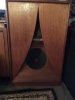
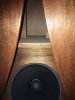
IMG_4431.jpg IMG_4433.jpg
 
Last edited:
hjames I've never heard a Karlson, so I didn't know if they fit into this category of very large ports & very lifelike mids. I've always thought they look interesting when I've seen photos.
 
I wonder if I can get the Amish to pump some music into their drying kilns. :deal:
Hmmmm...:idea:... Mozart or Metallica?

But, back to topic. I have a pair of cabs with shallow wide ports.
They're nothing special as far as name brand but I do love their sound.
Definitely something different about them.

I'm having a hard time describing what is different about the sound of cabs with large shallow ports. How would you describe what it is about the sound that you love? Any ideas as to why they sound the way they do?

I don't think most Amish have electricity. Maybe the up & down motion of an old fashion windmill could be harnessed to operate a bagpipe?
 
Back
Top Bottom