

You are using an out of date browser. It may not display this or other websites correctly.
You should upgrade or use an alternative browser.
You should upgrade or use an alternative browser.
Why Does 8-Track Exist?
- Thread starter Outland
- Start date


I,ve always wondered.....even though digital and the cd were pretty much the deathknell for cassettes,was there ever any chance for cassettes to live on in their own way if they had more reliable transport systems? I was a teen in the early 70s and the one thing that drove me nuts was that no matter what cassette player I was using,the Craig in my car,or the TEac deck in my room, it was pretty much a given that my cassette tapes were eventually going to be "eaten'! I had a huge collection of cassettes and happily tossed them when CDs came out just due to the fact that I was tired of losing my good tapes. I,ve always wondered if I would have hung on to those tapes and a few of my decks if they had been a little more reliable...

SoundOfSound
Super Member
I got into 8-Track because my mom bought an RCA home stereo for the living room that had one built into the receiver. Not the greatest thing in the world but a giant upgrade from having nothing at all.
After a few years of building up my 8-track collection I bought a much better Panasonic 8-track player that allowed me to record things off the radio such as the King Biscuit Flower Hour. It also had stereo microphone inputs and giant UV meters. :thmbsp:
I think one of the main problems with the 8-track was its inherent cheap design. Most players were cheap and made like garbage and the heads would go out of alignment pretty quickly like the auto reverse heads would do on the early cassette decks that offered them. There was also the problem of having a metal strip scraping across the head like sandpaper wearing out the head. If you ever left your tapes in a hot car just forget about it, anybody remember jamming a matchbook under the tape to get it to play correctly?
IMO, the 8-track died out because of its reputation for poor reliability and the introduction of Dolby C for cassette tape in the high tech 80's.
It was not unusual to look inside older decks and see scarring on the heads from the metal strip. :sigh:

Inside the beast.

This was my second audio gear purchase. The Panasonic RS-808 US, They actually put a lot of effort into that unit. It was a really good player as far as 8-tracks went. :thmbsp:
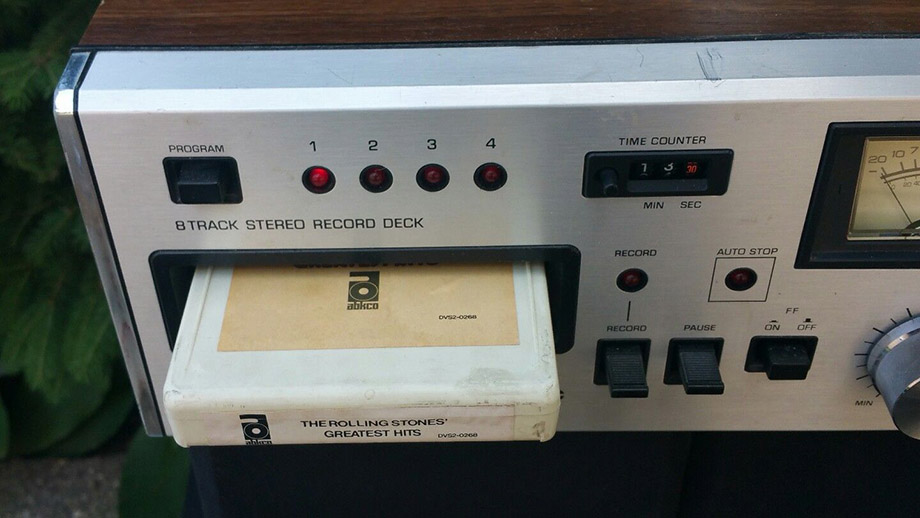
After a few years of building up my 8-track collection I bought a much better Panasonic 8-track player that allowed me to record things off the radio such as the King Biscuit Flower Hour. It also had stereo microphone inputs and giant UV meters. :thmbsp:
I think one of the main problems with the 8-track was its inherent cheap design. Most players were cheap and made like garbage and the heads would go out of alignment pretty quickly like the auto reverse heads would do on the early cassette decks that offered them. There was also the problem of having a metal strip scraping across the head like sandpaper wearing out the head. If you ever left your tapes in a hot car just forget about it, anybody remember jamming a matchbook under the tape to get it to play correctly?
IMO, the 8-track died out because of its reputation for poor reliability and the introduction of Dolby C for cassette tape in the high tech 80's.
It was not unusual to look inside older decks and see scarring on the heads from the metal strip. :sigh:
Inside the beast.
This was my second audio gear purchase. The Panasonic RS-808 US, They actually put a lot of effort into that unit. It was a really good player as far as 8-tracks went. :thmbsp:
Last edited:
KentTeffeteller
Gimpus Stereophilus!
1tumbleweed is entirely right. 8 Track was designed for music choices in the car, airplane, boat, trucks. It was the first commonly accepted mobile music format where the driver had choices of music. AM radio then was the common in car entertainment most cars had. FM radios were just getting available in luxury cars.

jimbo2k
AdcomGFT500,2GFA535,BandO,RX2.,MMC3,C101.L810's
Late 60s early 70s
Came time to make a choice, ate track or cassette. Chose cassette because it was easier to find machines that recorded. Had a 67 TR4 with an under dash Automatic radio Cass player,with 2 Utah 5 1/4s in the back and at home I had a Radio Shack STC 2b top loader. Made my own tapes. I was King. Today I still have a cassette deck in my truck though the music is downloaded from MOG. Some things never change if you are old school.
Makes sense :yes:
I was in HS when the 8 track and Cassette were both popular. The main attraction to me, with any tape deck, was the ability to record. Virtually all 8 track portables, and the majority of home decks were playback only. The recording ones were way too expensive.
I made due with a Sony mono cassette deck-bought for a song, from a real audio shop, was my first quality deck. Think it was a TC52 or something like that.
I (correctly) reasoned, that I could buy the LP, dub it to cassette, for less than the tape version. It was a no brainer.
So I came along when the door could have swung either way-I went for the option of recording.
Came time to make a choice, ate track or cassette. Chose cassette because it was easier to find machines that recorded. Had a 67 TR4 with an under dash Automatic radio Cass player,with 2 Utah 5 1/4s in the back and at home I had a Radio Shack STC 2b top loader. Made my own tapes. I was King. Today I still have a cassette deck in my truck though the music is downloaded from MOG. Some things never change if you are old school.

OldSkool
Pioneer Nut
Those fellas above are right, all we had was AM radio and you had to just take what came your way when it came to mobile listening. 8-track gave everyone choice and it was a big hit with my father in the early 70s. At home everything was on R-t-R and in his '72 Econoline was 8-track. Cassette just wasnt something people used back then really. Like was said before those tiny tapes were used for dictation type applications or shown as 'high-tech' in the movies; something 'Q' would give James Bond for surveillance or Maxwell Smart might have installed in his shoe.


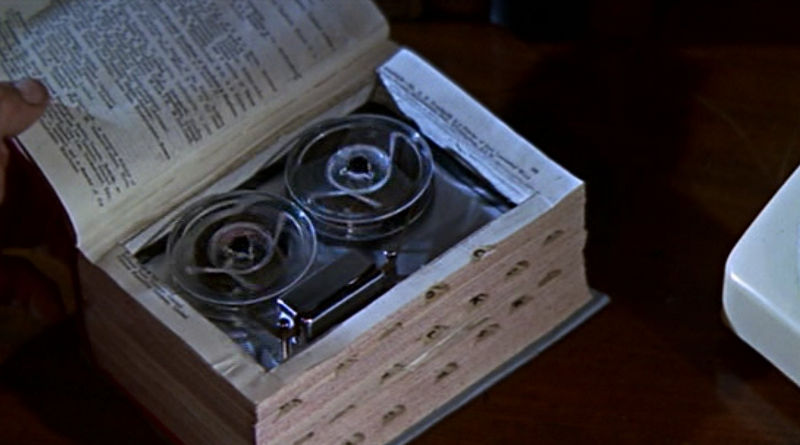


1tumbleweed
Kozmik Kowboy
Les Paul invented and first used it for certain background, tape loops he used in his live shows. It proliferated from there.
I believe you're confusing the 8-track reel to reel recorder that Ampex built for Les Paul in the '50s with the endless-loop cartridge that became the 8 track in the '60s. Other than the "8 track" part, there is no connection between the two.
Was that not the first use of 8 track, period?
Not to put too fine a point on it, but was that not the original use of 8 track? He asked why it exists, that's why it exists.
I believe Les had multiple machines that he used over the years/tours, later ones were cartridge 8 track, though more similar to radio station tape of the day than commercial 8 track. I remain pretty certain that is where commercial 8 track evolved/proliferated from.
I believe you're confusing the 8-track reel to reel recorder that Ampex built for Les Paul in the '50s with the endless-loop cartridge that became the 8 track in the '60s. Other than the "8 track" part, there is no connection between the two.
Not to put too fine a point on it, but was that not the original use of 8 track? He asked why it exists, that's why it exists.
I believe Les had multiple machines that he used over the years/tours, later ones were cartridge 8 track, though more similar to radio station tape of the day than commercial 8 track. I remain pretty certain that is where commercial 8 track evolved/proliferated from.
KentTeffeteller
Gimpus Stereophilus!
That was but not for the mass public. That was an over 700 pound studio machine. They were temperamental at times. Tape in 1958 was over $100 a reel for that and was 1" wide. 8 track cartridges were not similar to this machine. None of Les Paul's machines took cartridges, they took reels of tape running at 15 IPS minimum.

Scary as it may seem, I still have an Akai studio 8-track recording deck from the 70's... and I still buy blank 8-tracks on ebay... I belong to a vintage car club, and a lot of people have the stock 8-track decks in the dash... so I can record whatever you want onto a blank 8-track for your enjoyment... at whatever level of quality..., but it can be done and I do it for our gang...

Scary as it may seem, I still have an Akai studio 8-track recording deck from the 70's... and I still buy blank 8-tracks on ebay... I belong to a vintage car club, and a lot of people have the stock 8-track decks in the dash... so I can record whatever you want onto a blank 8-track for your enjoyment... at whatever level of quality..., but it can be done and I do it for our gang...
A wonderful service-bet it's fun for everyone.
You are likely the coolest dude there
Thank you for this. I often wondered about the high speed duplicating process that was used for factory pre-recorded tapes. The subsonic rumble tone that triggered the machinery in the duplicating factory would also trigger the auto-reverse mechanism on Ampex open reel decks with that feature. I wonder if Ampex ever made an 8 track deck that used the rumble tone for triggering the track change? Probably not since they all came equipped with foil at the change point anyway.
I think some players used tape tension or absence of counter input to switch directions, but I think 8-Track always used the foil for track change.
To put the tone on the tape the 1" (8-Track) an 1/2" (cassette) masters ran on an upright reel to reel type playback unit. The ends of the masters were also splices together with metallic tape. The bulk of the tape was fed into a bin which would move to the rear under a drum mechanism. The tape was then fed across a vacuum block which was used to provide tension. The metallic tape would cross a sensor which pushed the tone to the recorders.
Another sensor was used on our audiophile Masterworks system to shutdown the playback amps during track selections, so the noise between tracks would be lower. I'm sure we've all heard that rumble at the beginning of a tape.
I found a video of cassette despooling. Very similar to the machines we had.
http://www.youtube.com/watch?v=Vlvxme-o-D8
I'm surprised I remember this much about the process. I left the company in 1981, when they moved to Carrolton Ga. It's strange, I now find myself in the same building working for Sony.
1tumbleweed
Kozmik Kowboy
Scary as it may seem, I still have an Akai studio 8-track recording deck from the 70's...
Not scary at all; I have one too, although these days it's used for playback only, not recording. It's in my computer sound setup, and playing Strawbs' "Burning For You" right now!
Akai, Wollensak and Pioneer made the best 8 track recorders by far. Sony made one dreadful one (the TC8) and one good one (TC-228). There weren't many others that came up to that level. As has been discussed, 8 track was a mobile, play-only format primarily - where cassette was intended for recording from the beginning.

yardanimal
Active Member
I've got a jvc model with adc recording that just continues to work playback and records excellent quality on good tapes. I just buy bulk ebay lots and take unworn duplicates and stuff I dont like and degausse them and get good recordings. I have stopped messing with and fixing the tapes themselves. I get exposure to some titles I wouldnt otherwise.

I found a video of cassette despooling. Very similar to the machines we had.
http://www.youtube.com/watch?v=Vlvxme-o-D8
I'm surprised I remember this much about the process. I left the company in 1981, when they moved to Carrolton Ga. It's strange, I now find myself in the same building working for Sony.
It's really fascinating stuff. It's incredible how that machine that can duplicate like that over and over all day (although I'm sure it needed service or at least checking in between batches). I'll bet if one of those tapes ran off the rollers or got away from the machine it would screw everything up very quickly.
Did the master playback unit rewind itself and start back at the beginning every time it duplicated a tape or was it a continuous loop that just ran over and over?
I've never run across one of those Masterworks "Audiophile" series tape cartridges in all these years, but the idea of potting down the amps in between tracks is a good one. Guess you can't really do that easily when you're going at 40 times the normal playback speed.
What about the speed accuracy of high speed duplications - do they match the original master tapes very closely or is there a major slop factor there? If I play a CD or an album and it's factory prerecorded counterpart side by side and get them to synch up would it be close enough to set the speed on the tape player's capstan motor?
The master playback ran in a continuous loop. The recorded spools of tape, depending on the program length, could have anywhere from 12 -30 units recorded on it. Handling the spools took some practice, especially the cassette tape, but you eventually got the hang of it. The recorders had servo-controlled motors providing the correct amount of tension. On the take-up side there was an arm with a wheel guide which held and aligned the tape to the take-up reel. We had to check and adjust tensions frequently.
We ran test tones daily to check the levels and EQ'd all recorders and the Master playback unit once a week. We used a real-time frequency analyzer on the master while playing a white noise flat level test tape. We had a custom designed computer which check the levels and EQ on the recorders. Our specs were +- 0.5db for the recorders and +-.3db for the Master.
I was also responsible for EQ of our QA and A/B rooms which were used to test the masters against product. We used mostly McIntosh and Crown amplifiers, Nakamichi cassettes, huge JBL Studio Monitors, one in each corner of the room. This was just after the Quad phenomenon. We still had a quadrophonic version of Backman Turner Overdrive on an 8-Track tape. Instead of 8 separate tracks it switch a four-track head to two positions for Quad. Very cool at the time.
So yes the duplicated tapes sounded very close to the masters. They were compared constantly. The capstan motors were a constant 60Hz motor, so its speed was constant. If there was any variation in speed it was adjusted by adjusting the tension roller, adjusting the tension on the take-up motors, or in severe cases, different diameter capstans were used. We were very sensitive to specs.
Occasionally we "farmed out" replication to other plants, Ampex in Indianapolis was one of them. To ensure quality they sent us test tapes from their recorders which we tested once a week. They were not as good at making consistent adjustment as we were. It was common to see distortion in the 2.0 range, or +-3db out of spec in the 2K, 6K, and 10K readings of their EQs. WIth our specs being +-.5db for recorders and +-.3db for Master playback, QA and A/B rooms.
Working there was a blessing and a curse. A blessing because I was exposed to some very high quality gear. And a curse because I was exposed to some very high quality gear. I was taught what to listen for. What was good/bad. Afterwards I had a very low tolerance for Hisssss, distortion, sibilance, and scrape flutter. It made it very difficult to listen for enjoyment while hearing artifacts.
We ran test tones daily to check the levels and EQ'd all recorders and the Master playback unit once a week. We used a real-time frequency analyzer on the master while playing a white noise flat level test tape. We had a custom designed computer which check the levels and EQ on the recorders. Our specs were +- 0.5db for the recorders and +-.3db for the Master.
I was also responsible for EQ of our QA and A/B rooms which were used to test the masters against product. We used mostly McIntosh and Crown amplifiers, Nakamichi cassettes, huge JBL Studio Monitors, one in each corner of the room. This was just after the Quad phenomenon. We still had a quadrophonic version of Backman Turner Overdrive on an 8-Track tape. Instead of 8 separate tracks it switch a four-track head to two positions for Quad. Very cool at the time.
So yes the duplicated tapes sounded very close to the masters. They were compared constantly. The capstan motors were a constant 60Hz motor, so its speed was constant. If there was any variation in speed it was adjusted by adjusting the tension roller, adjusting the tension on the take-up motors, or in severe cases, different diameter capstans were used. We were very sensitive to specs.
Occasionally we "farmed out" replication to other plants, Ampex in Indianapolis was one of them. To ensure quality they sent us test tapes from their recorders which we tested once a week. They were not as good at making consistent adjustment as we were. It was common to see distortion in the 2.0 range, or +-3db out of spec in the 2K, 6K, and 10K readings of their EQs. WIth our specs being +-.5db for recorders and +-.3db for Master playback, QA and A/B rooms.
Working there was a blessing and a curse. A blessing because I was exposed to some very high quality gear. And a curse because I was exposed to some very high quality gear. I was taught what to listen for. What was good/bad. Afterwards I had a very low tolerance for Hisssss, distortion, sibilance, and scrape flutter. It made it very difficult to listen for enjoyment while hearing artifacts.
What an excellent rundown of the duplication process! I never realized so much quality control went into making those prerecorded units. I'm glad to hear that the speed is very accurate since I sometimes use prerecorded tapes (high and low speed reel to reel and occasionally cassette) as a basis for speed adjustment since I don't happen to have access to a frequency counter. Not the best way to do things but it gets pretty close when run up against a cd or lp of the same material.
I still have a quad 8 track of The Doors. The quad 8's are pretty neat with their 4 individual track mixes. You can hear all kinds of things when they are separated out that you'd never notice when listening to the final mix (Riders On the Storm is particularly interesting with Jim Morrison's creepy screaming whisper mimicking his vocals).
With all the QC and effort put into assuring that the tapes were of such good quality it's a shame that the average cartridge player had pretty lousy w/f specs and the head amps induced tons of hiss before a tape was even inserted into the machine. Of course the cartridge packs used by the duplicator played a huge part in the w/f specs, and I even remember seeing some carts (Warner Bros. mostly) that would actually move back and forth in the player while making a loud grinding sound as they played.
I can understand how it would be pretty difficult to just "tune out" all of the artifacts that you've been trained to listen for when you're off the job. Still it sounds like a fascinating and rewarding place to have worked and you seem richer for the experience. Thanks very much for sharing that. :thmbsp:
I still have a quad 8 track of The Doors. The quad 8's are pretty neat with their 4 individual track mixes. You can hear all kinds of things when they are separated out that you'd never notice when listening to the final mix (Riders On the Storm is particularly interesting with Jim Morrison's creepy screaming whisper mimicking his vocals).
With all the QC and effort put into assuring that the tapes were of such good quality it's a shame that the average cartridge player had pretty lousy w/f specs and the head amps induced tons of hiss before a tape was even inserted into the machine. Of course the cartridge packs used by the duplicator played a huge part in the w/f specs, and I even remember seeing some carts (Warner Bros. mostly) that would actually move back and forth in the player while making a loud grinding sound as they played.
I can understand how it would be pretty difficult to just "tune out" all of the artifacts that you've been trained to listen for when you're off the job. Still it sounds like a fascinating and rewarding place to have worked and you seem richer for the experience. Thanks very much for sharing that. :thmbsp:
CBS manufactured most of their own cases. They are assembled, then sonically welded. We had our own plastic compound plant where they made plastic/vinyl for cartridges and records (CBS columbia house was attached to the tape facility). The Masterworks cassettes were higher quality and assembled with screws. Over the years I've thrown away many bad squeeling tapes. The plastic guides wear out. I now do DVD and BD copy-protection. Can't tell you about that, or I'd have to kill you