• The move to the new server is done. There are some software and database maintenance updates in process. This has us passing the hat around to help out. We appreciate any donations. Seriously, even a dollar helps. The payment page may be found here - https://www.audiokarma.org/support.html

Why music is getting worse. It's only 12 minutes, it's worth the time.

Might have been a T Bone Burnett quote tied to a project he was working on with Dylan: in developing a new recording medium:

Said Burnett, “When describing the quality that raises analog sound above digital sound, the word ‘warmth’ is often used,” Burnett further notes. “Analog sound has more depth, more harmonic complexity, more resonance, better imaging. Analog has more feel, more character, more touch. Digital sound is frozen. Analog sound is alive.”

https://variety.com/2022/music/news...e-burnett-new-audio-analog-medium-1235241159/

I'm not sure what constitutes 'fake' music and who decides. Music is a preference. You'll like some of it and you'll hate some of it.

Thanks for that!!

I did hear Bob Dylan did say it, or read that Bob Dylan said it, somewhere. It just stuck in my head because it 'sounded so true' to me - frozen, like 'that's it'! That's the word I was looking for to describe the sound of digital ~ Frozen.

Yes, it could very well be T Bone Burnett said it originally and Bob Dylan just picked up on it and said it later on agreeing with him - working in collaboration with him.

Maybe digital sounds 'frozen' because of all the fake manipulation described in the video!!?? As well as the computer medium itself. It all does make 'total sense' now. Don't even have to remember it, it's stuck in my head - got it. Super thread!!!

I appreciate that Mingo. Now I know the 'full story' and where the word 'frozen' came from! Put that together with the opening video, it makes a compelling story that sounds very true!

Like they say - If it's really 'EASY to understand', it makes 'total logical sense', it sounds true, and the people that are saying it that really know what they are talking about... :)

Thanks Mingo!!!!!
 
Last edited:
I don' think that technology alone is killing music. I believe that music kind of has to change with the tech... Jimi Hendrix with that loud, distorted electric guitar kind of had to happen, or we would all be listening to the same acoustic kinds of sounds and have gotten bored with that long ago. Drum machines, synthesizers, samplers, etc are just tools and they're understandably going to be exploited by creative folks who happen upon these things. I think that the issues that Beato is expressing are more specific than that, so that even though the tech offers plenty of creative options, that too often it's being used not for all of the options that it can provide, but more to streamline the process of making music. All of that means that too many artists are tending to use the same settings and techniques, which results in music that ends up being really homogenized, and for many of us more into this stuff, something that's very boring.

I feel that there are similar issues too with the way that folks consume music. Though with streaming, we have the whole history of music at our fingertips, too often folks are lead by the algorithms as to what to listen to. Rather than say, experiencing a whole Led Zep album, with all of it's breadth, a listener is more likely to come across the hit, say Black Dog, enjoy that, and then allow themselves to be lead along by the algorithm, which chooses lots of songs by various artists that are all kind of derivative of that one song. When the folks that have come up this way end up creating music themselves, it only naturally is going to end up being on the derivative, formulaic side of things.

It isn't then so much the technology that's killing music, but the patterns that folks end up falling into when using that technology...

E.G. Spotify has this function in-built that when you choose an album and press play it will play it will turn off shuffle and play it from start to finish.

I like the algorithm thing. It recommends new stuff based on what I already listen to. The "radio" function is brilliant as well for discovery. It creates a complete playlist from similar songs or artists.
Every week I also listen to the automatically generated "Newly released" playlist. It's generated from my preferences and the tracks that has been released during the last month or so.
 
a few years back, I realized that I'd all but stopped listening to new music and instead relied on material from my salad days in college for most of my listening. I found this deeply disturbing. I reached out to a couple friends that I hadn't seen in years, but knew they kept up with new stuff for recommendations and that kept me going for a while, however it wasn't until I started playing guitar again that I started finding more new music; getting back into the audio hobby a few years ago put it into overdrive. These days, 90% of the music I buy is new and I find I'm getting the same novelty seeking thrill from new music that I got in my teens and twenties. I firmly believe that cutting ourselves off from new experiences only accelerates the aging process, turning us into embittered oldsters, but we can delay that by seeking out new experiences. To that end, finding new music is one of the safest, yet most fulfilling things I've found.
I totally agree with this. I love music (and lots of other art/culture) and never liked the idea of living in the past with it, Particularly since I like you, also play music. I hate the idea that I'm creating something that's meant to some kind of pastiche of past styles. I want to create with the same idea that any of the artists from the past I love had, which is to make something that's of the current moment. I still love the old 60s and 70s rock that first got me excited about music, but I also got into music that was of the time that I was growing up, in the 80s ... and then each decade beyond that. I may not have been interested in whatever the prevailing trends were in music, but I was always able to find things that were very current sounding that I liked. All that being said, I've had a harder time finding music that I'm interested in in this new century of ours. In terms of prevailing trends, there's very little these days that I can get excited about and even lesser well known, more "indie" type artists aren't catching my ear in the way that they had been in the past. There are a few things that I've heard that I like, but not so many. So much of the music that I see posted here by folks who say that they don't tend to like many current artists, but like only certain things, are artists that to my ears have a kind of "living in the past" quality, where their music is so based on an older aesthetic that it just makes me want to put on the stuff that they're inspired by, rather than the copy, however competently it may be done.

Music only really is interesting to me for the variety of it. I like to explore all different styles from traditions around the world, past and present. Because I'm always sampling all different kinds of stuff, I find that sometimes even albums that I really love, I end up listening to rarely enough that certain songs still catch me by surprise, as I've mostly forgotten about them. This way, I can keep my favorite stuff fresh and not burn out on it...
E.G. Spotify has this function in-built that when you choose an album and press play it will play it will turn off shuffle and play it from start to finish.

I like the algorithm thing. It recommends new stuff based on what I already listen to. The "radio" function is brilliant as well for discovery. It creates a complete playlist from similar songs or artists.
Every week I also listen to the automatically generated "Newly released" playlist. It's generated from my preferences and the tracks that has been released during the last month or so.
Well... I have to admit that I'm not expert on streaming and don't know a ton about the various algorithms as I don't stream music often at all and when I do, it's typically specific things that I don't own physical copies of. I don't doubt that there are more interesting ways to use the algorithms of these streaming services so that you get a more eclectic mix. Just like these classic rock stations that seem to pare down their playlists year by year and still have folks tune in, I feel like a lot of folks are using the algorithms in similar ways, so that they are exposed to a rather limited mix of sounds. I don't really care so much about how other folks choose to listen to music though, except for the fact that some of these listeners become artists themselves, and when they do, I fear that they are likely to create what I hear as overly homogenized music... just the kind of thing that Beato is complaining about. I feel that folks who have very limited taste in music are likely to create music that I would hear as cliche, like most of the popular music these days, unfortunately.
 
I used the term “natural music” as a shorthand way to mean music that involves no use of electronics to produce, modify or amplify sound. I agree that “acoustic” could also be used as a shorthand term for such music.
Acoustic isn't shorthand, it's mainly a means, and a widely understood one, of classifying instruments (and the music made with them, if it is made only with such instruments). For the most part, an instrument is very obviously either acoustic or it is not.

The type of music you prefer (classical) happens to fall almost wholly within the category of acoustic music. Most other types of music do not, because even those that have a strong tradition of acoustic-only forms, such as folk or jazz, evolved quite happily to also embrace electric instruments - for those who chose to make use of them - as well as modern contrivances like microphones. Used by jazz singers as early as the late 1920s, I think.

Outside the realm of recording, and for practical reasons, classical music has always remained apart from that. Obviously, there's no problem with someone liking mostly or only classical music.

There’s a wealth of music that solely employs non-electronic instruments such as violin, viola, cello, double bass, harp, flute, oboe, clarinet, English horn, bassoon, trumpet, piccolo trumpet, flugelhorn, natural trumpet, cornet, French horn, natural horn, trombone, bass trombone, tuba, Wagner tuba, piano, celesta, harpsichord, pipe organ, timpani, snare drum, bass drum, Mahler hammer, cymbals, xylophone, vibraphone, marimba, glockenspiel, gong, tam-tam, chimes, tubular bells, orchestral bells, triangle, etc.

Not sure why a list of such length, containing even vibraphone and marimba, conspicuously omits saxophones: about the most important development in acoustic instrumentation in the last 140 years. In other respects it looks largely like a rundown of classical instruments.

However, again, once we get classical out of the way, an insistence that music is preferable as long as no electric means are employed in its performance seems quite restrictive. Consequently, a lot of people simply wouldn't be interested in filtering that way. No Sarah Vaughan? Forget it.
 
Last edited:
If you like super heavily manipulated 'new' music - perfect! By all means, enjoy!!
Ummm, I do not like it and that's my point about your short sighted false comment about how that is what all new music is on streaming services :thumbsup:

When your wrong your wrong and thats okay. Not all new music is how you describe it.
:beerchug:
 
For the most part, an instrument is very obviously either acoustic or it is not.
Is the electric guitar an acoustic instrument or not? Personally, I'd argue that that's sort of a trick question. The electric guitar is only half an instrument. The amplifier is the other half. When you put the two halves together you have an instrument which makes sound and in that respect it's no different from a cello or a piano or whatever. It is capable of great subtlety as well as crushing brutality, it sounds completely different in different players' hands, and it needs to be played rather than programmed.

I'd be interested to know which category you would put it in.
 
I totally agree with this. I love music (and lots of other art/culture) and never liked the idea of living in the past with it, Particularly since I like you, also play music. I hate the idea that I'm creating something that's meant to some kind of pastiche of past styles. I want to create with the same idea that any of the artists from the past I love had, which is to make something that's of the current moment. I still love the old 60s and 70s rock that first got me excited about music, but I also got into music that was of the time that I was growing up, in the 80s ... and then each decade beyond that. I may not have been interested in whatever the prevailing trends were in music, but I was always able to find things that were very current sounding that I liked. All that being said, I've had a harder time finding music that I'm interested in in this new century of ours. In terms of prevailing trends, there's very little these days that I can get excited about and even lesser well known, more "indie" type artists aren't catching my ear in the way that they had been in the past. There are a few things that I've heard that I like, but not so many. So much of the music that I see posted here by folks who say that they don't tend to like many current artists, but like only certain things, are artists that to my ears have a kind of "living in the past" quality, where their music is so based on an older aesthetic that it just makes me want to put on the stuff that they're inspired by, rather than the copy, however competently it may be done.

Music only really is interesting to me for the variety of it. I like to explore all different styles from traditions around the world, past and present. Because I'm always sampling all different kinds of stuff, I find that sometimes even albums that I really love, I end up listening to rarely enough that certain songs still catch me by surprise, as I've mostly forgotten about them. This way, I can keep my favorite stuff fresh and not burn out on it...

Well... I have to admit that I'm not expert on streaming and don't know a ton about the various algorithms as I don't stream music often at all and when I do, it's typically specific things that I don't own physical copies of. I don't doubt that there are more interesting ways to use the algorithms of these streaming services so that you get a more eclectic mix. Just like these classic rock stations that seem to pare down their playlists year by year and still have folks tune in, I feel like a lot of folks are using the algorithms in similar ways, so that they are exposed to a rather limited mix of sounds. I don't really care so much about how other folks choose to listen to music though, except for the fact that some of these listeners become artists themselves, and when they do, I fear that they are likely to create what I hear as overly homogenized music... just the kind of thing that Beato is complaining about. I feel that folks who have very limited taste in music are likely to create music that I would hear as cliche, like most of the popular music these days, unfortunately.
I will concede that I hear a lot of truly awful music when I take Lyft and Uber rides: mumble rap and a lot of popular music that has lost the magic of nuance, innuendo and wordplay that made old-timey music charming. However, I would make the case that with few exceptions, popular music has always been bland and caters to the lowest common denominator of what the most people will find tolerable, rather than what is actually good. Oldsters will point to their favorites from yesteryear, but generally, what we remember from the past is the cream that rose to the top, we typically forget all of the pap that populated the top forty charts of days gone by, so that when we look to the past with longing and nostalgia, we only remember what was good and have blocked out everything else.

It’s within that viewpoint that we see many of our members frozen in their glory days, refusing new experiences and closed off to the possibilities of anything new. It’s easier for them to remain in the closed comfort of sentimentality, than remain open to new experiences. It’s intellectually lazy to proclaim that today’s music is terrible, because it takes absolutely no work to say “I like what I like and everything else is awful!” I find it ultimately more rewarding to try to maintain the curiosity and wonder that I had in my youth, to continue to be open to new experiences and try new things. It helps to maintain neuroplasticity and keeps me feeling younger, even when I’m now one of the oldest in the room at shows.
IMG_9542.jpeg
 
Is the electric guitar an acoustic instrument or not? Personally, I'd argue that that's sort of a trick question. The electric guitar is only half an instrument. The amplifier is the other half. When you put the two halves together you have an instrument which makes sound and in that respect it's no different from a cello or a piano or whatever. It is capable of great subtlety as well as crushing brutality, it sounds completely different in different players' hands, and it needs to be played rather than programmed.

I'd be interested to know which category you would put it in.
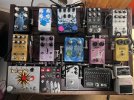
Pedals are also instruments! IMG_7792.jpeg
 
Pedals are also instruments! View attachment 3236755
Yes, pedals are an interesting sub-category which covers a wide spectrum too. At one end you have pedals that you simply turn on and they do something to the sound of the guitar. Chorus would be one example of that. At the other end of the spectrum you have pedals that need to be skillfully manipulated in real time - ie played - such as wah-wah pedals and loopers.
Anyway, I'd say it's true that electric guitars are not acoustic instruments in as much as they won't make sound without being supplied with electric power, but they are acoustic instruments in as much as they make sound and must be played by someone.
Programmed VST drums which exist inside a computer programme are definitely not acoustic instruments.
Electronic keyboards I'd put in the same category as electric guitars, ie, they need to be played by somebody so they are practically acoustic instruments.
 
Is the electric guitar an acoustic instrument or not?

That's why I was sufficiently cautious to say "for the most part". But speaking for myself only, I would say I don't have much doubt that it would normally be classed as electric, because that's how it is generally conceived, played, and heard. I probably wouldn't want to dissect much further than that; I'm certainly no musician, but I know of acoustic-electric guitars, John Martyn and his echoplex, and the use of electronic devices such as wah-wah pedals with acoustic as well as electric instruments. So very strict distinctions aren't always possible.

I also think (since you were asking me about this) that we both agree on having no objection to music made by electrical or electronic means: so as I don't own or play guitars, the question of what is and isn't acoustic isn't so important. I'll take the guitars as they come. As an aside, I believe there's some electric guitar on a few Billie Holiday recordings, as well as some Louis Armstrong recordings: probably recorded in the 1950s, though could be earlier. Their music is mostly acoustic, but the use of an electrically amplified instrument doesn't seem to have bothered them - and even if it did, it doesn't bother me. And it's appropriate to the history of 20th century music, whereby these instruments arrived and immediately began to blend in with the (non-classical) music that was being made at the time.
 
Last edited:
It’s within that viewpoint that we see many of our members frozen in their glory days, refusing new experiences and closed off to the possibilities of anything new. It’s easier for them to remain in the closed comfort of sentimentality, than remain open to new experiences. It’s intellectually lazy to proclaim that today’s music is terrible, because it takes absolutely no work to say “I like what I like and everything else is awful!” I find it ultimately more rewarding to try to maintain the curiosity and wonder that I had in my youth, to continue to be open to new experiences and try new things. It helps to maintain neuroplasticity and keeps me feeling younger, even when I’m now one of the oldest in the room at shows.
This
 
I thought I was done with this thread but this occurred to me, so here goes nothing...the main topic is the quality of "new music" and the teams seem to be old intellectually lazy boomers vs cutting edge diversifiers...I think it is unfair to throw a blanket over new music and say it's all bad, but what if the topic was "all modern country, or all reggae, or all rap, or all bluegrass, or any genre you want to insert?...no doubt there would be responses like modern country sucks, or rap is dangerous to society, or southern rock is for rednecks, or classical is for nerds, or traditional country is for hillbillies...and these responses would come from every age group on this forum...point is if we focus on genres vs all new music, we would all find ourselves pretty much in the same boat....now I'm done!
 
It’s within that viewpoint that we see many of our members frozen in their glory days, refusing new experiences and closed off to the possibilities of anything new. It’s easier for them to remain in the closed comfort of sentimentality, than remain open to new experiences. It’s intellectually lazy to proclaim that today’s music is terrible, because it takes absolutely no work to say “I like what I like and everything else is awful!” I find it ultimately more rewarding to try to maintain the curiosity and wonder that I had in my youth, to continue to be open to new experiences and try new things. It helps to maintain neuroplasticity and keeps me feeling younger, even when I’m now one of the oldest in the room at shows.
It's good to have friends from a range of ages and backgrounds. It keeps the mind fresh and pliable. :thumbsup:
 
Is the electric guitar an acoustic instrument or not? Personally, I'd argue that that's sort of a trick question. The electric guitar is only half an instrument. The amplifier is the other half. When you put the two halves together you have an instrument which makes sound and in that respect it's no different from a cello or a piano or whatever. It is capable of great subtlety as well as crushing brutality, it sounds completely different in different players' hands, and it needs to be played rather than programmed.

I'd be interested to know which category you would put it in.
I noodle around on my unplugged electric. You can hear the bends and vibrato. :thumbsup:
 
You know, I don't think that music is getting worse. There just seems to be more that seem to lack the 5-second "hook." I'm spoiled that way --- if the song hasn't hooked me in seconds, I usually move on to another. New or not.

The 5-second hook. :thumbsup:

____________

I like The Chemical Brothers' Galvanize because of that infectious riff.
I want to thank Michelin Tires for turning me on this tune. :)
 
Last edited:
Back
Top Bottom