• The move to the new server is done. There are some software and database maintenance updates in process. This has us passing the hat around to help out. We appreciate any donations. Seriously, even a dollar helps. The payment page may be found here - https://www.audiokarma.org/support.html

Will KEF Uni-Q Drivers be good for a speaker build?

Gtyler

Active Member
Hi,

I have always wanted to tackle a speaker build and do all the proper desing calculations to get proper results. I have been holding off because it is rather expensive to get really good drivers etc, but right now there is a local guy selling some KEF Uni-Q drivers (I think they were used in the IQ9). They are the right price, so if they would be good for a speaker build I would like to pick them up.
What do you think?
 
Register to hide this ad
They certainly can't be terrible with adequate implementation - I guess. ;) You will ideally want to know or measure the T/S parameters to decide wich kind of enclosure will suit them best, or at the least follow a KEF factory enclosure that is using them. Is the seller including crossovers? That can be somewhat of a big hurdle in the design process (even stock Xovers might require tweaking if anything differs in the design). This is something I just have to mention without making assumptions on your knowledge of this subject.

What kind of speakers are you looking to build, for which kind of room/application, SPL levels, music type and amplification? Are there any constraints regarding size or form factor? Care to give a budget estimate for this project? I'm certain you can get good recommendations from the many knowledgeable members here regarding either the KEF drivers or something else that might suit your criteria.

az
 
I have been doing some searching and I contacted KEF to see if I could get some T/S parameters for these drivers, but from the looks of things, I am out of luck. You mentioned measuring the parameters. Can that even be done without an expensive setup?
 
Well, if they are the drivers from the IQ9, it's just a smallish sealed enclosure that shouldn't need to be a very particular size. You'll probably not beat KEF at crossover design with extensive measurements, let alone without, so you'd be wise to just copy their crossover (http://www.diyaudio.com/forums/multi-way/191661-upgrading-x-over-my-kef-iq9.html). Looks like it uses some quite high DCR inductors, so you might have to add some resistors in there.

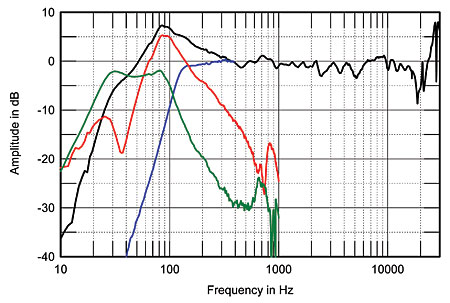
Here's the response (blue line):
206KEFfig3.jpg


Looks like you'd have to bring in a bass driver on a 4th order lowpass around 120Hz. That might be easiest to do with active subwoofers.

Btw, there's no such thing as just doing all the "proper calculations" and getting the desired results. Speaker design happens with measurements. Calculations are somewhat optional :D.
 
To answer the question you asked... Yes, the Keff drivers should be pretty good, but those particular drivers are likely to have diffraction artifacts in the tweeter response due to the woofer cone being used as a waveguide. Later UniQ drivers avoid this due to some better engineering. Those (edit- the IQ9 uniQ) would likely be similar to the Seas co-ax drivers, which are a little rough on top. Whether you can actually hear it...that's another question
http://www.madisound.com/loudspeaker_specifications/h1333_t18re_xfctv2_datasheet.pdf
the Keff Q100 on the other hand looks great, but you've got to have a serial # or pull from existing units.
http://zaphaudio.com/blog.html
(scroll down)

To answer the question you really didn't ask...there are tons of well known and respected relatively cheap DIY designs out there. Unless you want a new hobby within a new hobby, you should just build one of those. For example:
http://zaphaudio.com/BAMTM.html

A friend built these, and they sound quite good. The price is going to be a bit higher than estimated now, but quite reasonable for the sound you get.

If you do want a new hobby within a new hobby, speaker design is fun and will give you plenty to do for a long time unless you are already a trained engineer- lots to know. In which case, it's not all that $$$ to put together a measurement set up, if you shop carefully.

Zach
 
Last edited:
To answer the question you asked... Yes, the Keff drivers should be pretty good, but those particular drivers are likely to have diffraction artifacts in the tweeter response due to the woofer cone being used as a waveguide. Later UniQ drivers avoid this due to some better engineering. Those would likely be similar to the Seas co-ax drivers, which are a little rough on top. Whether you can actually hear it...that's another question
http://www.madisound.com/loudspeaker_specifications/h1333_t18re_xfctv2_datasheet.pdf
the Keff Q100 on the other hand looks great, but you've got to have a serial # or pull from existing units.
http://zaphaudio.com/blog.html
(scroll down)

To answer the question you really didn't ask...there are tons of well known and respected relatively cheap DIY designs out there. Unless you want a new hobby within a new hobby, you should just build one of those. For example:
http://zaphaudio.com/BAMTM.html

A friend built these, and they sound quite good. The price is going to be a bit higher than estimated now, but quite reasonable for the sound you get.

If you do want a new hobby within a new hobby, speaker design is fun and will give you plenty to do for a long time unless you are already a trained engineer- lots to know. In which case, it's not all that $$$ to put together a measurement set up, if you shop carefully.

Zach

Well, I'm in 3rd year mechanical engineering, so I'm not exactly a trained engineer, but I do have some understanding of frequency response, natural frequency, band width, etc, and how 1st, 2nd, 3rd,.... order systems respond. Also, I do like to do things the hard way. I guess I need to get some books though. I was under the impression that if the T/S parameters where know, it was mostly up to a bit of calculation to match up some drives after that. Any recommended books or resources?

Also, thanks for the links and the comments!
 
Close enough!

Well, I'm in 3rd year mechanical engineering, so I'm not exactly a trained engineer...Any recommended books or resources?...

Close enough! You won't even need to actually do the math, just understand how it works. There's plenty of freeware to take care of the numbers, not that you couldn't at your stage of your engineering education, but it would be extremely tedious calculating response frequency by frequency, yuck. (I'm about to finish an Engineering Associates Degree this semester myself, so I have an idea where you are.) :D

Books:
Speaker Building 201, Ray Alden.
The Loudspeaker Design Cookbook, Vance Dickason.
Testing Loudspeakers.

Also, this is a pretty great resource to get you started.
http://techtalk.parts-express.com/showthread.php?219617-The-Speaker-Building-Bible

It really is a pretty deep subject, though. A thorough understanding involves electronics, physics, acoustics, anatomy, and psychology. Good stuff!

Zach
 
http://www.audiokarma.org/forums/showpost.php?p=4908608&postcount=17

Some great links in this post by sreten. Look at the zaphaudio links in particular, to get an idea of state of the art.

IMHO speaker design, properly done, is the most underrated endeavor that the audio hobbyist can undertake. Unfortunately, the existence of pre-made crossovers, crossover calculators online, glowing reviews of project success, etc, perpetuate the illusion that it is simple.
 
http://www.audiokarma.org/forums/showpost.php?p=4908608&postcount=17

Some great links in this post by sreten. Look at the zaphaudio links in particular, to get an idea of state of the art.

IMHO speaker design, properly done, is the most underrated endeavor that the audio hobbyist can undertake. Unfortunately, the existence of pre-made crossovers, crossover calculators online, glowing reviews of project success, etc, perpetuate the illusion that it is simple.

I agree with all of this.

In particular, "...the existence of pre-made crossovers, crossover calculators online..." these are a recipe for wasted time and money. Thanks for mentioning it.

Minor aside:
Roger, any chance you're located near me? There's a small handful of us in these woods that I'm aware of. P.M. me if you are.

Zach
 
I bought them I couldn't resist

For the price I couldn't resist, and here they are. They are all new, and I got the lot for $40. I realize that I may not be able to use them if I can't find a way to get some accurate measurements from them, but for $40 I figured it's worth a try. Included are 4X SP1596 8" divers, 3X SP1588.2 6" drivers, 1X SP1537, and 1X SP1535. The 1596's, are used in the KEF Q900, the 1588.2's are used in the KEF Q300, and the 1537, and 1535 are used in iq9's. My hope is that I will be able to set ups some sort of measurement equipment so that I can design actively, and not just plug parameters in to a calculator, and hope for the best. If all else fails, I should at least be abel to get my money back for them.
picture.php


picture.php


picture.php


picture.php
 
P.S. Thanks for the great links. I have only had a chance to briefly gloss over them, but they look great so far.
 
Parts Express sells the woofer tester, usually for around $100, that will do all the measurements.

I believe that you can do your own measurements if you have a function generator (or signal gen + counter), DMM and maybe a couple precision resistors. I think that is all that is required, others posting in this thread would know. I have instructions on how do do this in books and/or journals. You could find it online most likely.

Or...you could reverse engineer the Q900. Dimensions would be easy, original X-over might require some digging but could be done.

EDIT: I just looked-up Q900 on eBay and found that it is not a simple 2-way. So scratch the reverse engineering suggestion, lol
 
Last edited:
Or...you could reverse engineer the Q900. Dimensions would be easy, original X-over might require some digging but could be done.

EDIT: I just looked-up Q900 on eBay and found that it is not a simple 2-way. So scratch the reverse engineering suggestion, lol

I suppose I could reverse engineer the Q300 though. It is a simple 2-way, and takes the 6" drivers I have.

q300.jpg


I think I want to go bigger though. Maybe as a fall back, or maybe I could do a set of those to get me started, and use the 8" drivers for a larger project. Anyone have a Q300 that wouldn't mind taking some detailed measurements, and pictures of the X-over?
 
Last edited:
Dude, in case you don't know it already...you got a screaming deal there! The drivers you got one each of are surely pretty good, but the others are going to make superb speakers with the right design.

You really don't need much to get started with measurements.

Do you have a desktop computer with a full duplex sound card? (most any pci card will be full duple, and some onboard may be.)

Otherwise you can get by with a USB or firewire card, but some measurement software is touchy about those.

You need:
Sound card
Pre amp with phantom power (sometimes combined with USB/ firewire card, and a handful of pci cards)
omnidirectional condenser measurement mic (preferably with calibration file, but not required to get within tweaking distance of a final design)
most any class a/b solid state amp
a few resistors (often built into a jig)
software (lots of free stuff out there)
odds and ends of hook up wire.

read, read, read. do

another great link
https://sites.google.com/site/undefinition/diy-gettingstarted

Zach
(hopefully I didn't forget anything- it's early.) :D
 
Parts Express sells the woofer tester, usually for around $100, that will do all the measurements.

I believe that you can do your own measurements if you have a function generator (or signal gen + counter), DMM and maybe a couple precision resistors. I think that is all that is required, others posting in this thread would know. I have instructions on how do do this in books and/or journals. You could find it online most likely.

Or...you could reverse engineer the Q900. Dimensions would be easy, original X-over might require some digging but could be done.

EDIT: I just looked-up Q900 on eBay and found that it is not a simple 2-way. So scratch the reverse engineering suggestion, lol

I can't recommend the woofer tester, personally. If you've got a full set up, it's not needed, and if you want to do design, you need a full set up. Some use it as a quick way to get woofer parameters, but that's just that much more $.

You can do woofer measurements for box design the way you propose, but as a practical matter no one does. tedious. software is the way to go.

Were I in Tyler's shoes, I'd be considering a "three way" with an actively powered sub in each cabinet. Such as the Dayton RSS210HF-4 or HO. Would dig fairly deep in a small package. The subs will play cleanly enough high enough in frequency to mate up with the Kef's. You want to relieve the Kef's (even the 8's) of some excursion requirements since even though they are relatively large they were not likely meant for large excursions, and will play nicer even if they were. Duplicating the Q900 would be a trick considering it appears to use 3 active woofers which would likely be 12r- not common.

He could do passive, but the XO parts involved will be pricy to cross low, and some of those funds can go toward relieving the main amp of some load.

Many many, possibilities with these drivers.

Zach
 
Were I in Tyler's shoes, I'd be considering a "three way" with an actively powered sub in each cabinet. Such as the Dayton RSS210HF-4 or HO. Would dig fairly deep in a small package.

Yes this is exactly what I was thinking too, except I don't mind having a larger package size, so if it would help I would consider larger subs too.

Duplicating the Q900 would be a trick considering it appears to use 3 active woofers which would likely be 12r- not common.
I was looking at this speaker earlier to get some ideas, and actually it has just one active woofer, and two passive radiators.
 
Yes this is exactly what I was thinking too, except I don't mind having a larger package size, so if it would help I would consider larger subs too.


I was looking at this speaker earlier to get some ideas, and actually it has just one active woofer, and two passive radiators.

Bigger could be better it depends on your goals. I didn't look closely at the Q900. The presence of one active 8" and 2 PR's makes sense from a constant directivity perspective. That's pretty much what I recommended except using PR's instead of a port. Bigger driver = more volume displacement = higher max output, given the same Xmax, so if you want loud, that's likely the ticket. Using an 8" helps ensure that the the "sub" and mid/ tweeter are radiating the same overall output in terms of direct vs reflected sound. this has an effect on perceived timbre, and is more important with acoustic instruments.

Going back to the first respondant's very good questions, audiozaz asked all the right questions, "What kind of speakers are you looking to build, for which kind of room/application, SPL levels, music type and amplification? Are there any constraints regarding size or form factor? Care to give a budget estimate for this project? I'm certain you can get good recommendations from the many knowledgeable members here regarding either the KEF drivers or something else that might suit your criteria."

We need to know this stuff before we can make really good recommendations.

Zach
still more to say, but I have got to do some work. :D
 
I'm going full heretic....

As a mechanical engineer you will just absolutely love the "art" portion in the science of speaker building. There are no optimum solutions...just a continuum of compromises within a range of a acceptability that you define. Sort of like making chili... What is the ASME standard for chili? Look it up!

I suggest you look at mini-DSP since it will allow you a tremendous amount of flexibility to play with the drivers you have. Yes, you will spend more on amps but they are getting cheaper and you will have more or less a lifetime to spend on figuring out how to make it work best....but you will figure out basics in a few hours. Considering that you have a nice collection of drivers and zero crossover parts, you might as well go electronic from the start. 2x4 to start for stereo 2-way...

Regarding measurement gear, if you are going to geek out, consider the omnimic system....

http://www.parts-express.com/pe/showdetl.cfm?partnumber=390-792

Never tried it myself but it looks sweet.....

Good luck.
 
Going back to the first respondant's very good questions, audiozaz asked all the right questions, "What kind of speakers are you looking to build, for which kind of room/application, SPL levels, music type and amplification? Are there any constraints regarding size or form factor? Care to give a budget estimate for this project? I'm certain you can get good recommendations from the many knowledgeable members here regarding either the KEF drivers or something else that might suit your criteria."

We need to know this stuff before we can make really good recommendations.

Zach
still more to say, but I have got to do some work. :D

Looks like I have some questions to answer.

What kind of speakers are you looking to build?:
I want to build music speakers. No theatre sound system or anything. Just music. I want speakers that are as precise as possible. People use the word transparent, and I think that is a good one. I realize that is a tall order, but i will try my best. Also, my primary source is my turntable, and therefore I would like to keep things analogue.

for which kind of room/application?:
I don't have a music room right now, but eventually I would like to have a room with some proper sound deflectors and bass absorbers etc. For now it's just a living room. Not small, not large.

SPL levels?
I do like to listen to music loud, but not party, or theatre, or concert loud. I wish that I had a dB meter so I could give you an actual number. Basically when I go to the theatres and watch a movie, I think it is far too loud, and I would never bring my home system to similar levels. Maybe I can find a way to take some measurements, and get back to you on this one.

music type?
I listen to a bit of everything. Right form Opeth, to Tchaikovsky. Mostly I listen to alt rock, and prog rock, but I frequent vocal jazz, and oldies. Mostly I just want to hear the intricacies of the music whatever it may be.

amplification?
I have a Yamaha C4, B4 combo that I am using right now. Normally I use my Cambridge Audio A75, C75 combo, but very soon I will be getting a Meridian 101/103 that will be my main amp.
Like this
101_105_front2.jpg


I suggest you look at mini-DSP since it will allow you a tremendous amount of flexibility to play with the drivers you have. Yes, you will spend more on amps but they are getting cheaper and you will have more or less a lifetime to spend on figuring out how to make it work best....but you will figure out basics in a few hours. Considering that you have a nice collection of drivers and zero crossover parts, you might as well go electronic from the start. 2x4 to start for stereo 2-way...

These things look fantastic!! Only problem is I would really like to eventually end up with a finished speaker that could be used with a stereo amp. I think that I will make it bi-wireable, but I would like a finished and enclosed speaker system. I guess that pretty much means passive X-overs. So now the question is, can I use a MiniDSP to tweak and design my X-overs to my liking, and then once I am satisfied build my X-overs modelled after the digital version? Would that be impractical, or difficult to go form the digital to analogue design?

 
Back
Top Bottom