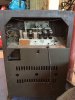
I can't speak to the inexpensive variac, but I revived an old Hammond organ in the following fashion:
Look under the chassis for any cracked insulation on the wires. Replace any that look suspect. Then -
If the radio has a fuse, make sure it is good, and I would put in the fast-blow version even if it calls for a slow blow.
Plug radio into variac, plug variac in, turn everything on. Start with the variac at zero Volts! If the variac does not have.a voltage meter, connect a DMM across the incoming voltage to the radio in as safe a manner as possible. Walk the variac voltage up to ten volts or so. Let it sit 5 - 10 minutes and walk it up to 20. Each time you up the voltage keep your hand on the can cap on the left side of that chassis (looking at it from the back), and make sure it is not getting warm. If all is good so far, after another 10 minutes, walk it up to 30 Volts. Wait ten minutes again, check the filter cap for heat, if cool, go to 40 Volts. Keep repeating the process until either the fuse blows (You should probably start to notice heater glow about 60 Volts, sooner maybe if they are low-voltage heaters), or the filter cap starts getting warm, or you reach 110 Volts. If you make it to 100V without the fuse blowing or the can cap getting warm, test the radio for function. If all is well, power it down and replace that can cap anyway. If the fuse blows, replace the can cap and start the process over again from 0V. If the can cap gets warm before or after 110V, stop, replace the can cap, and start over from 0V. Sense a common theme here? Replace it now, or after a successful test to 110V, but replace it either way.
Good luck, and personally, I wouldn't buy a variac that didn't have a built-in voltmeter.