• The move to the new server is done. There are some software and database maintenance updates in process. This has us passing the hat around to help out. We appreciate any donations. Seriously, even a dollar helps. The payment page may be found here - https://www.audiokarma.org/support.html

X-202: one tube suddenly redplating!

ssouci

Well-Known Member
HELP!

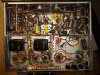
I recently did some work on my Fisher X-202

upon turning it back on, it started playing, but it sounded odd and I heard a lot of general distortion (at least in the R speaker, which I was sitting beside)... then I noticed one of the four output tubes was glowing BRIGHT RED, so I immediately turned the amp off... YIKES... had it on for perhaps 1 minute(?), after the soft-start completed

it all happened so quickly, but it seems that only one tube redplated

after turning off and waiting a minute or so, I touched all tubes... 3 were only slightly warm, but one was noticeably hot (the redplating one)

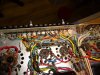
the work I performed was bypassing / disabling all of the slider switches (which I always kept OFF anyway), in an effort to take all dirt-prone switch contacts out of the signal path permanently... in each case, I modified so that the normal state was now permanent OFF, and putting the switch to ON would do nothing

I did these switches:
1. Phase Reverse (wired the R speaker "directly", same as the L)
2. Tape Monitor (relocated wires on switch)
3. High Filter (relocated wires on switch)
4. Low Filter (placed jumper wires across terminal strips, where long wires leading to switch originated)

(did not do Center Channel switch, because OFF state seems to be signal not passing through any contacts)

the amp was playing FINE before the work, so I'm guessing I disturbed something, or made a mistake... I checked my work carefully, but who knows?... or perhaps overheated an attached component while soldering? (carbon resistor, ceramic cap)

NOTES:
- tube ID that redplated was "V12"
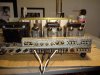
- output tubes are vintage Russian equivalents to 7189s (the 10,000 hour ones)... they have maybe 1,500 hours now
- this amp was modified earlier with individual tube biasing... I've always biased the tubes precisely (~29 mv), and don't think I accidentally disturbed any of the bias setting knobs when I was working (since they are so inset)

Q: what could have possibly gone wrong, and how should I proceed... hopefully so that I don't wreck my amp or the output tubes!?

thank you!
 

Attachments

  • 2020-02-03_1449.png
    2020-02-03_1449.png
    400.9 KB · Views: 18
  • DSC08863.JPG
    DSC08863.JPG
    149 KB · Views: 20
  • DSC08862.JPG
    DSC08862.JPG
    124.3 KB · Views: 18
  • DSC08904.JPG
    DSC08904.JPG
    97.3 KB · Views: 19
  • DSC08893.JPG
    DSC08893.JPG
    111.2 KB · Views: 19
  • switchbypass.png
    switchbypass.png
    731.6 KB · Views: 16
Last edited:
Register to hide this ad
I see you biased the tubes to 29mv. Do you have cathode resistors to check the current? I tend to monitor the current rather than the bias voltage.
 
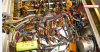
Tim. The cathode resistors are circled in Red. 10 ohm. (See pic)

sscouci: couple of items to check. The tube that redplated "BRIGHT RED"(your quote) is history, replace it. Then do the following to rule out or rule in ciruitry as a cause. It could very well been the tube running near max dissipation and up and quit.

Check the condition of the cathode resistors (check for continuity or other open), also the pots.

If the pots and the cathode resistor are ok, check the condition of the socket connections and the leaves themselves. Clean with DeOxit and a interdental brush. Do the same with the tube pins.

swap the tube in V12 to any other socket and power up. If the redplate moves with the tube, the tube is the problem, if it doesn't the socket or circuit is the problem. You'll have to re-bias those two tubes for each swap.

x202.jpg
 
Last edited:
sscouci -- As a most basic guide of troubleshooting your issue, something happened with the circuitry associated with pin #2 of the tube that red plated. Now besides the usual checks for shorts, lose connections, and physically damaged components that relate to that particular terminal, that can also include (in no particular order):

1. A dirty or defective DC Balance control for channel B.

2. A broken, dirty, or lost-tension receptor terminal at pin #2 in the relevant tube socket.

3. A defective tube, with an internally broken or intermittent pin #2 connection inside.

That's really it. The bias supply is fine -- or else the other tubes would have red plated as well. The bias control for channel B is also fine -- or else the problematic tube's mate would also have red plated. A lose connection or circuit failure on any other terminal of the tube would would have caused the opposite problem to occur -- very little or no current to flow through the tube at all, which is not your problem.

For it to be #1, the outside terminal of that control that serves the tube in question would have to have lost its connection with that end of the carbon track within the control -- probably the least likely scenario. It cannot be a problem or the usual "dirty" control where the wiper losses contact with the carbon track -- of else the problematic tube's mate would have also red plated. Some aspect of #2 is always possible, and don't discount #3 either. Shake the tube and see if anything rattles inside the tube that might have shorted pins 2 and 3 together when you turned the amplifier up-side-down.

Finally, check the negative bias voltage appearing at pin #2 of the target tube. It should be within a range of (about) -10 to -13 vdc if all is good and stable in the wiring up to pin #2 itself.

No doubt you will find the problem somewhere in these areas.

I hope this helps!

Dave
 
thanks everyone!!! -- I will dig into all this asap

Larry:

RE: "The tube that redplated "BRIGHT RED"(your quote) is history, replace it..."

--> really?... I've seen of several cases online where people had redplating, but were able to continue using the tube... if it's toast, then I can't really proceed with my troubleshooting tests, since I don't have a backup tube (I only have a "regular 6BQ5" Russian, not another heavy-duty equivalent that can replace 7189)
 
thanks everyone!!! -- I will dig into all this asap

Larry:

RE: "The tube that redplated "BRIGHT RED"(your quote) is history, replace it..."

--> really?... I've seen of several cases online where people had redplating, but were able to continue using the tube... if it's toast, then I can't really proceed with my troubleshooting tests, since I don't have a backup tube (I only have a "regular 6BQ5" Russian, not another heavy-duty equivalent that can replace 7189)

I have sometimes seen tube survive brief redplating. In any case, you can surly use it for troubleshooting. DCGillespie is one of our resident experts, follow his suggestions. It is possible to pull all the output tubes, (mark or keep track of the one that redplated) and turn the amp on. You can then check the gid pin on all the output tubes to see if V12 is substantively different from the other 3. You can also populate V9 and V10 with the tubes that were in V11 and V12, leave sockets V11 and V12 empty. If it still redplates it is the tube and indeed it is toast. If it does not redplate, there is a circuit issue.

Shelly_D
 

PROBLEM SOLVED!!!


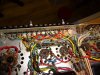
I removed the bottom cover and looked around the V12 socket area...

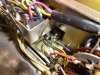
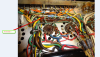
noticed that one of the resistors (that I had replaced a couple of years ago when doing the restoration) was bent down and shorting out on an adjacent terminal on the terminal strip!... I simply had to bend the resistor out of the way, and re-positioned it so it can no longer make inadvertent contact

that resistor was connected to pin 2 of V12

SEE PHOTO below

I must have accidentally pushed down on this resistor when I was doing my recent work (described above)

I checked for any other similar scenarios around all 4 output tubes, and also visually checked and measured the value of it and all the similar resistors... all seemed to be OK, including the one that caused the redplating

I visually inspected the redplated tube and compared against the others in the quad... it looked identical, except that the top mica was slightly more yellow/brown... not sure if that was caused by the redplating (duration ~ 20 secs), or, because this particular tube was made in a different year??? (dated 1991 vs. 1990 for the other 3 in the quad)

the plates visually looked the exact same in all four tubes, and I couldn't see anything else "weird" in the redplated tube

then I started up the amp... no more redplating!...

then I let amp warm up and checked bias (note: bias was last set 8 mths ago with all four set to 29.0mv, and adjuster pots have NOT been touched since)

bias readings as-found:
28.2 / 29.6
29.2 / 29.2*

for the heck of it, I readjusted bias to:
29.8 / 29.5
29.2 / 29.5*

* denotes redplated tube

amp was then run with music playing, and it sounds *excellent*... no issues I could detect, the R channel (with replated tube) sounds fine... the redplated tube looks fine running, no more redplating

boy this amp sounds nice, and I could swear that bypassing all those slider switches has resulted in better sound (crisper, more detailed)... regardless, I no longer have to think about maintaining any of those slider switches, plus they cannot be inadvertently switched or left on

so I'm pretty happy!

(I still have my "sound bleeding at zero volume" issue, but that's another issue and I don't know if I even care too much about that)

QUESTION: is there a chance the redplated tube can safely be used, or do I definitely have to replace it?

so, a big THANKS to all of you that helped me out... AK is amazing.........
 

Attachments

  • shorted_lead.png
    shorted_lead.png
    690 KB · Views: 13
Last edited:
Glad you got it resolved! All you can do is watch that tube carefully for a while. If it remains stable over time (next month or so depending on how much you operate the amp), then just maybe you dodged a bullet!

Dave
 
Glad you got it resolved! All you can do is watch that tube carefully for a while. If it remains stable over time (next month or so depending on how much you operate the amp), then just maybe you dodged a bullet!

Dave

thanks Dave!

I've heard that those particular Russian tubes are quite tough... these are the special 10,000 hr version, apparently "military rugged", and they have thick glass... so who knows, maybe that tube has survived with no damage?

I suspect that at minimum, it might have lost a bit of its rated lifetime, through accelerated emissions that occurred from the plates during redplating? (I surely don't know enough about tubes to judge that though)
 
Back
Top Bottom