• The move to the new server is done. There are some software and database maintenance updates in process. This has us passing the hat around to help out. We appreciate any donations. Seriously, even a dollar helps. The payment page may be found here - https://www.audiokarma.org/support.html

XRT20 Speaker System Restoration (and questions)

Did you check the electrolytic caps while you had the woofers out? In a previous thread I documented the correction of crossover issues in similar vintage Mac speakers caused by tired caps which caused driver blending problems. Could easily be your midrange issue.
Ah, that's good to know. Is there by chance a schematic or parts list for the crossover? When I opened it up I did peer back there but didn't closely examine the crossover. I noticed some yellow poly caps for the higher frequencies and a bunch of power resistors. I assume the xover is just screwed in?
 
I have finally got the circuit diagrams scanned and emailed for both the early and late models. The crossover for the later model run is much more complicated and so I included the parts list. I am hoping to soon update a pair here locally to the later design as a part of a complete system update.
 
That is a killer set of speakers and looks as if you are doing a great job of restoration. Hopefully, some day you will have an an MC7270 or MC500 or other McIntosh amp to drive them. Enjoy!!
 
It's great to read about someone else's experience with these babies. I refoamed mine and drive them with an MC 2205. I would love to have the above mentioned crossover schematics so I can properly recap them. The midrange seems a little thin. I have augmented my set with (horrors!) a pair of Altec horns driven by my MC 240.
 
I always measure room response first. There is only 1 electrolytic C4 in the early version (1st 1000 pair) and the later had 3. All are 50mfd.

If you document the speakers response curves you can see the holes caused by crossover issues as well as those caused by boundry interaction and room nodes. These speakers were expected to make use of the MQ104 or 107.

When I posted about the recap on stacked 16 pairs and single 14s I included curves highlighting the shifted crossover points caused by a bad cap in one 16 and both 14s. We of coarse replaced all electrolytics in all the speakers which is now probably the correct action for all these 30 year old speakers.

Even though tweeter columns dominate visually I still believe the 8 inch drivers are the most important sonically.
 
Last edited:
I had the back plates off and I thought I saw a goodly number of caps, there's a maximum of only 3? Mine is the earlier version with the crossover mounted to the terminal plate so it's more likely there's only one...

I was also unaware that the XRT's required an equalizer.

While my current listening space is laughable, the house I lived in previously was ideal. The room was 16' by 20' with 12' cielings, wood foors and lath and plaster walls.
 
The early units had many metalized polystyrene caps (very, very, rarely a problem) and only 1 electrolytic. This is part of the shaping circuit of the 8 inch mid driver. The later models had a crossover similar to the XRT19s which also had the shaping circuit AND changes to the inductors and 2 additional electrolytics to limit the upper response of the lower woofer.

I thought it was, or a least was becoming, common knowledge that all these 20, 30 year old electrolytic caps either need or should be replaced in both electronics and speakers.

To pull a woofer for refoaming and not refurb the electrolytics in the crossover and replace the flakey binding posts, is a false economy

Over the last few months I have been inside 5 pair of ML and XR speakers and all had elecrolytics with issues or outright failure. I have posted before and after voicing graphs of the XRs documenting these refurbs.

I have already expressed my amazement in the improved performance by recapping both equipment and speakers and hope to continue to back up what I have heard with actual tested documentation from either my test bench or speaker measuring equipment.

Have you read McIntosh's white paper on their speaker design philosiphy? I think it makes it quite clear that McIntosh speakers DO NOT NEED an eq but are designed to accomadate one IF your room and speaker placement demand it.

They and their dealers, back in the 70s, went through the extraordinary step of designing the equipment and then training their salespeople and techs to go visit you in your home, measure the interactions both good and bad of your speakers and room, and then help you make the corrections needed. These corrections involved speaker and furniture placement, wall hangings and treatments, and yes, the use of MQ104 and MQ107 parametric equalizers.

I still find it amazing of how resistent most are in not making use of this extraodinary service and capablity, both today and in the past. When Gordon Gow or Dirk Roos would come to our storefront they always wanted to see the voicing curve of the system that would be representing them and supporting their seminar. (Also the turntable setup).
 
There are 3 electrolytics in the later version - the earlier version only has the one 50uf/100v electrolytic.
Remember that these are non-polar caps.
There are also 3-8uf and 2-12uf poly film caps in the early version and 5-8uf and 1-12uf poly in the later version - I suspect that these will not need replacement but I'll be replacing mine due to my OCCRD (Obsessive Compulsive Capacitor Replacement Disorder).

Attached is a PDF of the XRT20 crossover schematics courtesy of "c_dk".
 

Attachments

I would document what actually is happening before hoping to correct what might not be correctable with cap replacement.
 
I would document what actually is happening before hoping to correct what might not be correctable with cap replacement.
Good point.
I'll endeavor to create a basic response curve using a frequency generator and my SPL meter for each individual speaker.
 
1/3 octave pink noise should be used. A copy of Mac graphing paper is posted in Mac Teck sticky along with white paper reprint.
 
The early units had many metalized polystyrene caps (very, very, rarely a problem) and only 1 electrolytic. This is part of the shaping circuit of the 8 inch mid driver.

Thank you, that explains what I saw. Six years ago when I acquired the speakers I was unaware of the distinction.

I thought it was, or a least was becoming, common knowledge that all these 20, 30 year old electrolytic caps either need or should be replaced in both electronics and speakers.

I have you guys to thank for knowing that now

To pull a woofer for refoaming and not refurb the electrolytics in the crossover and replace the flakey binding posts, is a false economy

Agreed and seconded

I have already expressed my amazement in the improved performance by recapping both equipment and speakers and hope to continue to back up what I have heard with actual tested documentation from either my test bench or speaker measuring equipment

Have you read McIntosh's white paper on their speaker design philosophy? I think it makes it quite clear that McIntosh speakers DO NOT NEED an eq but are designed to accomadate one IF your room and speaker placement demand it.

As a musician, I realized long ago that you actually play three things; The instrument, the music, and the space you're in.

Again, Thank you for your insight and the benefit of your experience.
 
After some additional critical listening I've determined that most of the abnormality I'd been hearing regarding the midrange was in fact primarily due to the electronics (in this case my Pioneer SX-1980) and not the speakers themselves. The right channel has a hole in the midrange and I suspect that somehow the right channel is bleeding over to the left. I'll have to track that down with my frequency generator and oscilloscope. I knw it's in the preamp section - I removed the jumpers and used an external preamp which cleared up the problem. The joys of vintage gear!

I replaced the SX-1980 with my Pioneer SX-D7000 and the sonics were much improved though at only 120 per channel I have to be careful playing it loud.

I know that many in this forum will recommend that I upgrade to McIntosh electronics but frankly I don't think that is in the cards, primarily for economic reasons.

I had gone ahead and measured the frequency response of the speakers which is what ultimately lead me to the conclusion regarding the electronics - so unfortunately those measurements are not valid.

I replaced the 3 - 50uf/100v caps in the crossovers. The originals were 10% tolerance; I replaced them with Erse Audio 5% parts.
I measured the old caps and found them to be between 10%-20% high in their values; not horrible but some were certainly on the way out.

While originally I was planning on replacing the poly film caps I've decided that there is no significant advantage in doing that - so the originals will remain.

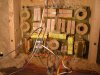
Below is a picture of the crossover while still installed in the cabinets for reference.
I've circled the 3 original caps prior to their replacement.

Next step is to give these some more critical listening and then I'll do some new weasurements to determine what (if any) equalization is necessary.



attachment.php
 

Attachments

  • XRT20_Xover.jpg
    XRT20_Xover.jpg
    106.4 KB · Views: 288
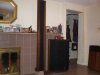
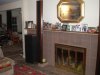
You posted a picture of the system which showed the LH woofer cabinet quite near to an open doorway. Under most circumstances this would mean setting the MQ's bass compesation at 3-4 with the 20s with smaller 16s at 4-5. What is the relationship with the RH speaker with the room boundries?

Did you run the speaker curves at the listnening position, does it take in all the room issues? Doing it at one meter, like in a manufacurer's test rig, will tell you nothing but what might have changed, unless its a before and after the cap replacement.

You should still post the curves or email them to me if you think they are too ugly...I can assure you I will have seeen worse.

I had a customer who sucessfully ran a pair of 20s for years with a 75 watt MA6200 with no issues. When he started to see PG more often as his music tastes grew.. and he played it louder, his wife purchased for him a new MC2255 as a birthday present.
 
Here are 2 more pictures of each speaker to illustrate the environment a bit better.
Ignore the mess, it was at 5:30 AM as I was going to the airport for another work adventure.

I'll try to get the frequency response done and posted over the weekend.
 

Attachments

  • P9201973.jpg
    P9201973.jpg
    56.2 KB · Views: 115
  • P9201974.jpg
    P9201974.jpg
    69.6 KB · Views: 106
Back from my road trip of the week (Sioux City - woohoo).

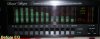
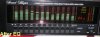
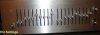
I decided to use the RTA on my ADC SoundShaper along with it's internal pinknoise generator to run some tests. I know this is hardly laboratory quality and the external "calibrated microphone" isn't going to be that great either but I figured it would get me in the ballpark.
I found that the bass needed attenuating whereas the highs needed some boost.

First picture is the before, 2nd is the after and the third are the EQ settings I used to get there.
I like the bass bump and the rolloff at 16K doesn't concern me much since my hearing stops at about 15K.

Now time for more listening tests :banana:.


attachment.php


attachment.php


attachment.php
 

Attachments

  • P9231987.jpg
    P9231987.jpg
    43.6 KB · Views: 229
  • P9231989.jpg
    P9231989.jpg
    46.4 KB · Views: 228
  • P9231990.jpg
    P9231990.jpg
    32.4 KB · Views: 227
I could do that - use the analog meter and my frequency generator.
Not sure when I'll get the opportunity - requires the spouse to leave the house.
 
She can handle 1/3 octave pink noise at 80 dB. When I would go to out of town clients homes I would often bring my wife along. She calls it "doing that whistleing thing".
 
Last edited:
In my research I find evidence that the 12" woofers on some of the McIntosh speakers were treated with some sort of a "dope".
I found this thread on the XR-6 speakers, specifically posts 17, 26, 27 and 29 lead me to this conclusion.
None-the-less it appears that nobody thinks it is important to redope the speakers after a refoaming so I will continue that trend.
Here's an update - I found a reference on the Rodger-Russell site talking about the treatment used on the woofer surrounds:

The surround is still foam but a protective coating of diluted Airflex 400 was painted on the outside of the surround.

See the information under "12" Woofer 036-047" about midway down the page.
 
Back
Top Bottom