• The move to the new server is done. There are some software and database maintenance updates in process. This has us passing the hat around to help out. We appreciate any donations. Seriously, even a dollar helps. The payment page may be found here - https://www.audiokarma.org/support.html

Yamaha CR-820 worked for a day

Ramblerman

New Member
I just picked this up on eBay. It worked great and sounded great for a day. I came home from work the next day and it wouldn't turn on. I took the case off and found the main fuse was blown. I replaced the fuse and crossed my fingers. About 2 seconds after pushing the power button, the fuse blew again.

I'm no electrical engineer. Quite the opposite, I'm a software developer. But I am technically minded and can follow instructions, even if they get complicated. Can anyone help me bring this thing back from the dead? It looks and sounds gorgeous (at least it did) and I'd like to learn more about working on these. Where should I start? (other than at a repair shop...)
 
Register to hide this ad
Something is shorted obviously. So....I´d be check´n
A. The output and driver transistors
B. Power supply components ie capacitors and semiconductors.
 
Hello Ramblerman. Welcome to AK. The Owners and Service manuals are at HiFi Engine.com. Just register and download.
 
As previously suggested, down load the service manual. Familiarize
yourself with the different sections, amp layout, board layout, schematic,,,
Open up the amp, again familiarize yourself with the different boards etc...

Visually check for any bulging caps (receeding outer plastic sleeve) and
charred/discoloured resistors.

Blown fuses normally mean a low resistance path to ground, ie a short. Or
it could just mean that the CR is drawing more current than intended due to
a failing components as suggested above.

You could try measuring the resistance between the fuse/fuse holder(red probe)
and the chassis/black speaker post (black probe) with the unit powered off/unplugged.
This is wishful thinking but would be good to eliminate. It will probably just
charge up the main filter caps. Likewise you can measure resistance from the +30 pin
on the main board again to ground.

The CR appears to have at least 4 fuses F801,2,3,4. Good to get confirmation which
is blown, expect F801 or 2.

Diode check(see below) TR806 and D804, in circuit is ok.
Visually inspect R813(3.9K), R814(2.2k) and FR801 for burn/char.

Probably best to build yourself a Dim Bulb Tester (DBT), a current limiting device.

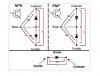
Below is a brilliant graphic from markthefixer explaining how to diode check a
transistor, the different colours refer to MM probe colours.

DiodeTest.JPG
 
Thanks for the tips, guys. I'll download the service manual and take a closer look at the caps and resistors. I'll report back with what I find. It may be a few days. Life has been keeping me busy lately.

Ray
 
Back
Top Bottom