• The move to the new server is done. There are some software and database maintenance updates in process. This has us passing the hat around to help out. We appreciate any donations. Seriously, even a dollar helps. The payment page may be found here - https://www.audiokarma.org/support.html

Yamaha GT = Gigantic and Tremendous!

I'd say that any turntable which the build quality exceeds the value of the coin dropped is a great buy.

Agreed.

The 2000 arm sounds amazing once the turntable is isolated correctly. It could be bettered but it is not the turntable's weakest link. Of course, if one has never isolated their GT 2000 correctly, one would not be aware of that.

So other than the isolation issue, what's the weakest link if any in your opinion?
 
Agreed.


So other than the isolation issue, what's the weakest link if any in your opinion?

More than likely the arm. My point is that with the isolation correctly addressed I get better sound via the GT 2000 with the stock arm than I've heard via the Regas and SME Vs that I've heard on other turntables like Michell Gyrodeck and Aura in other systems(plural). I can make my GT with stock arm sound worse by detuning my isolation. By worse, most people would be very happy with the sound of it. I'm not, because I know what it is capable of with correct isolation and can't live with the lack of the same now that I've heard the difference.
 
The strong point of the turntable is the motor & control (coreless motor with bidirectional servo and big platter). Yamaha clearly designed this as a modular system where users would be induced to spend money on various upgrades: power supply, feet, tonearm, platter, etc.

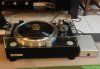
The arm in particular can be upgraded. As drop-in replacements, Yamaha had two other models and SAEC made 407GT. There are also aftermarket arm boards available. Here's mine with FR64s - earlier attempt with FR64fx didn't work as the anti-skating mechanism would always touch the large platter. I also have an arm board for SAEC 407/23, but that requires enlarging the arm hole a bit. Others have mounted Technics EPA100 and Dynavector DV505, for instance.

A more radical approach is to replinth:
GT750 with new plinth & Reed 3P


But a close friend of mine, for example, who has had 2000L & 2000X ended up preferring his other table featuring classic Ortofon arms and Regas. He was of opinion that the GT arms just didn't cut it. The table itself is great, no doubt.

Haven't done that comparison, but both my wife & I thought the GT2000 + FR64s was more refined & dynamic than our Garrard 401 + Jelco 750L with everything else the same, incl. SPU Gold cartridge. My wife much preferred the GT2000 + FR64s. How much of that is table vs. arm vs. plinth is anyone's guess.
 

Attachments

  • Screen Shot 2014-12-07 at 16.19.43 .jpg
    Screen Shot 2014-12-07 at 16.19.43 .jpg
    35 KB · Views: 52
That's some nice table you assembled there Plato. I agree that the GT table's strong point is the motor & control; and the quality of such if obtained in current-production tables could potentially be in the entry ultra high-end realm.

Always desired the SAEC arm, but didn't think it was worth the coin for a 750. I somehow recall a brief mention by another owner that even the SAEC arm 'isn't all that' though. I could be wrong.

What's your thought on the stock arm though?

Obviously you feel it can be improved further by replacing it with another arm like that FR64? I note the FR alone costs probably more than the GT2000 table itself. Probably 3 times more than the Jelco.
 
I found that an auralex gramma base to be really beneficial on my sp25 table. Tons are out there used. I got mine for only $35 shipped and it was in mint cond. other than the box. My friend brought over his 20"x15"x3" maple block and we found the difference to be subtle and he paid $120 for his block. We both def. found the bigger difference to be no base to gramma than gramma to maple block.

I'm not a fan of auralex bass traps. I def. like gik and real traps but I have mo pads under my a7x's, subdude under my sub8 and the gramma under my TT and all 4 used less than $100 and for sure my best bang for buck accessories.
 
The real strength of the GT 2000 must be the motor and motor control electronics.

With the Direct Drive principle one is stuck with the motor noise and the inaccuracies of the motor control electronics as they provide the control for the motor. There is no escaping the motor issues because the motor bearing spindle is the platter spindle and the same goes for the motor control electronics because the motor spindle is the platter spindle and not a separate entity. All of the flaws of the motor and the control electronics are directly passed-up to the platter. There is no place to hide. No duality of motor spindle and platter bearing spindle to buffer the motor/motor electronics problems and separate those problems from the record/stylus interface.

If the GT 2000's motor and electronics were grossly noisy or defective I would not be getting the results I am getting with my isolation efforts. The gains from the isolation would be simply swamped by the crap coming up from the motor. That's why I'm certain that the GT's motor is the pearl in the GT oyster. I think that the plinth could be improved, but again, like the arm If the plinth was another terribly weak link I doubt that the isolation gains would be so superb. One is stuck with the arm and the plinth(as stock) and they are both as stock in my situation and I'm getting amazing sound from the properly isolated GT 2000.

Notice that I'm saying 'correctly', 'properly' and that I've acknowledged that I can 'detune' the isolation and essentially lose all of the gains. It is not just a matter of having 21 Clearaudio Magix. It is not just a matter of having a cup and ball application in conjunction with the Magix array. Everything hinges on level, placement of the individual elements and load. That means exactly where the Magix are placed. Exactly where the cups and balls are placed and exactly where the GT 2000 is placed. it also means dealing with the non-infinitely compliant fixed power cable, the cable to the outboard power supply and the arm leads. They all 'pull' on the isolation. They interfere with the free motion of the isolation if not taken into consideration.

Then we have the vexing matter of tuning the weight 'seen' by the Magix array. This is the most problematic aspect of my isolation set-up because the it is not only the amount of weight but also the precise placement of the weight that matters. When one has two separate elements for isolating vertical and horizontal isolation, the Magix and the cups and balls respectively, they interact with each other and potentially interfere with each other. The isolation frequency of the cup and ball set up is determined by both the diameter of the curve of the cup combined with the diameter of the curve of the ball. The isolation frequency of the Magix is determined by whether or not they are each equally sharing the load(ie is the load optimally centered) and by the load itself. That frequency could be better or worse, in other words it could solve problems or create them.

I promise you if it wasn't for what I hear when I approach an optimal or beneficial tuning, I'd chuck the lot of this as too f***ing hard. The benefits that I've heard have me determined to continue to experiment with all of this. I doubt that I've got things even close to what can ultimately be achieved and the results are astonishing. It is the quality of the GT 2000's motor that I'm hearing. I'd guess possibly I'll reach a brickwall where no further improvements to the isolation garner further sonic gains and that limit will be determined by the GT's arm and plinth before the motor/motor control electronics.

Ultimately I want to replinth the motor, use more compliant power leads and arm leads and get a better arm. A new more easily/accurately/finely tunable tunable support shelf between the Magix and the cups and balls will need to be fabricated. All of these I have considered and have a mental picture of how I'd like to bring it all together.

Like I said, if the results I was getting didn't justify the extreme efforts I going to I just wouldn't bother with the fastidiousness of the factors involved in this method. The results are anything but discouraging. The precision needed can be exasperating, but the results are addictive.

 
Not too sure about DD giving more noise to the platter compared to other mechanisms.

But, anyway, so how do you rate a stock GT2000 per se compared to other favourites like SL1200mk2 etc?
 
Always desired the SAEC arm, but didn't think it was worth the coin for a 750. I somehow recall a brief mention by another owner that even the SAEC arm 'isn't all that' though. I could be wrong.

In the above link, someone thought the $6k Reed 3P was worth the coin for a replinthed 750.

What's your thought on the stock arm though?

Obviously you feel it can be improved further by replacing it with another arm like that FR64? I note the FR alone costs probably more than the GT2000 table itself. Probably 3 times more than the Jelco.

I thought the stock arm is quite good, but the FR64fx even without anti-skating sounded better. Then it took me a while to get the FR64s, so it's been too long to compare how it sounds with the original arm. Yes, the FR64s cost me a bit more than the GT2000 and about double what I paid for the Jelco.

And have you addressed the isolation issue? If so, how?

I haven't yet gone there as I don't have a proper rack yet either. Various feet can be used with the GT2000 as the screws I think are standard M6. AmCan feet for instance look promising. Yamaha's own optional upgrade feet were heavy blocks of brass with spikes and a layer of cork.

But, anyway, so how do you rate a stock GT2000 per se compared to other favourites like SL1200mk2 etc?

I haven't done the comparison, but based on specs, I'd think the GT2000 is better.

Off topic: Your system, by the way, has been an inspiration. I'm sure the sound has improved over time, but I really like the look of the setup in the very first picture of the "antipodean audio" thread.
 
Not too sure about DD giving more noise to the platter compared to other mechanisms.

Read again. I said that with the DD one is locked into just how noisy the motor is and how good the control electronics are because the motor spindle doubles as the platter bearing spindle. There are abominable DDs, there are poor DDs, there are good DDs, there are excellent DDs and there are superlative DDs. Whether they are more noisy depends upon what one is comparing them to: An abominable belt drive, a poor belt drive, a good belt drive, an excellent belt drive or a superlative belt drive.

But, anyway, so how do you rate a stock GT2000 per se compared to other favourites like SL1200mk2 etc?

Other than in a nightclub, I've never heard any of the Technics 1x00 turntables. Nor have I heard a SP10,15,20. I own a SL-10. Most of the turntables I've heard in my life have been suspended belt drives: Linns, SOTAs, Regas, Oracles, Michells, Luxman vacuum, Mission, Aura, Ariston, Systemdek, Alphason, Heybrook. The occasional direct drive at a dealership but very rare. A few friends had direct drives over the years. Direct drives were not taken seriously for decades. Direct drive was automatically equated with low quality sound. The only direct drive I saw reviewed well was the Kenwood L-07D. Ken Kessler bucked the trend and said that the Technics SL-10 was as good as the Linn in a review. He also said that he thought that the Thorens TD 124 sounded better than the Linn. There weren't many that said that. It was Linn fever for 10 years or more. Nothing was better than the Linn(supposedly). The Oracle was the first breach in the wall.
 
In the above link, someone thought the $6k Reed 3P was worth the coin for a replinthed 750.

The main problem I had with the 750 was the sheer size :D

Off topic: Your system, by the way, has been an inspiration. I'm sure the sound has improved over time, but I really like the look of the setup in the very first picture of the "antipodean audio" thread.

Thanks. Very flattering to hear that from someone who has such impressive table. The sound has improved and/or changed over time. Quite happy with what I have now, but that's not to say there are things that I'd like to address further.

Read again.

I read it. I didn't meant to twist what you said but the line about motor noise getting to the platter [when compared to BD - not yours] has long been a typical argument advanced by those who dismiss DD, which has not been too convincing to me. Hence the passing remark.


I own a SL-10.

And how do you rate the 2000 compared to the 10?
 
Is there anyway to damp the tone arm? I see the cable comes out of the top of the plinth. I found that a tonearm stabilizer nut on my fr-54 arm did more to tighten up the bass than the same price maple block.
 
I read it. I didn't meant to twist what you said but the line about motor noise getting to the platter [when compared to BD - not yours] has long been a typical argument advanced by those who dismiss DD, which has not been too convincing to me. Hence the passing remark.

Again, the argument against DD vs belt really depends upon whether one is comparing apples to apples ie comparing a poor DD to a superlative belt drive or a superlative DD to a poor belt drive. In every instance irrespective of DD or belt, the superlative turntable will trounce the poor one. The specific application of the technology is what is superior not the technology per se.

What doesn't change however for the DD is the fact that the motor bearing is the platter bearing hence all compromises made at the motor design and manufacturing stages mean that noise/vibration/speed anomalies cannot be avoided at the platter. With a belt drive there might be motor problems which are ironed-out with a massy platter taking care of speed/torque irregularities or even electrical hum/mechanical vibration which does not get transferred via the belt. The direct drive motor does not have distance and a belt between it and the platter. The platter is integral to the motor. hence the DD motor in order to be superlative by any standard by superlative belt drive standards for example(to compare apples to apples), needs to be almost completely devoid of any problem to an absurd degree. Much more difficult(read: expensive) to make a superlative direct drive motor than a superlative belt drive motor. The Linn was regarded as The World's Best Turntable for over a decade with a motor that was speed regulated by the Mains Frequency(synchronous motor). No other method was used. The Linn motor was super inexpensive. No investment into servo control electronics or Quartz referencing and the sensing and regulating of the same that went into direct drives. Just run the motor from the Mains and Bingo!


And how do you rate the 2000 compared to the 10?
I'd say that they aren't in the same league but I have been told that the SL-10 can be modified to perform at a much higher level(it has a very good motor). All unsuspended turntables( direct, belt or whatever) would benefit
from a proper, individually tuned isolation solution and thus probably perform to a much higher level than almost all of their owners would be aware of. The same would apply to the SL-10.
 
Is there anyway to damp the tone arm? I see the cable comes out of the top of the plinth. I found that a tonearm stabilizer nut on my fr-54 arm did more to tighten up the bass than the same price maple block.

You can implement some DIY fluid damping there.
 
Back
Top Bottom