• The move to the new server is done. There are some software and database maintenance updates in process. This has us passing the hat around to help out. We appreciate any donations. Seriously, even a dollar helps. The payment page may be found here - https://www.audiokarma.org/support.html

Yamaha M70 Class A?

avantbored

Active Member
Greetings, Friends,

Just picked up a Yamaha M70 near me -- person ahead of me ghosted him, and I came in to get it. I am still after the M80, but I'm really liking the M70 so far. I think it will anchor my secondary separates system.

In the process of researching this component, I found some rumors that the M70 ran in Class A until about 20W. That would be really fortunate news for me, as the meters are telling me that my NS1000Ms need only about 5 or 6 to be pleasurable :). But I was under the impression that the next series -- topping out at the M80 -- introduced Class A operation for the first handful of watts before switching into AB.

I am hoping the Yamaha Expert Panel can confirm or deny these rumors.
 
Register to hide this ad
Class A for the first few milliwatts maybe.. M-70 is class AB..
topping out at the M80 -- introduced Class A operation for the first handful of watts before switching into AB.
If class A is selected !
 
Greetings, Friends,

Just picked up a Yamaha M70 near me -- person ahead of me ghosted him, and I came in to get it. I am still after the M80, but I'm really liking the M70 so far. I think it will anchor my secondary separates system.

In the process of researching this component, I found some rumors that the M70 ran in Class A until about 20W. That would be really fortunate news for me, as the meters are telling me that my NS1000Ms need only about 5 or 6 to be pleasurable :). But I was under the impression that the next series -- topping out at the M80 -- introduced Class A operation for the first handful of watts before switching into AB.

I am hoping the Yamaha Expert Panel can confirm or deny these rumors.
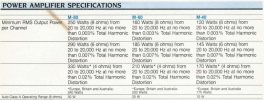
M-80 is first 30 watts in Auto Class A mode:
1688846827484.png
 
Class A for the first few milliwatts maybe.. M-70 is class AB..

If class A is selected !


M-80 is first 30 watts in Auto Class A mode:
View attachment 2928590
That's what I thought! Thanks for the clarification.


And @Soundscape --

Damn, didn't know this. Well, they are pretty pricy out my way in LA, and also a bit scarce. M60 or M65 come up more often.

Do you know if a similar issue has happened with either of those units?

Ryan
 
SANKEN MT-200 outputs--are no-longer in production.
TO-220 would be a tad inadequate for output duty..
 
There is a Yamaha brochure titled "Yamaha Auto Class A Power With Zero Distortion Rule (How It Works And Why It's Better)".

Auto Class A and Zero Distortion Rule are described in separate sections within the brochure and no specific model of amplifier is mentioned, nor did I find a date within.

A brochure for Yamaha separates describing the C-70/M-70/T-70 along with the contemporaneous x-50s mentions Zero Distortion Rule, but not Auto Class A.

Although these brochures were stored together, they may have been acquired separately, during different years. At this point, I can't recall with any likelihood of accuracy.
 
Model
Class Type
Power Output (RMS)
Total Harmonic
Distortion (THD)
Frequency Response
Special Features
Yamaha B-1
Class A​
150W per channel (8Ω)​
<0.1%​
20Hz–20kHz​
Yamaha's first solid-state amp, MOSFET​
Yamaha B-2
Class A​
100W per channel (8Ω)​
0.005%​
20Hz–20kHz​
V-FET transistors, Pure Class A​
Yamaha B-3
Class A​
60W per channel (8Ω)​
0.002%​
5Hz–100kHz​
X-Power amplification, V-FET​
Yamaha M-65
Class AB (Class A for low power)​
170W per channel (8Ω)​
0.003%​
20Hz–20kHz​
Auto Class A switching, High Dynamic Power​
Yamaha M-85
Class AB (Class A for low power)​
260W per channel (8Ω)​
0.003%​
20Hz–20kHz​
Auto Class A, Pure Direct Signal Path​
Yamaha M-80
Class AB (Class A for low power)​
250W per channel (8Ω)​
0.003%​
20Hz–20kHz​
Auto Class A, High Dynamic Power​
Yamaha M-40
Class AB (Class A for low power)​
120W per channel (8Ω)​
0.003%​
20Hz–20kHz​
Auto Class A, High Dynamic Power​
Yamaha M-45
Class AB (Class A for low power)​
125W per channel (8Ω)​
0.003%​
20Hz–20kHz​
Auto Class A, Pure Direct Signal Path​
Yamaha M-35
Class AB (Class A for low power)​
80W per channel (8Ω)​
0.03%​
20Hz–20kHz​
Natural Sound, Compact Design​

Key Points:​

  • B-Series (B-1, B-2, B-3): Pure Class A amplifiers designed for audiophiles seeking the highest sound fidelity.
  • M-Series (M-65, M-85, M-80, M-40, M-45, M-35): Primarily Class AB amplifiers that switch to Class A for low-power output, delivering high sound quality at lower volumes, while optimizing efficiency at higher outputs.
 
Model
Class Type
Power Output (RMS)
Total Harmonic
Distortion (THD)
Frequency Response
Special Features
Yamaha B-1
Class A​
150W per channel (8Ω)​
<0.1%​
20Hz–20kHz​
Yamaha's first solid-state amp, MOSFET​
Yamaha B-2
Class A​
100W per channel (8Ω)​
0.005%​
20Hz–20kHz​
V-FET transistors, Pure Class A​
Yamaha B-3
Class A​
60W per channel (8Ω)​
0.002%​
5Hz–100kHz​
X-Power amplification, V-FET​
Yamaha M-65
Class AB (Class A for low power)​
170W per channel (8Ω)​
0.003%​
20Hz–20kHz​
Auto Class A switching, High Dynamic Power​
Yamaha M-85
Class AB (Class A for low power)​
260W per channel (8Ω)​
0.003%​
20Hz–20kHz​
Auto Class A, Pure Direct Signal Path​
Yamaha M-80
Class AB (Class A for low power)​
250W per channel (8Ω)​
0.003%​
20Hz–20kHz​
Auto Class A, High Dynamic Power​
Yamaha M-40
Class AB (Class A for low power)​
120W per channel (8Ω)​
0.003%​
20Hz–20kHz​
Auto Class A, High Dynamic Power​
Yamaha M-45
Class AB (Class A for low power)​
125W per channel (8Ω)​
0.003%​
20Hz–20kHz​
Auto Class A, Pure Direct Signal Path​
Yamaha M-35
Class AB (Class A for low power)​
80W per channel (8Ω)​
0.03%​
20Hz–20kHz​
Natural Sound, Compact Design​

Key Points:​

  • B-Series (B-1, B-2, B-3): Pure Class A amplifiers designed for audiophiles seeking the highest sound fidelity.
  • M-Series (M-65, M-85, M-80, M-40, M-45, M-35): Primarily Class AB amplifiers that switch to Class A for low-power output, delivering high sound quality at lower volumes, while optimizing efficiency at higher outputs.
M-60 should be on there too....My 2¢ toward the class A hall of fame.:rockon:
 
Class A question:
If I put a small fan on top of the unit sucking away from the main board blowing up and away while the class A button is engaged, is it just operating in class AB?
M-60\65
M-80\85
 
Last edited:
Class A question:
If I put a small fan on top of the unit sucking away from the main board blowing up and away while the class A button is engaged, is it just operating in class AB?
M-60\65
M-80\85
Putting a fan on top of the unit does not change the class of operation, just removes the heat … a good thing.

Class A operation is when your transistors are biased to be ’ON’ at all times regardless of whether there’s input signal or not. Hence the low efficiency due to lots of generated and wasted heat especially when there’s no input signal.

Class B operation is when the transistors are biased to turn ‘ON’ when there’s an input signal higher than ‘usually’ 0.7V or lower than ‘usually’ -0.7V. Since there’s severe audio distortion in pure class B operation, the transistors are then biased to turn ‘ON’ with any input signal. This is achieved by adding two diodes (hence the 0.7V mentioned) to the input side of the transistors. This is called class AB because the transistor input voltages hover right around turn ‘ON’ turn ‘OFF’ region, waiting for an input to put them in active region. When no input present, transistors are practically ‘OFF’ and therefore no heat generated or power wasted.

Was this what you were after?
 
I am considering buying an M-70 locally for $300. Do I understand correctly that the conclusion of this thread is that the M-70 cannot do class A at lower power? That would make sense as all the amps listed above that support this option have an "Auto Class A" button.

Would I be better off waiting for an M-60/65 or even an M-40/45? I love the design of the M-4 how does that older amp compare to the 40/45/60/65?

I currently have a set of Klipsch KG4 but just getting started so would like to have something than can drive harder to drive speakers in the future.

@avionic am I right in thinking your SANKEN MT-200 comment was in reference to the M-80?

Thanks
 
Hey @rupes2 --

The M70 has no low-power class A function. Which is what avionic means by a "few miliwatts" above.

I did end up selling my M70 to fund the purchase and refurb of a M65 (glue removed, some transistors replaced). Barely breaking past 1W in "Auto Class A" mode driving my NS1000Ms in a huge room. Average dB is maybe 78? Much cleaner to my ear, but not forced, and better imaging than the M70.

I also picked up a M-4 that had been worked on by Tom Nishimoto. No fancy upgrades, just a maintenance to keep it running. I do really like how musical and perhaps more muscular the M4 is.

I don't think the M65 nor the M4 would have an issue driving speakers more demanding than your KG4s. Except Maggies?
 
Thanks @avantbored, that is helpful. I missed avionic's witty "few milliwatts" remark!

It sounds like I would be better off with an M-65 or an M-4. It is interesting that you have both and it sounds like you like them both about the same but they have a different sound. Is that accurate? How does the imaging compare between them?
 
Back
Top Bottom