

You are using an out of date browser. It may not display this or other websites correctly.
You should upgrade or use an alternative browser.
You should upgrade or use an alternative browser.
Yamaha PX-3 troubles, help requested
- Thread starter therocket290
- Start date
-
- Tags
- yamaha px-2 yamaha px-3
therocket290
Member
Thanks for following up. I have been working on it for a few days. Here is an update (It is long and I am confused about what is going on).
Dr. Ear, Unfortunately for me, it was not the diode (d12). I tested the diodes in circuit and that was the only diode that did not test normal. I replaced it and had no change. The diode tests normally out of the circuit. That ended up being a bit of a waste of time for me, so I decided to look at the circuit diagram and better understand it. Here is something I have a question about regarding this diode.
1. If my understanding is correct, diode 12 is in the part of the circuit that sends voltage to a solenoid that moves the tonearm up/down. When I test the resistance between the two ends of the diode while in circuit, it is only ~30 ohms. This is not true of any of the other diodes and I can’t find a path in the circuit between those points that is supposed to have such little resistance. But I might be missing something.
I discovered that the schematic has many more test voltages marked than are actually marked on the circuit board, so proceeded to test these voltages. Some things to note: It is difficult for me to adjust variable resistors 1 and 2 while reading the voltage at the test pin and centering the tonearm. I currently do it with the turntable upside down, because I don’t have a probe on my multimeter that fits into the hole under the platter from above. Also, the variable resistors seem very finicky. It is difficult to get the voltage correct at the test pin. When I do have them adjusted, the voltages look pretty good. The biggest discrepancy is the voltage going into RCdS and LCdS ( Which are the photoresistors in the tonearm). The voltages are supposed to be +/- 5.9V and they were about +/- 4.7V. Other than that, the voltages look good when the tonearm is centered. The problem occurs when I try to send negative voltage to the tonearm motor.
First, I will describe the behavior with the motor disconnected, because I think it is close to what should happen. In terms of voltage going to the motor (or where it would be), they are the same as described in a post above: about +3V to move right, about -1.3V to move left (this is from moving the tonearm). When I connect the motor, the negative voltage goes to 0. I decided to follow the voltage from the tonearm to the motor. +/- voltage comes from CdS (this is adjusted with vr2 and is around zero when the tonearm is centered), depending on which way the tonearm is rotated. This goes into IC1 and comes out of IC1 between -5.5V and +5.5V (or close to that) as the tonearm is rotated back and forth. This then goes into what I have learned to be a drive circuit for the tonearm motor. There are two pairs of transistors in the drive circuit: tr20 and tr1 for the positive voltage and tr2, tr21 for the negative voltage. The emitters of tr1 and tr2 are connected to the tonearm motor. When the motor is connected, the negative voltage stops at tr2. There is negative voltage at the emitter of tr21 which is connected to the base of tr2, but not at the emitter of tr2 (the negative voltage is present with the motor disconnected). This is with the tonearm rotated to produce negative voltage at the motor. Maybe something is wrong with tr2, but I don’t understand why it seems to work with the tonearm motor disconnected.
I thought I had found the problem and it still might be, but here is where the story gets even more strange. I decided to move the turntable to our back porch for soldering. When I was turning the turntable back upright, I saw the tonearm move to the left a bit. I thought it must have just wobbled a bit as I was flipping the turntable. To my disbelief, the move right button moved the tonearm to the right a bit.
I have experimented with it before getting back into it. It has playing three sides without stopping, but typically stops at least once. The interesting thing is that if I put my ear near the turntable, I can hear the tonearm motor nudging the tonearm along. I can also hear the motor stop. It is not a slipping belt. If I nudge the tonearm after it stops, then I can hear the motor turn on and the tonearm moves to straighten out. Sometimes it continues to the end and then returns as usual. Sometimes it stops again.
As for the move left/right buttons, the move right button seems to work without fail (which agrees with my experiments with the turntable upside down. The move left button does not always work, but if I press move right and then move left, it will move left. Now the 30 button will start move the tonearm to the platter and drop it. This seems to happen every time I try now.
Here are my guesses:
Dr. Ear, Unfortunately for me, it was not the diode (d12). I tested the diodes in circuit and that was the only diode that did not test normal. I replaced it and had no change. The diode tests normally out of the circuit. That ended up being a bit of a waste of time for me, so I decided to look at the circuit diagram and better understand it. Here is something I have a question about regarding this diode.
1. If my understanding is correct, diode 12 is in the part of the circuit that sends voltage to a solenoid that moves the tonearm up/down. When I test the resistance between the two ends of the diode while in circuit, it is only ~30 ohms. This is not true of any of the other diodes and I can’t find a path in the circuit between those points that is supposed to have such little resistance. But I might be missing something.
I discovered that the schematic has many more test voltages marked than are actually marked on the circuit board, so proceeded to test these voltages. Some things to note: It is difficult for me to adjust variable resistors 1 and 2 while reading the voltage at the test pin and centering the tonearm. I currently do it with the turntable upside down, because I don’t have a probe on my multimeter that fits into the hole under the platter from above. Also, the variable resistors seem very finicky. It is difficult to get the voltage correct at the test pin. When I do have them adjusted, the voltages look pretty good. The biggest discrepancy is the voltage going into RCdS and LCdS ( Which are the photoresistors in the tonearm). The voltages are supposed to be +/- 5.9V and they were about +/- 4.7V. Other than that, the voltages look good when the tonearm is centered. The problem occurs when I try to send negative voltage to the tonearm motor.
First, I will describe the behavior with the motor disconnected, because I think it is close to what should happen. In terms of voltage going to the motor (or where it would be), they are the same as described in a post above: about +3V to move right, about -1.3V to move left (this is from moving the tonearm). When I connect the motor, the negative voltage goes to 0. I decided to follow the voltage from the tonearm to the motor. +/- voltage comes from CdS (this is adjusted with vr2 and is around zero when the tonearm is centered), depending on which way the tonearm is rotated. This goes into IC1 and comes out of IC1 between -5.5V and +5.5V (or close to that) as the tonearm is rotated back and forth. This then goes into what I have learned to be a drive circuit for the tonearm motor. There are two pairs of transistors in the drive circuit: tr20 and tr1 for the positive voltage and tr2, tr21 for the negative voltage. The emitters of tr1 and tr2 are connected to the tonearm motor. When the motor is connected, the negative voltage stops at tr2. There is negative voltage at the emitter of tr21 which is connected to the base of tr2, but not at the emitter of tr2 (the negative voltage is present with the motor disconnected). This is with the tonearm rotated to produce negative voltage at the motor. Maybe something is wrong with tr2, but I don’t understand why it seems to work with the tonearm motor disconnected.
I thought I had found the problem and it still might be, but here is where the story gets even more strange. I decided to move the turntable to our back porch for soldering. When I was turning the turntable back upright, I saw the tonearm move to the left a bit. I thought it must have just wobbled a bit as I was flipping the turntable. To my disbelief, the move right button moved the tonearm to the right a bit.
I have experimented with it before getting back into it. It has playing three sides without stopping, but typically stops at least once. The interesting thing is that if I put my ear near the turntable, I can hear the tonearm motor nudging the tonearm along. I can also hear the motor stop. It is not a slipping belt. If I nudge the tonearm after it stops, then I can hear the motor turn on and the tonearm moves to straighten out. Sometimes it continues to the end and then returns as usual. Sometimes it stops again.
As for the move left/right buttons, the move right button seems to work without fail (which agrees with my experiments with the turntable upside down. The move left button does not always work, but if I press move right and then move left, it will move left. Now the 30 button will start move the tonearm to the platter and drop it. This seems to happen every time I try now.
Here are my guesses:
- There is a bad connection somewhere. But then I wouldn’t expect the behavior I’m getting with the motor disconnected.
- I was adjusting vr2 with the turntable upside down and vr2 is for tonearm angle adjustment in the down position. I have fiddled with it a bit with the turntable upright, but have not have success.
- I need to replace vr2 and/or vr1. These seemed to swing the voltage more than I expected, but that might be normal.
- Something is wrong with tr2.
Attachments
Last edited:

Hey Rocket, thanks for updating your progress. I was hoping for your sake it would be the simple diode fix. You'll be getting more help, hopefully, when others see this post. Pfcs49 might have some other ideas now that you have not been successful with the diode replacement.
therocket290
Member
While I appreciate the challenge of working on my PX-3 and learning some electronics, this project has piqued my interest in simpler turntables. My other turntable is a Sony PS-X60 which also has a lot of electronics in it. I don't want to spend a whole lot right now, so I have been checking out AR XA turntables. This question is getting off the topic of the thread, but does anyone have suggestions for simple turntables like the AR XA to look out for?
I hear you rocket....there have been some other threads wherein suggestions are made to replace (recap) everything but that's where my indulgence ends, I'm afraid.
I'm lucky that I've only had a few oddities with mine pretty easily resolved. I have come to the conclusion that these likely were caused by not using it for extended periods of time as it is not my daily/main driver. The thing does not like to sit idle, I'm convinced. After I start using it more, it becomes flawless....go figure!
In any case, I think I would miss it dearly because it is an absolute marvelous instrument for playback and so, so easy to use. I have the Thorens TD160 sitting just a few feet to the left, which is exactly what you are describing as a "simple" turntable.....guess which one gets used most? I do hope you get it sorted out and are able to once again use it without issues.
I'm lucky that I've only had a few oddities with mine pretty easily resolved. I have come to the conclusion that these likely were caused by not using it for extended periods of time as it is not my daily/main driver. The thing does not like to sit idle, I'm convinced. After I start using it more, it becomes flawless....go figure!
In any case, I think I would miss it dearly because it is an absolute marvelous instrument for playback and so, so easy to use. I have the Thorens TD160 sitting just a few feet to the left, which is exactly what you are describing as a "simple" turntable.....guess which one gets used most? I do hope you get it sorted out and are able to once again use it without issues.
therocket290
Member
Thanks for the suggestion. I'll try that. While I'm at it, I might redo the connection on the board that contains vr2. I had that unplugged back when I worked on the belts.These connectors do come loose if you pull the plugs repeatedly.
I probably won't get to it until next week because I am currently working on a Pass A3 clone. Hopefully I get these projects finished before the next semester starts back up. And I still have a couple of guitar projects on my list!
My bad, it is Stainach, Austria (not Steinach), very close to Bad Mitterndorf where my father and I fished at a place called the Salzastausee. There was a dairy in Stainach that provided us with permits to fish the lake and the river coming into it. We were friends with some of the proprietors through my father's employment as a commissary officer while we lived in Germany. Beautiful area, wonderful memories, and very dear friends.....I saw Austria in your location.

Dr. Ear
Super Member


Hey, that's outta sight! Watch out for scorpions and rattlesnakes when you do that! My mother grew up in Freilassing, which is in Germany just across the Saalach River from Salzburg as you know!
Back to the business at hand.....rocket, when you are working on the PX-3, have you made a stand that you can place it on so you can get to the underside? I found this extremely helpful to see how things are working, or not, just be careful where you put your fingers while you have it plugged in.
Back to the business at hand.....rocket, when you are working on the PX-3, have you made a stand that you can place it on so you can get to the underside? I found this extremely helpful to see how things are working, or not, just be careful where you put your fingers while you have it plugged in.
therocket290
Member
Hey, that's outta sight! Watch out for scorpions and rattlesnakes when you do that! My mother grew up in Freilassing, which is in Germany just across the Saalach River from Salzburg as you know!
Back to the business at hand.....rocket, when you are working on the PX-3, have you made a stand that you can place it on so you can get to the underside? I found this extremely helpful to see how things are working, or not, just be careful where you put your fingers while you have it plugged in.
I need to set up a higher stand so that I can access the bottom while upright. I was doing most of the work/testing with it upside down.
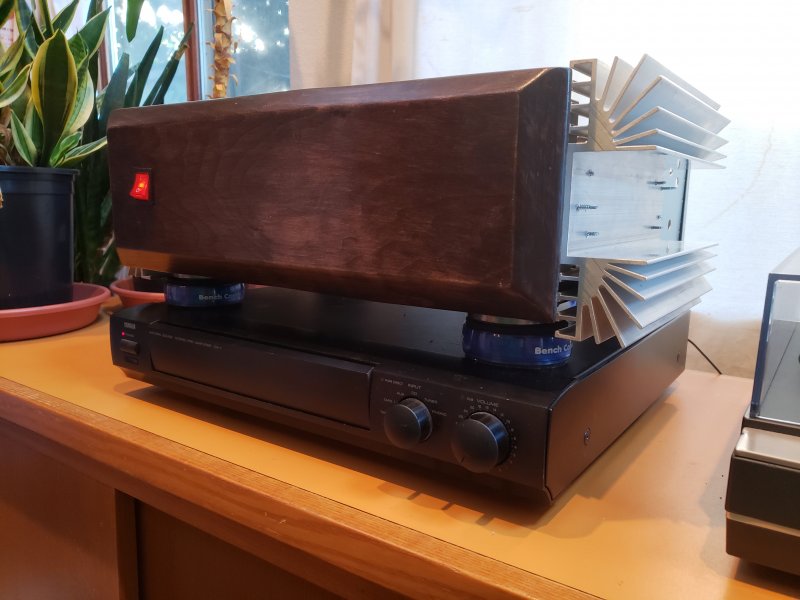
Since we already got off topic, my Pass Aleph 3 clone build went reasonably well. I have it set up with my Yamaha CX-1, Yamaha WXC-50, and Sony PS-X60. Sounds really nice come through my Klipsch Quartets! I got the heatsinks from the estate of James Bongiorno (on the bay). They were originally intended for a Sumo The Nine amp.

I have about one more week to spend on hobby stuff and might work on my guitar stuff first. I will let you know when I get the PX-3 out to resolder stuff.
Thanks for the interest and encouragement.
A while ago, my PX-2 showed irrational behaviour which resolved after resoldering the connector pins of the tonearm on the main pcb.
The broken solder joint was not visible.
Hey Rocket, just a follow-up on what the good Dr. advised.....ironically, the tonearm on my PX-3 started "misbehaving" similarly to what you described in your first post. I pushed the "30" button and was really surprised to see nothing happen. This was after an hour or so of playing just fine and then that button became unresponsive! And here I thought I had resolved the issue a while back when it was acting similarly by taking things apart and cleaning that pot under the 30 button with Deoxit D5.....guess it must have helped but not for long.
I remembered what the Dr. had mentioned about the solder joints where the connector pins of the tonearm connect to the main pcb and decided to follow up with that. Upon inspection, those all looked fine but what I found in the process was that there are two other sets of connectors that appear to be routed to the power transformer. With the naked eye, I saw what appeared to be minute cracks in the solder joint on the smaller of the two. I am going to try to paste a screenshot of the manual here (click on the photo to enlarge):

Admittedly, not a great photo but you can see what I'm talking about. I highlighted that connection in the blue-ish rectangle if you look closely. You will be able to follow the wiring from there to the power transformer. Using a magnifying glass, I confirmed that what my naked eye spied turned out to be at the very least a suspicious-looking solder joint. It only took a few moments to hit it with a bit of flux (very small amount placed carefully just at this joint) using a wooden toothpick and some new solder (very tiny amount at the tip of the iron) and re-flowed it. Looking further with the magnifier, both of these two, IIRC, solder joints at this connector did not look as shiney and good as the others on the connectors to the right of this one. I then just decided to do the entire set of four until they looked really nice, just like they should have and like the others on that side of the main C board. Put everything back together and now, after over a week of operation, the "30" button is totally responsive.
Just thought I would add this to your list of things to check and do and since it is so simple.....and makes sense that if the power is intermittent or just shut off, that the tonearm would likely not be moving and just stop. Hope that will help you out Rocket!
PS - Don't remember if I asked you if you have the service manual, but if not you can download it from VinylEngine and the above is page 2.
Last edited:

Tiago
New Member
Hello, did you find the issue? I have the same problem, the tonearm does not move left, and it is intermittent... Can't figure out what may cause it.
I changed all TRs and diodes on the motor drive section, still no success.
IC1 is sending the negative voltage on pin 7 that was supposed to make the arm move left. Only, no voltage appears at the motor pins, whether it is connected or not. After a while it starts responding, then it stops again... So it seems like a semiconductor issue? Or could it be a capacitor leaking?
It's been quite unnerving, can anyone help? Thanks!
I changed all TRs and diodes on the motor drive section, still no success.
IC1 is sending the negative voltage on pin 7 that was supposed to make the arm move left. Only, no voltage appears at the motor pins, whether it is connected or not. After a while it starts responding, then it stops again... So it seems like a semiconductor issue? Or could it be a capacitor leaking?
It's been quite unnerving, can anyone help? Thanks!