Well ... after two days of playing, I think it's time to put this to bed. Finally. After having declared it solved what, like 5 times?
I had replaced D7 but was still getting speed issues, especially if I touched, moved, or held D6 (a VD-1220). So I replaced D6 with a 1N4148, and things were much better. However, the speed still drifted more than I liked. So I touched / moved / held D8 (the double diode VD-1220) and the speed also drifted. I replaced D8 with two 1N4148 in series, and also replaced for good measure D10 (VD-1121) with a 1N4148 as well.
After re-adjusting the trim pots, the speed is rock solid no matter what, from record to record back to back, or after hours of off time, including first thing in the morning after sitting overnight. There's no more speed pulsing, no more drift.
While I was debating replacing those diodes, I did some research and found that the circuit with D6 and D7 in parallel, with D7 reverse biased, in a common method of voltage regulation (in this case it regulates the base of TR13). See
https://www.electronics-tutorials.ws/diode/diode_7.html and
https://www.allaboutcircuits.com/textbook/semiconductors/chpt-3/zener-diodes/. It also appears that Yamaha designed this circuit to be immune to temperature deviations, since 5.6V zener diodes have a near-0 temperature coefficient:
Both below images credit to https://www.electronics-tutorials.ws/diode/diode_7.html, the below is the example used to illustrate use of a zener diode as a voltage regulator:

and
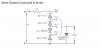
Look at the D7 circuit in on the Servo board ... look familiar?

So my hypothesis is that although all of the original diodes had degraded somehow to become significantly temperature-sensitive, it was really D6 that was causing improper voltage supply to the base of TR13, thus causing errant and inconsistent current to the motor. Advice to anyone in the future is to replace all those old diodes!




