• The move to the new server is done. There are some software and database maintenance updates in process. This has us passing the hat around to help out. We appreciate any donations. Seriously, even a dollar helps. The payment page may be found here - https://www.audiokarma.org/support.html

yet another 6550 bias thread, as it relates to cj design consternation

sae-7125

Super Member
after reviewing more than a few threads across the usual assortment of forums, and some one-on-one with a calculator, there are a few things that seem slightly disaster prone for the cj mv75a-1 (mv75/mv75a/mv75a-1 evolution family tree). i will refrain from boring readers with the parts cooker oven design theme...

for the 6550 bottle a calculation of 35w/anode voltage = 100% bias current setting per 6550.

for this cj amp running 590v anode the max bias would be 35/590 = 59.322ma per output tube. each output has its own bias adjust pot with an LED indicator operated by an LF353n dual op-amp which responds to 1.2v across a 20r 5w cathode resistor. so, 1.2v/20r = 60ma (per tube) which means the bias is running at or close to 100% since the owner/operator manual says to adjust up until light turns on and then slightly down until light is off.

what is the life expectancy of average 6550's regardless of brand/flavor vs bias setting? is there any noteworthy variance compared to the 6550eh (electro-harmonix) bottle?

many regulars of the tube side of hifi say 70% is close to ideal which would be 41.52ma or 830mv. when feeding the now repaired/updated amp 110v mains (still slow and cautious with testing) one output bottle is unable to min bias below 950mv so far. is it showing extreme signs of age/abuse from the factory bias inferno?

this particular make and multi rev model tube amp seems to have more than a few design negatives about it even though it was cj's first attempt at a tube amp albeit 2nd design rev.

6550 cj - 1.jpg
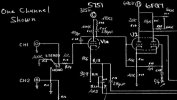
small and blurry schematic slice

a few people have adjusted the amp to run kt88 and some mention kt90 being a nice robust upgrade but i have my doubts about how much "output wattage per channel" can be achieved when there is a 20r 5w cathode resistor involved. perhaps this is a 25-30w/ch amp that can do 75w of dynamic power at some questionably high percentage of distortion, jury's still out on that calculation.

thoughts, ideas, experiences or the occasional nixon themed quagmire? life experience results may vary.
 
Last edited:
Register to hide this ad
Both the Tung Sol and GE data sheets for the 6550 and 6550A (respectively) state the “design maximum” plate dissipation rating to be 42 watts. The RCA data sheet states “design center” plate dissipation to be 35 watts.

There is a difference (stating the obvious) between the two rating scales (design maximum and design center). I’m not sure I understand what those differences are, but for what it’s worth I’ve always used 42 watts as the max plate dissipation in similar calculations.

Also the current being measured via this method of a resistor in the cathode circuit includes the plate current and “screen” current. At idle the screen current is going to be maybe 2 or 3 milliamperes with 6 milliamperes being the maximum under that same rating system.

The 20 ohm cathode resistor does suck a few watts off the top but at least for the Premier 11, which I have personally measured on my bench which uses a similar design, it does indeed deliver 70 watts output with less than 1.5% THD from 30 Hz to 15 KHz as its spec sheet claims.

You can draw your own conclusions from this, but in my view I think the design of this amp is fine.
 
The Heathkit W6m went to the trouble of measuring plate current with its meter. CJ is reading both plate and g2 current. That cathode current sense resistor is doing its part to make the amp able to run a single light for when bias is proper. It is raising the plate resistance a bit, and reducing distortion( un bypassed cathode resistance ).

Douglas
 
depending on the circuit your using. look up the data sheet. i use old NOS 6550 Tung-Sol 3225904 i tried to attach the data sheet file it is to large so i can not add it to this replay. big difference is the circuit weather its SE, P/P it differs on all the plate, cathode ect. if your using new 6550 then look up the type of manufacture..
 
**had to edit the original post, mv75 not mv70.

the mv75a-1 is a push-pull judging by the 6cg7/6fq7 phase splitter/inverter for each channel.

Screenshot 2025-03-09 at 12-30-54 Bias Setting - NOS Tung Sol 6550 (3 hole).png

i seem to be bumping into the 1939 vs 1957 spec sheet rating adjustment for a 1955 tube design. odd that the dissipation went up by 20%, from 35w to 42w.
 
Both the Tung Sol and GE data sheets for the 6550 and 6550A (respectively) state the “design maximum” plate dissipation rating to be 42 watts. The RCA data sheet states “design center” plate dissipation to be 35 watts.
RCA did not make their own 6550. I believe that they are relabeled Tung-Sol.

And as far as I know, GEC/MOV recommended the same max output wattage for their KT-88 as Tung-Sol's 6550. 42 watts. :idea:
 
Right, the plate dissipation ability itself did not go up. The change was in the rating scale or rating definition used. It wasn’t just for the 6550, but for any tube where the manufacturer started to publish ratings using the “design max” definition.

The other issue you may be seeing is you can’t properly bias the tubes. Meaning there is no bias adjustment you can make that will cause the bias LED to go out. All that means is the tubes you are using are out of spec relative to what the circuit expects. That’s what I experienced anyway. CJ designed the amp for a narrow bias control range. You might be able to fix that by tweaking the bias circuit (giving the bias adjustment circuit more range).
 
tubes you are using are out of spec relative to what the circuit expects. That’s what I experienced anyway. CJ designed the amp for a narrow bias control range.
all the zeners in the power supply/regulator were updated from 0.5w to 1.3w 2%, also adjusted bias supply from -81v (27+27+27 original) to -87v (30+27+30 1.3w 2%). the op-amp has a 2 diode reference voltage that is looking for ~1.2v across the cathode resistor before the light goes on. the fact that the pots open the door to over-bias is rather worrying even though when feeding the amp with signal its bias will go up significantly as expected, headroom before 100% rating.

would this design benefit from an auto bias mod that some of the other brands enjoy using?

if the grid is weak vs normal and unable to block the flow of electrons from cathode to anode would that constitute an aged output which should be updated? since the extreme heat (normal tube environment) will accelerate the out-of-tolerance condition.

still need to have the local tube addict do some bottle testing and see where the numbers are overall.

currently testing the amp with a fresh eh 12at7, didnt have any 5751 floating around, and a pair of general electric nos 6cg7 which are feeding the eh outputs the owner was using when the right channel went down. had to rebuild the power supply and regulator circuit plus most of the carbon comps had to go along with electrolytics.

typical 6550 pp stereo amp idle wattage when biased at 70% (1.2v in this case)? from the looks of things and based off the 110v mains numbers i am seeing my guess would be around 280w idle when at 120v even though the chassis specifies 117v.
 
The builders seem quite happy to violate the grid circuit resistance spec. Tung-Sol says 50k Ohm max.

So far as I have been able to tell, IFF the driver is able, the lower that value is, the better the amp sounds.

Douglas
 
I was always under the impression that design max was 10% over design center, but this is a 20% difference.
 
the MV75 series runs the tubes pretty hard. Used to own 2 of these amps many moons ago. Friends of mine that had these amps were always watching for NOS GE 6550s to run in them. The GEs were a pretty robust tube. Today not too many NOS GEs remain. A person can turn the bias down a bit but pretty hard to lower that plate voltage.
Today would stick with either the Tungsol re-issues, the GL KT88s or the EH KT88s. Many thought the 6550s sounded better when run hard. But the trade off is shorter life. Some of the high end brand tube amps made today still run these tubes just below or right at the design limit for the original GE 6550.
 
the MV75 series runs the tubes pretty hard. Used to own 2 of these amps many moons ago. Friends of mine that had these amps were always watching for NOS GE 6550s to run in them. The GEs were a pretty robust tube. Today not too many NOS GEs remain. A person can turn the bias down a bit but pretty hard to lower that plate voltage.
Today would stick with either the Tungsol re-issues, the GL KT88s or the EH KT88s. Many thought the 6550s sounded better when run hard. But the trade off is shorter life. Some of the high end brand tube amps made today still run these tubes just below or right at the design limit for the original GE 6550.
GE 6550A were the most robust. The Tung-Sol (USA) with holes in the plates were the next robust. Holes ensured the grid winding alignment during production.

VTV #6. Page 21.

VTV #19, page 4.
 
Last edited:
Between the two rating systems, max voltage and current ratings went up by 10% while max dissipation ratings went up by 20%.

Design Center ratings took into account both typical tube and circuit variations, while Design Maximum ratings only take into account tube variables.

Tubes are rated under the rating system in place at the time they are first released, and generally those ratings are not updated because the prevailing rating system changes. As a result, both systems are needed to cover all the various tubes offered in the last RCA Receiving Tube manual since it covers tubes released under both systems.

For the 6550, when the original tube was released, the DC rating system was in place. When GE released its A version, the DM rating system was in place, but both tubes can handle and dissipate the same amount of energy. Only the rating system changed between the two versions.

This rating change is also (in part) what gave the 6L6GC such a boost in capability over its predecessors as well.

Dave
 
the MV75 series runs the tubes pretty hard.
the early cj gear seems to have more than a few low longevity designs. after rebuilding a couple pv5 preamps and now an mv75a-1 it is becoming easier to quote repair min/max range. some forum posts have noted the zener addiction design to be of concern.

Design Center ratings took into account both typical tube and circuit variations, while Design Maximum ratings only take into account tube variables.
lots of variables when a device naturally runs at or beyond 350f. the hot (power on) cold (power off) delta is more than significant which makes every on-off cycle a gradual yet considerable component tolerance deviation.

lower lifespan on the bottles along with a circuit design that can handle only so much deviation before the high tension design eats itself... lots of variables indeed. from a baseline calculation i wonder if using the 35w rating for the 6550 as a 100% safety limit and then adjust to 70% below that would be a better longevity strategy.

an electrical engineering analogy would be a 15a mains panel breaker vs 80% load limit of 12a for the overall circuit. using the 80% as a design maximum and then trimming things down from there seems like a better metric. think of "tripping the breaker" as a point of no return for a component whether it be a transistor or resistor or tube.

knowing the absolute max dissipation of a tube is still useful for dynamic throttle ability but it should be seen as a threshold of device destruction (example: 42w = 100h lifespan) vs a region of consistent/stable operation.

even though marketing is a numbers game regardless of consumer product longevity (lower lifespan = higher profit on replacement cycles).

a lower bias strategy will most likely have a different effect on front end tubes. looking at the 5751 vs 12at7 specs, using 325v seems a bit high even with a 100k on the anode limiting current for the triodes. i am guessing there is 0v grid bias on this 5751 circuit by design?

6550 cj - 2.jpg
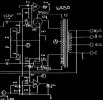
another slice of the same blurry roadmap
 
6550 cj - 3.jpg
its nice that the board can be pulled from the chassis and still be functional, with a few extension wires. also helps with thermal camera diagnostics, what is getting hot and why. old photo showing original caps.
 
Design max isn't absolute max, though that rating system did exist in the 1930s.

The 5751 is cathode biased which is typical for small signal tubes. Grid returns to ground via R14 and R13 (I think, its fuzzy). Cathode is some volts above ground, grid would be at 0v, so relative to cathode its negative. The A-K voltage is the one that actually matters, but being fed from 325v isn't that odd. There are datasheet values for a 300 volt supply, and the tube itself is rated for 250 across it.

5751 is more linear than a 12at7, fair bet thats why they used it.
 
good info. i finished the rebuild with some minor mods to dial in a few things and bumped up remaining tube life for the used/aged outputs. one or two value deviations vs what was listed on the schematic. i will eventually post the details in the growing diy>menagerie thread.

another scott amp walked in the door (type 208) plus rogue and willsenton integrated amps. almost drowning in tube gear plus the usual major ss brands.

examples:


Nice tubes but about as impossible to score as NOS Tung-Sol these days

Only Svetlana tubes I've ever had in my hands was some odd variant they made on the EL509. I think it was the EL509 anyway. Normally that was a plate cap tube, they made a version that didn't have the cap, and used the same pinout as a 6550, etc. They were installed in a set of Luxman MB3045 in place of the original impossible to get NEC triode tubes. One had failed, and I couldn't find a sub. Ended up doing the Lux mods to run a KT88 to get them back in working shape for the owner.
 
Nice tubes but about as impossible to score as NOS Tung-Sol these days

Only Svetlana tubes I've ever had in my hands was some odd variant they made on the EL509. I think it was the EL509 anyway. Normally that was a plate cap tube, they made a version that didn't have the cap, and used the same pinout as a 6550, etc. They were installed in a set of Luxman MB3045 in place of the original impossible to get NEC triode tubes. One had failed, and I couldn't find a sub. Ended up doing the Lux mods to run a KT88 to get them back in working shape for the owner.
I wish the old St. Petersburg plant still made quality tubes. Their EL34 and 6L6GC were also quite good.
 
Back
Top Bottom