


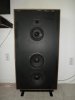
For some time, I had been following and studying all the various A400 recap threads, which motivated me to recap my A400s, made in April 84. The drivers had already been refoamed, so the caps were the only thing left.
I went with a middle of the road approach, cost-wise. Here's the combo I went with per speaker:
All resistors replaced with Mills 12 watt;
Woof- two PE 80uf electrolytics for the shunts;
Mid- two 30uf Axon films, two 30uf Axons with one 100uf PE lytic, one 15uf Clarity ESA with one 1uf Clarity ESA
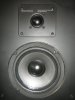
Tweet- one 3.9 Clarity ESA with one .1uf MKP-1837
Replaced the two upper spring clip cups with PE nickel-plated 5-ways, and the A400s are run biwired now.
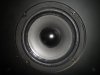
During reassembly, I wanted to compare the Boston squawker to another I had in a pair of Speakerlab towers. I felt the clarity, speed and dynamics of this textured poly mid exceeded that of the pulp Boston. An A/B comparison in free-air run full-range further confirmed my impression. The DCR of the Speakerlab was 5.5ohms vs. 4.3 of the Boston, so I'm not sure what effect that has on the crossover.
The basket size was identical, so it was an easy drop-in. Apart from the poly cone, the Speakerlab's larger magnet size is the biggest difference. I assume the cone material combined with the motor size is what enables these polys to sound quicker, and cleaner than the Boston mids, which I felt was the a400's weak link at higher volumes, where the mids got congested and distorted. Mind you, this was before the recap, so after I become accustomed to the current setup, I plan to reinstall the Boston mids and compare again.
Reassembled and after 30 or so hours of burn-in, I feel it was all worth it. The bass, for one, has a bit more power and tightness. The mids, with the polys, are a wee bit more forward, but not shouty. They may have altered the A400's frequency response neutrality. However, with acoustic guitar chord changes, I can practically feel the musician dragging his fingers across the wire-wound strings. Brass and piano have more front row bite and sharpness.
Treble is clean, yet smooth. Very good clarity, but not hyper-detailed, any sibilance in the recording is still there, but it doesn't drill it through my skull. Haven't had a long listening session yet, but overall, no worries of headache-inducing fatigue.
Through an amp more clinical than my MA6900, I suppose this could be too bright and forward a presentation, and become tiresome. But, for my room and my system, I feel it would take a heck of a lot more expensive speaker to better it.
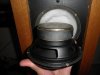
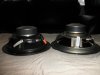
Going off on a bit of a tangent, I saw another thread where someone asked if the A40 woof is the same as the A400 mid. I have both, so I'd see for myself.
Resistance is different, A40 at 2.8ohms, A400 at 4.3ohms. Furthermore, the A40 has a deeper basket/longer voice coil, and the basket diameter/screw holes are spaced slightly wider on the A40.
I went with a middle of the road approach, cost-wise. Here's the combo I went with per speaker:
All resistors replaced with Mills 12 watt;
Woof- two PE 80uf electrolytics for the shunts;
Mid- two 30uf Axon films, two 30uf Axons with one 100uf PE lytic, one 15uf Clarity ESA with one 1uf Clarity ESA
Tweet- one 3.9 Clarity ESA with one .1uf MKP-1837
Replaced the two upper spring clip cups with PE nickel-plated 5-ways, and the A400s are run biwired now.
During reassembly, I wanted to compare the Boston squawker to another I had in a pair of Speakerlab towers. I felt the clarity, speed and dynamics of this textured poly mid exceeded that of the pulp Boston. An A/B comparison in free-air run full-range further confirmed my impression. The DCR of the Speakerlab was 5.5ohms vs. 4.3 of the Boston, so I'm not sure what effect that has on the crossover.
The basket size was identical, so it was an easy drop-in. Apart from the poly cone, the Speakerlab's larger magnet size is the biggest difference. I assume the cone material combined with the motor size is what enables these polys to sound quicker, and cleaner than the Boston mids, which I felt was the a400's weak link at higher volumes, where the mids got congested and distorted. Mind you, this was before the recap, so after I become accustomed to the current setup, I plan to reinstall the Boston mids and compare again.
Reassembled and after 30 or so hours of burn-in, I feel it was all worth it. The bass, for one, has a bit more power and tightness. The mids, with the polys, are a wee bit more forward, but not shouty. They may have altered the A400's frequency response neutrality. However, with acoustic guitar chord changes, I can practically feel the musician dragging his fingers across the wire-wound strings. Brass and piano have more front row bite and sharpness.
Treble is clean, yet smooth. Very good clarity, but not hyper-detailed, any sibilance in the recording is still there, but it doesn't drill it through my skull. Haven't had a long listening session yet, but overall, no worries of headache-inducing fatigue.
Through an amp more clinical than my MA6900, I suppose this could be too bright and forward a presentation, and become tiresome. But, for my room and my system, I feel it would take a heck of a lot more expensive speaker to better it.
Going off on a bit of a tangent, I saw another thread where someone asked if the A40 woof is the same as the A400 mid. I have both, so I'd see for myself.
Resistance is different, A40 at 2.8ohms, A400 at 4.3ohms. Furthermore, the A40 has a deeper basket/longer voice coil, and the basket diameter/screw holes are spaced slightly wider on the A40.
Attachments
Last edited: