

You are using an out of date browser. It may not display this or other websites correctly.
You should upgrade or use an alternative browser.
You should upgrade or use an alternative browser.
Zero Zone Cary SLP-90 clone Preamp
- Thread starter meako
- Start date
It should be an easy enough mod (all components are on the top side, big chunky pads etc) , I just think I need to get some caps that can actually perform well into the single Hz range (being an AC path, I need to keep that corner low enough) .
I will just make a list of all the rest of the stuff I want to upgrade, order parts
I will just make a list of all the rest of the stuff I want to upgrade, order parts

FlaCharlie
Super Member
Now, I am looking to modify the board: with two targets - inherent reduction of the gain, and upgrading the supply decoupling on this clone (the clone kind of went lean on the final stage's decoupling quality)
Question:
I was considering adding negative feedback on the first stage to reduce the gain by ~10db ( to avoided snr reduction with the RCA attenuators) . In sims, it looks like doing that on the gain stage (the first 12au7) as an CAP-Resistor feedback between Plate and grid, should allow to cut the gain by 10db , instead of going the rout of NGF, which should maintain the global sound characteristic of the preamp, not change any operation point .
A 2v signal is considered standard line level, same as the output of a typical CD player. You might try using a DAC that has a variable output, sometimes called a "preamp mode", in combination with the volume control on the preamp. I haven't noticed any audible noise from my DACs or Wiim streamer when doing so.The version I got already uses the 12au7-s (If I understand correctly this is as low a gain as I can get from that pin compatibility) + the tube I got really sounds great (only problem is that the signal at the input is very strong - 2v from the DAC ) .
I was just wondering if there was anyone who did some manipulation and how it sounded before I do them myself LOL
But, IMO, this is another example of all the problems that result when a preamp uses a tube whose characteristics are not well suited for the job. Then they try to reduce the tube’s shortcomings by using a more complex circuit. Without success, apparently, based on many of the recurring comments.
Nice chassis and controls, though. I’d be tempted to gut the audio circuit and use a tube that eliminates the shortcomings and works with a simple circuit.
Perhaps the existing power supply could be used . . .

Hi FlaCharlie and Lavane
The question of DAC and volume:
There are DACs boxes that do include resistor attenuator or active preamp stage (X30, Eversolo A8 just pop to my mind)
Many Daces are performing digital attenuation of the output stage (essentially scaling the signal)
The latest gen of Sabre 9039pro (in the DAC I have) does have volume control, it is implemented prior to the DAC itself (digital filter), and with a DAC that is based on 32bit, it is very effective . I did check it and I am not sure if I heard any detectable distortion with it . I did check the WiiM ultra volume, I can not say the same on that one, but that could just be the fact that I am not a big fan of its DAC section overall ( it works ok, low volume not so great , can be its analog buffer or dac, does not matter).
The important stuff is that I like the coloring that the Tube ads to the mix (maybe it is the fact that driving my amp with its buffer stage, it can drive proper bass into my amp).
Now for for 12AU7 for preamp:
This circuit basically has the first stage is classic triode Class-A, gain stage, and the second is a cathode follower, which it is supposed to be good at. and does sound great: I am not sure about the shared supply between left/right: this is another think I am modifying.
Don't get me wrong, this circuit sounds great, and based on what I see in Carry original design (where the volume pot has a pre-attenuator) - this was a known "feature" .
I think it is all a question of what it is supposed to drive, and my power amp gain is quite high to begin with ... so it is really my fault that I want to take an input signal of 2V and effectively attenuate it rather than "amplify it", and have a better driving capabilities to push the power amp input.
The question of DAC and volume:
There are DACs boxes that do include resistor attenuator or active preamp stage (X30, Eversolo A8 just pop to my mind)
Many Daces are performing digital attenuation of the output stage (essentially scaling the signal)
The latest gen of Sabre 9039pro (in the DAC I have) does have volume control, it is implemented prior to the DAC itself (digital filter), and with a DAC that is based on 32bit, it is very effective . I did check it and I am not sure if I heard any detectable distortion with it . I did check the WiiM ultra volume, I can not say the same on that one, but that could just be the fact that I am not a big fan of its DAC section overall ( it works ok, low volume not so great , can be its analog buffer or dac, does not matter).
The important stuff is that I like the coloring that the Tube ads to the mix (maybe it is the fact that driving my amp with its buffer stage, it can drive proper bass into my amp).
Now for for 12AU7 for preamp:
This circuit basically has the first stage is classic triode Class-A, gain stage, and the second is a cathode follower, which it is supposed to be good at. and does sound great: I am not sure about the shared supply between left/right: this is another think I am modifying.
Don't get me wrong, this circuit sounds great, and based on what I see in Carry original design (where the volume pot has a pre-attenuator) - this was a known "feature" .
I think it is all a question of what it is supposed to drive, and my power amp gain is quite high to begin with ... so it is really my fault that I want to take an input signal of 2V and effectively attenuate it rather than "amplify it", and have a better driving capabilities to push the power amp input.
FlaCharlie
Super Member
Not your “fault”.I think it is all a question of what it is supposed to drive, and my power amp gain is quite high to begin with ... so it is really my fault that I want to take an input signal of 2V and effectively attenuate it rather than "amplify it", and have a better driving capabilities to push the power amp input.
Modern amps don’t need any gain at all, they can be driven to full power output by a signal that’s lower than the line level standard 2v. Typically input sensitivity is actually under 1v. I was unable to find a spec for its input sensitivity, but your amp is probably not radically different. They ALL require signal attenuation unless you’re using a weak source.
A preamp, by definition, adds gain which is not necessary but many people find that using a tube preamp subjectively improves the sound. I assume that’s why you’re using one. But the more gain you add the more attenuation is needed and this can create problems. As I see it, the trick is to find a happy medium.
The 12AU7 has an amplification factor (mu) of 20, which is the lowest of all the tubes in the 12A*7 family. But even with its (relatively) lower gain the useful range of the volume pot is limited which makes it difficult to make fine adjustments to the volume.
In the original Cary design they just added an additional volume pot which is the “pre-attenuator” you refer to. The variable output on your DAC provides the same function.
Sure, you could add some negative feedback to reduce the gain. But that just adds more complexity to an already overly complex (to me anyway) circuit. Who knows how it would sound. I recently tried plate to grid feedback and it did lower the gain but it sucked the life out of the sound. Different tube and implementation, though, so YMMV.I thought of adding negative AC feedback (R-C) from plate to Grid. At least in sims, I can trim down the gain from 20db, down to about 10db
I prefer to simply use a tube with lower mu.
I like the coloring that the Tube ads to the mix (maybe it is the fact that driving my amp with its buffer stage, it can drive proper bass into my amp).
The function of the cathode follower (aka buffer stage) is to lower the output impedance of the preamp so that it can easily drive the input impedance of your amp. A tube configured as a CF buffer is a common method. They are not used to add color to the sound they just lower output impedance.This circuit basically has the first stage is classic triode Class-A, gain stage, and the second is a cathode follower
If the sonic benefits you enjoy were due to lower output impedance then your system would sound just as good (or better) without the preamp because the output straight from a DAC has a lower output impedance than a preamp.
As for drive requirements, specs say your amp has an input impedance of 47k which makes it much easier to drive compared to most SS / Class D amps, which are commonly 20k and sometimes as low as 10k. Tube amps are typically 100k, so they’re very easy to drive.
In a preamp, I see the use of a cathode follower as a band aid that just adds more complexity to the circuit. But it's needed when the gain tube you choose has a plate resistance that results in an output impedance that’s too high.
I prefer to use a gain tube whose plate resistance is low so there is no need to add a cathode follower.
Hence my comment about gutting the audio circuit entirely. I prefer simple, low parts count, circuits.
Last edited:

Lavane
Lunatic Member
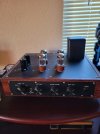
Hey Lavane
Wonderful looking preamp - what is it ? Your build ? Schematics ?
Well, Post modification of the clone slp-90:
Gain: tamed (If before I used 12db to get the volume under control, the range now is very reasonable , were listening volume is 22-40, and "party" levels above 50.
Added some higher grade (Mundorf 4u) caps on the cathode follower path, to help the installed SCR caps.
Total effect:
subjective and basically just my impression (and my wife's) :
There is a change in the total sound:
The basses are faster (more precise), and over all sound is cleaner (probably combination of the higher signal at the input, combined with the LNF on that first stage the help to track the signal better.
There is a full retention of the tube sound.
Wonderful looking preamp - what is it ? Your build ? Schematics ?
Well, Post modification of the clone slp-90:
Gain: tamed (If before I used 12db to get the volume under control, the range now is very reasonable , were listening volume is 22-40, and "party" levels above 50.
Added some higher grade (Mundorf 4u) caps on the cathode follower path, to help the installed SCR caps.
Total effect:
subjective and basically just my impression (and my wife's) :
There is a change in the total sound:
The basses are faster (more precise), and over all sound is cleaner (probably combination of the higher signal at the input, combined with the LNF on that first stage the help to track the signal better.
There is a full retention of the tube sound.
Hi FlaCharlie
I read your detailed explanation a number of times and it makes a lot of sense, and yes - I had to try the mods to the preamp - even if just to see what it does (and it actually came out very nice)
What tubes would you suggest that have a lower mu (gain)? I am in the mood to build my own fully customed preamp - maybe just "gut" similar preamp build and have a fully customed preamp instead: these clones comes with full kit of remote control and resistor ladder volume relay, so its pretty easy to work with (for ~$300, box, transformers. volume, I might even get one for less - it is pretty good starting point for any preamp)

I read your detailed explanation a number of times and it makes a lot of sense, and yes - I had to try the mods to the preamp - even if just to see what it does (and it actually came out very nice)
What tubes would you suggest that have a lower mu (gain)? I am in the mood to build my own fully customed preamp - maybe just "gut" similar preamp build and have a fully customed preamp instead: these clones comes with full kit of remote control and resistor ladder volume relay, so its pretty easy to work with (for ~$300, box, transformers. volume, I might even get one for less - it is pretty good starting point for any preamp)
Lavane
Lunatic Member
That preamp I bought complete from Erhard Audio. After building one from a kit using the same circuit design, but using 12AX7's I bought the 6SN7 version. They're both Aikido line stage preamps. Glass Audio should have schematics? Both preamps sound very good and are very quiet. I do prefer the 6SN7 version over the 12AX7 version though. My son has the 12AX7 version now.Hey Lavane
Wonderful looking preamp - what is it ? Your build ? Schematics ?
Well, Post modification of the clone slp-90:
Gain: tamed (If before I used 12db to get the volume under control, the range now is very reasonable , were listening volume is 22-40, and "party" levels above 50.
Added some higher grade (Mundorf 4u) caps on the cathode follower path, to help the installed SCR caps.
Total effect:
subjective and basically just my impression (and my wife's) :
There is a change in the total sound:
The basses are faster (more precise), and over all sound is cleaner (probably combination of the higher signal at the input, combined with the LNF on that first stage the help to track the signal better.
There is a full retention of the tube sound.
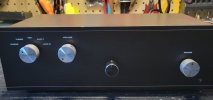
I bought the board kits from Arhard Audio and sourced the chassis from Dynakit. The faceplate I had made at Front Panel Express.
The Aikido's have plenty of gain. Most that either buy, or build them tend to like them.
Attachments
FlaCharlie
Super Member
Good to hear that your mods are working out.What tubes would you suggest that have a lower mu (gain)? I am in the mood to build my own fully customed preamp - maybe just "gut" similar preamp build and have a fully customed preamp instead: these clones comes with full kit of remote control and resistor ladder volume relay, so its pretty easy to work with (for ~$300, box, transformers. volume, I might even get one for less - it is pretty good starting point for any preamp)
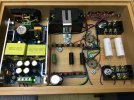
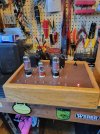
Here’s the preamp I built recently. It uses the 6CW5 or the Soviet 6P43P-E which have a mu of ~8 and low plate resistance so it can drive 10K SS / Class D amps without the additional circuitry of a cathode follower. Cost was ~$100.

More details are here:
The Flow Pre4D - A DIY Tube Preamp
I’m always encouraging people to build something themselves that uses tubes. My most recent amp threads feature simple designs that don’t even require the use of solder. And they use a SMPS (switch mode power supply), which also simplifies the DIY process. Here I’m presenting a similar DIY...
audiokarma.org
Hi FlaCharlie
Awesome ! I was not familiar at all with this tube .
I am going to read the other link... trying to figure out why you like the battery more than the resistor biasing.
Cool and minimalistic build !
Interesting question:
I don't see people using any protection for the "power off click" (the one with the 1237 and relays ) - any idea why ?
Thanks again!
Awesome ! I was not familiar at all with this tube .
I am going to read the other link... trying to figure out why you like the battery more than the resistor biasing.
Cool and minimalistic build !
Interesting question:
I don't see people using any protection for the "power off click" (the one with the 1237 and relays ) - any idea why ?
Thanks again!
FlaCharlie
Super Member
Thanks. In this case minimalism works because the characteristics of the tubes allow it. There are other tubes that have similar characteristics. Some of them are discussed in the thread linked above and I included some other schematics including some that use cathode bias (resistor and bypass cap).Hi FlaCharlie
Awesome ! I was not familiar at all with this tube .
I am going to read the other link... trying to figure out why you like the battery more than the resistor biasing.
Cool and minimalistic build !
Interesting question:
I don't see people using any protection for the "power off click" (the one with the 1237 and relays ) - any idea why ?
Thanks again!
For the Flow, my original intent was to use cathode bias simply because it’s common and widely recognized but I found that I preferred the sound of battery grid bias, which I’ve used previously.
I tend to use it even when I can’t hear any significant difference because it eliminates the need for a (large value electrolytic) cathode bypass cap. General consensus seems to be that eliminating the need for this cap or replacing it with a film cap, is recommended.
As I explain in the thread, when used in the grid the battery does not supply current, it just provides a reference voltage, so battery life is essentially the shelf life which can be as long as 10 years.
My earlier preamp build, the Boogie Factor, uses 1626s which have similar characteristics. Mu is 5 while output impedance is slightly higher but it will still drive a difficult 10k load. I used a different version of battery grid bias when I built that one.
After developing the Flow I also breadboarded and posted a schematic for a version of the Boogie Factor that uses a slightly larger SMPS, instead of the traditional linear power supply I used in the original build, and the same battery grid bias method used for the Flow.
I’m not that familiar with these Zero Zone clone preamps but “clicks / “thumps” can usually be eliminated if you follow the correct power up / power down sequence. Turn amp on last and off first. You can also put an X/Y rated safety cap across the power switch, which eliminates arcing.

MWalt
Super Member
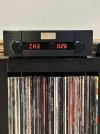
I recently picked up one of these Cary SLP90 clones, although I don't believe (not really sure) if it is of the Zero Zone variety. As soon as I opened up the very well packaged preamp, I took the cover off and replaced the stock JJ tubes with two matched pairs of NOS RCA clear top 12AU7's. It is broken in now and truly sounds great with no mods. It seems to pair well with my Odyssey Khartago extreme SE power amp; I literally have no gain issues whatsoever. Very happy customer!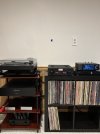
Last edited:
Hi, if there is any interest ..
My final change went in a few days ago, and I can finally say that I think I am happy with the sound and how it now capable of driving my power amp:
So : yeh- upgrade the capacitors driving out the signal (Base Mundorf are great ) , that is a no brainer.
Now the high gain of the this amp (about 20db) are not such big issue, the biggest problem is that clone is using some really low capacitance H+ supply capacitors that are not helping at all.
--> I tested it in stages: Sound fullness, bass control and depth = the two that drive the output stage
--> Stereo image/stage improved with the gain stage supply caps.
The second issue I found with this preamp is that the preamp is "lazy" due to the coupling capacitors (the yellow ones), between the gain stage and the output stage (cathode follower) , when the music get quick and busy (example = EDM / Trance), which kind of optimized the preamp for Jazz / Classic. Upgrading these made it snappier.
Ended up with a not cheap upgrade (~$130)
1) Replace the H+ caps (those 4 brown corners housing 12uF with some nice F&T Electrolytic Caps, 47uF, 500v)
2) The signal path caps , I replaced with 2x Mundorf Supreme EVO 0.15uF on each side (I found in stock the 1000v, so a bit expensive)
My final change went in a few days ago, and I can finally say that I think I am happy with the sound and how it now capable of driving my power amp:
So : yeh- upgrade the capacitors driving out the signal (Base Mundorf are great ) , that is a no brainer.
Now the high gain of the this amp (about 20db) are not such big issue, the biggest problem is that clone is using some really low capacitance H+ supply capacitors that are not helping at all.
--> I tested it in stages: Sound fullness, bass control and depth = the two that drive the output stage
--> Stereo image/stage improved with the gain stage supply caps.
The second issue I found with this preamp is that the preamp is "lazy" due to the coupling capacitors (the yellow ones), between the gain stage and the output stage (cathode follower) , when the music get quick and busy (example = EDM / Trance), which kind of optimized the preamp for Jazz / Classic. Upgrading these made it snappier.
Ended up with a not cheap upgrade (~$130)
1) Replace the H+ caps (those 4 brown corners housing 12uF with some nice F&T Electrolytic Caps, 47uF, 500v)
2) The signal path caps , I replaced with 2x Mundorf Supreme EVO 0.15uF on each side (I found in stock the 1000v, so a bit expensive)