• The move to the new server is done. There are some software and database maintenance updates in process. This has us passing the hat around to help out. We appreciate any donations. Seriously, even a dollar helps. The payment page may be found here - https://www.audiokarma.org/support.html

5AR4 questions

I will swap in a known good 5AR4 and check voltage between pins 2-8. Then remove dropping resistor and measure again to see how much load takes the voltage down.
Thanks for the heads up on the GE and Sylvania tubes. I shall return with numbers in a few days. Thanks again to all who have helped. I don't have the knowledge that any of you have. Just started this hobby about 8 years ago and haven't had any real troubleshooting issues.
Thanks and good luck!
 
BTW... if you need a new GZ34/5AR4 and NOS Mullard or Dutch Amperex tubes are too rich, look for a good NOS GE or Sylvania 5AR4. They are as reliable as the European GZ34s.
It's been said many times that the "military" 5V4GA made my Sylvania is probably their 5AR4 relabeled for the military since it would be drop in and heavier duty than the 5V4GT. I have a few and they have the same voltage drop as a 5AR4 which is less than a traditional 5V4GT. Note also that a 5U4G etc. is NOT a good sub for the GZ34/5AR4 because its filament requires 3 amps, vs the 5AR4 1.9 amps.

Stand by... I had the wrong picture, I will find the correct on and post it...
 
Last edited:
Note! I am only talking about Sylvania tubes. An RCA 5V4GA is not the same. Look at the construction, compare, you will see the difference. ONLY Sylvania, just to be clear.

EDIT: Sorry lets be more specific. Philips ECG which I think is the follow on company name. Unfortunately the sellers on eBay now know about this little "Secret:("
 

Attachments

  • 5V4GA.jpg
    5V4GA.jpg
    69.3 KB · Views: 22
Last edited:
It's been said many times that the "military" 5V4GA made my Sylvania is probably their 5AR4 relabeled for the military since it would be drop in and heavier duty than the 5V4GT. I have a few and they have the same voltage drop as a 5AR4 which is less than a traditional 5V4GT. Note also that a 5U4G etc. is NOT a good sub for the GZ34/5AR4 because its filament requires 3 amps, vs the 5AR4 1.9 amps.
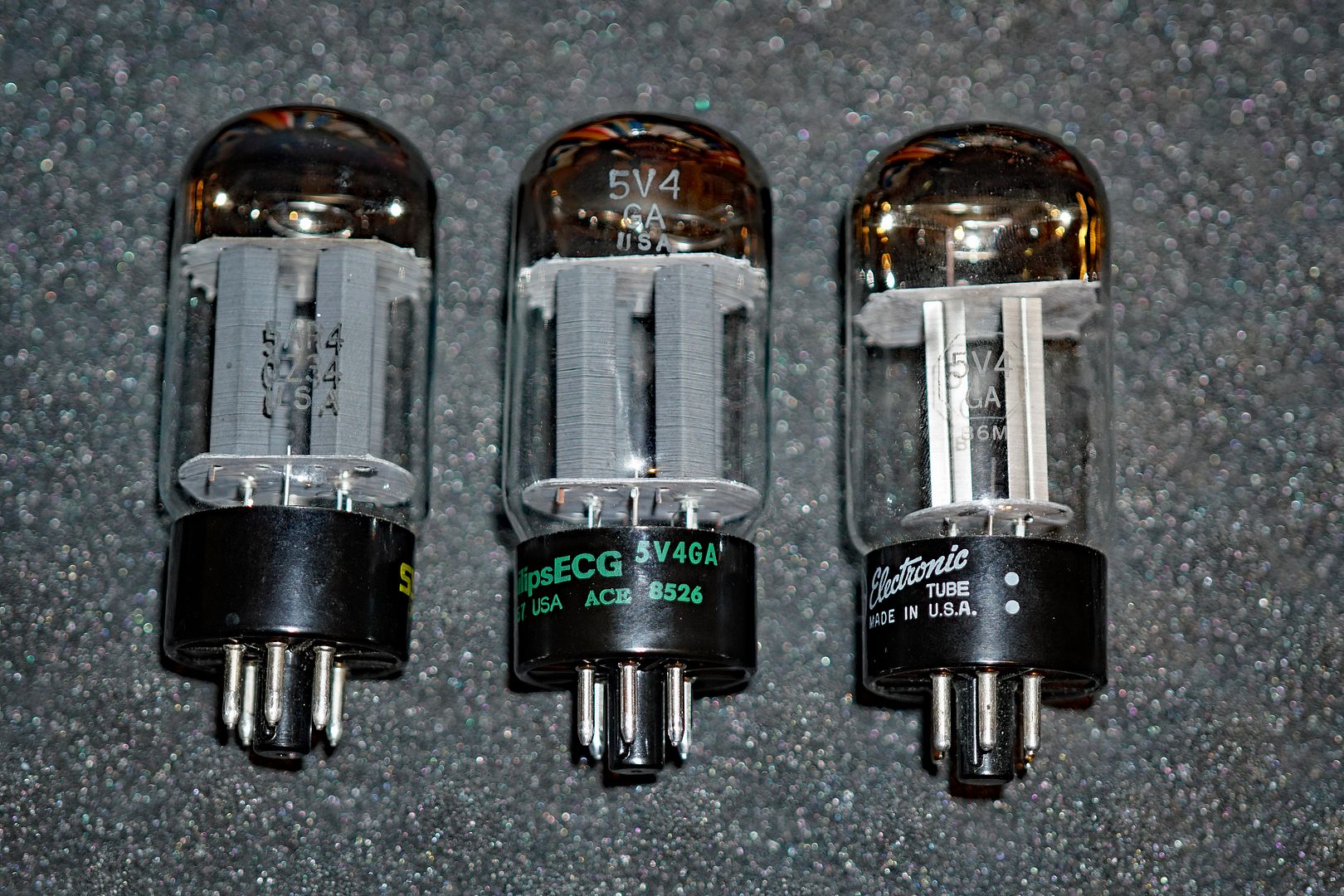
I bought a bunch of those 5AR4 (5V4GA) Philips-ECG mil-spec rectifiers. They are 5AR4. Built using old Sylvania jigs.

They are very good tubes.

db583da7-9974-4074-be04-6eaa7909ef46.jpg
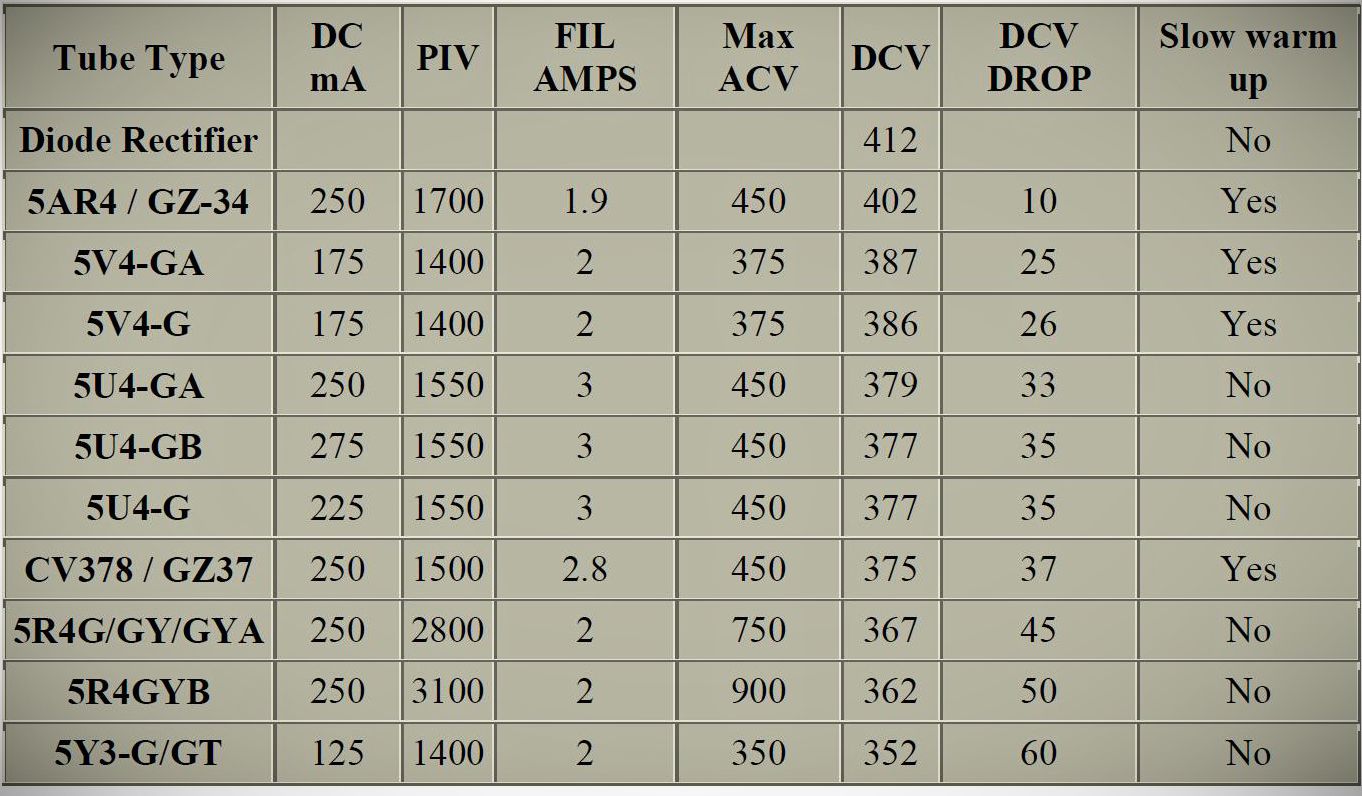
Sylvania 5AR4 on the left. Philips-ECG labeled "5V4GA" in the middle. "Real" GE (prolly RCA-made, relabeled) 5V4GA on the right.

4c3ffbab-dce0-466a-a2af-ae1af47e56a6.jpg

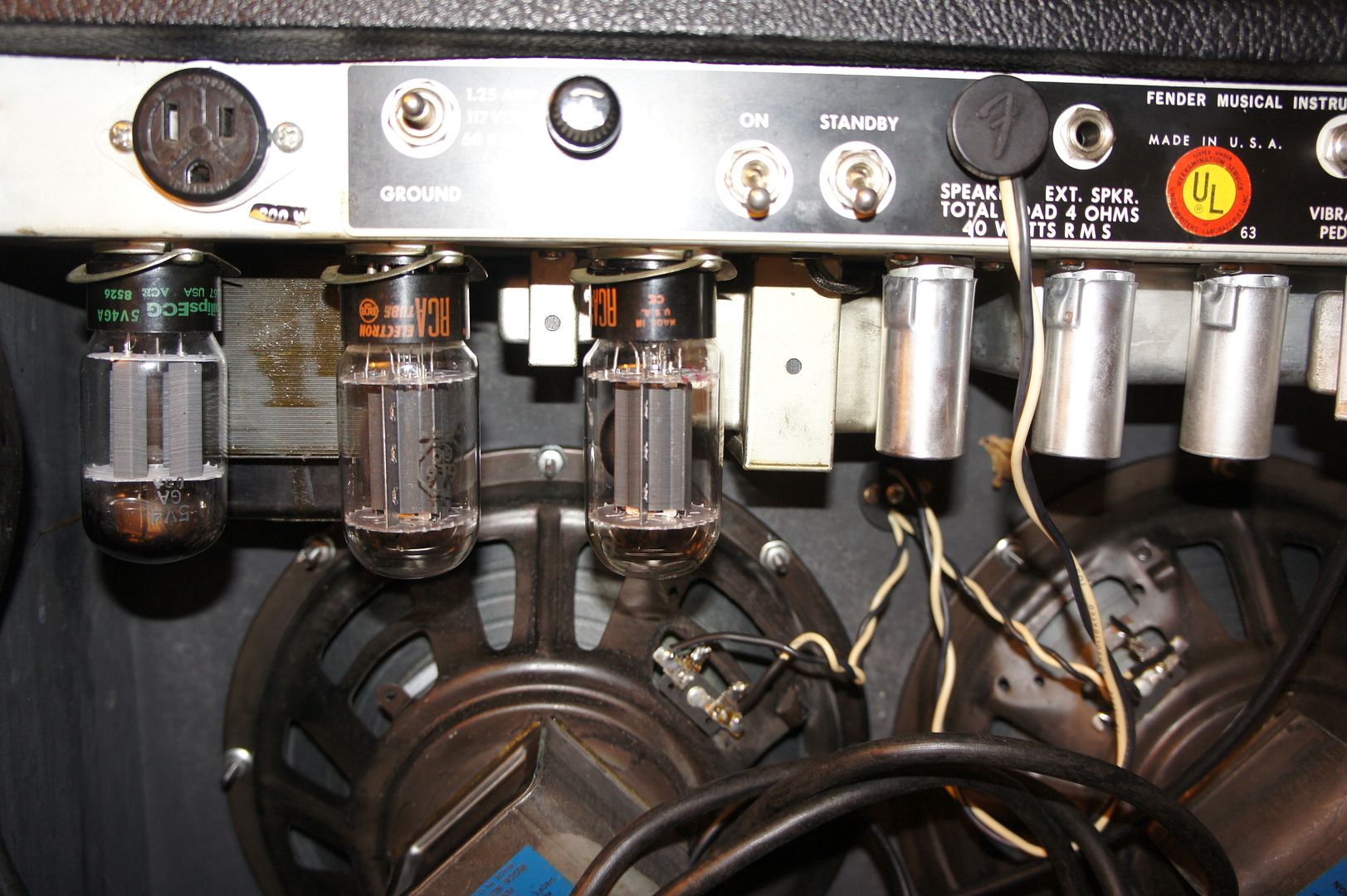
My 1972 Fender Vibrolux with the Philips-ECG rectifier.
 
Last edited:
Note! I am only talking about Sylvania tubes. An RCA 5V4GA is not the same. Look at the construction, compare, you will see the difference. ONLY Sylvania, just to be clear.

EDIT: Sorry lets be more specific. Philips ECG which I think is the follow on company name. Unfortunately the sellers on eBay now know about this little "Secret:("
Philips-ECG. I have not seen this "5V4GA" 5AR4 with a Sylvania label. Though they were made in the same US plant.
 
A 5V4G is not the same thing, those are good for (I think) 175mA vs 250mA for a 5AR4. Not looking at a datasheet so that may be slightly off but its a decent bit less, whatever it is. Might be able to get away with it but I think you'd be pushing your luck.

Philips-ECG. I have not seen this "5V4GA" 5AR4 with a Sylvania label. Though they were made in the same US plant.
The one on the left in your pic appears to be a Sylvania label.
 
New revelations. Correction from the very first post I made. I gave the 5AR4 voltages with a 30 ohm resistor and it had a 15 ohm in it. Should have said pins 4 and 6 have 260 vac NOT 235 vac.
Heater voltage with no tube 5.08 vac. With 5AR4 and 15 ohm resistor 4.4 vac. With 5AR4 and NO dropping resistor, just a CL90 thermistor is 4.95 vac. This did up my plates on the 6bq5’s. Have 289-309. Data sheet says 300 max. Schematic says 315..did they run them over just to achieve better marketing numbers?
Any new issues anyone can see? Suggestions?
 
Its cathode to plate voltage that matters, so you're probably very close to 300. Plenty of mfg did run them beyond 300 though, some well beyond.

4.95v for the 5ar4 heater with the tube in sounds very good.
 
Thank you gadjet73 for pointing out low primary and hence low secondary voltages. Would have never arrived at that as an issue. Probably didn’t help the 5AR4 any by running 20% lower that expected. I will have to start the search for an old stock 5AR4.
Great to have a village out there who have the knowledge and time to pass along the tribal knowledge that takes decades to acquire. Many thanks to all who have helped me along. Learned many things on how and where to look.
With the amp running it is only pulling .95 amps. Thank you everyone.
 
Seems like the addition of a resistor in mains primary - to compensate for higher line voltage - was not a good choice. Perhaps better to use a bucking transformer with a setting based on monitoring of the actual mains voltage available, and with a cross check of heater voltages.

I'd recommend adding in the yellow sheet mod as a way of extending the service life of the 5AR4, and avoiding the chance of collateral damage if the 5AR4 had arced.
 
A 5V4G is not the same thing, those are good for (I think) 175mA vs 250mA for a 5AR4. Not looking at a datasheet so that may be slightly off but its a decent bit less, whatever it is. Might be able to get away with it but I think you'd be pushing your luck.
FYI...

4942194d-28f2-415a-af1d-e075ebbc0e63.jpg
 
I have thumbed through the yellow sheet mod. Very good idea. I will definitely do that. Thanks for pointing me there.
This Pilot is very pleasant on the ears. Was never on my radar. Now it’s never leaving my home. Again thanks to everyone on AK. Hopefully in the near future I can pass along some useful info to beginner.
 
I think it bears repeating a point that's been made earlier and Gadget just repeated because it's easily lost when things are not fully understood.

Bias conditions on the output tubes determine current draw, with the output tubes accounting for the vast majority of the current use in the amp. This has *much* more to do with how "hard" the amp is being run and potential for damage than B+ voltage (and the B+ voltage is more a function of the current draw than most other aspects of the circuit).
The Pilot 240 is cathode biased so you want to know your voltage at pin 3 of the output tubes. Schematic shows 11.5V, so with a 150 ohm cathode resistor that means 76mA per pair of output tubes or around 38mA per tube.
In stock form with 325V on the plates (313.5 across the tube) and 38mA of current that's 11.9W dissipation. Given that the tube has a max dissipation rating of 12W, you can see why this is important.
You don't need to have exactly 11.5V on pin 3, but channel to channel the voltages should be similar and between the plate voltage (with a healthy rectifier), cathode voltage and some use of Ohm's law (V=IR, P=IV) you want to know that you're operating the tubes within limits.

Given that modern wall voltages tend to run high, it's unusual to see voltages significantly lower than spec, and it often points to excessive current draw somewhere.
 
The one on the left in your pic appears to be a Sylvania label.

5AR4 vs 5V4GA mislabeled3.jpg
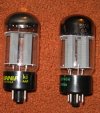
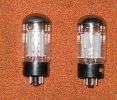
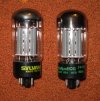
Yellow labeled tube is a Sylvania 5AR4. Green label = Philips ECG "5V4GA."


5AR4-GZ34 Sylvania 1970b.jpg
Sylvania 5AR4 plate structure.


5AR4 vs 5V4GA mislabeled.jpg
You can tell that both have similar internal structures.

Really, identical tubes. When the mil-spec "Philips-ECG 5V4GA" first hit eBay, there was a seller in Sacramento who bought a crate's worth from Beale AFB surplus. The USAF was going to destroy them. He must have sold 500 or more. It started at $25 a tube and went to $150/tube.

A very nice seller. We communicated quite a bit. That tube saved many vintage amps with dying GZ34s. :thumbsup:
 
Last edited:
Back
Top Bottom