

You are using an out of date browser. It may not display this or other websites correctly.
You should upgrade or use an alternative browser.
You should upgrade or use an alternative browser.
How important is the cartridge in the signal chain?
- Thread starter Old Driver
- Start date

both of mine are not too magnetic, left one is made of cobalt-chromium with porous ceramic to allow the bone to grow into them, right one is mostly titanium. I split the difference- MC in the living room, MM in the office !If you have any metal in your knees, I’d stick with MC, rather than MM.
Last edited:

If you have any metal in your knees, I’d stick with MC, rather than MM.
What do you do if your metal knee replacements cause a 60 cycle hum on your system every time you enter the room?
Do they make a human grounding systems. THIS IS A JOKE!
Do they make a human grounding systems. THIS IS A JOKE!
You have to attach a permanent ground wire (better yet an 8’ grounding rod) to your leg and properly ground yourself each time you play your stereo.What do you do if your metal knee replacements cause a 60 cycle hum on your system every time you enter the room?
Do they make a human grounding systems. THIS IS A JOKE!

I'm more afraid of attracting lightning !What do you do if your metal knee replacements cause a 60 cycle hum on your system every time you enter the room?
Do they make a human grounding systems. THIS IS A JOKE!
Last edited:

doctor fuse
Super Member


mkane
Lunatic Member
Expensive & not so expensive.I don't think most would agree with you
If a stylus doesn't have a sound, why do we have different stylus shapes? Why do we have so many different cantilever materials?
katana1100
Well-Known Member
Once you get past decent tracking $500 ish carts , they don’t get better!
All carts introduce their own distortions /colorations . Spend more and it’s really a matter of “ do you like this sound better than that sound?”
Yes, I have some $ microline boron shaft carts but I also have three tables with conicals , my pioneer pl41 and pl50 rock conicals with oem styli that’s around 60 years old and I like them a lot too.
Use your ears, not your wallet.
All carts introduce their own distortions /colorations . Spend more and it’s really a matter of “ do you like this sound better than that sound?”
Yes, I have some $ microline boron shaft carts but I also have three tables with conicals , my pioneer pl41 and pl50 rock conicals with oem styli that’s around 60 years old and I like them a lot too.
Use your ears, not your wallet.
Krautmaster,For an old 70's turntable the AT-VM540ML is an excellent choice, but their VM740xML is even better : it has a threaded aluminum body and better wires that deal with high capacitance better (not as bright).
Quick update for you. The Audio Technica VM740xML cartridge in now mounted and calibrated using the Hudson Hifi kit you suggested.
All I can say is very, very pleased with the results. This is a massive sonic improvement. Thanks for the great advice!
I'm glad you like it, the 740xML is a great cartridge - yours will sound even better after playing 15-20 albums !Krautmaster,
Quick update for you. The Audio Technica VM740xML cartridge in now mounted and calibrated using the Hudson Hifi kit you suggested.
All I can say is very, very pleased with the results. This is a massive sonic improvement. Thanks for the great advice!

melofelo
Addicted Member
The simple answer goes back to the 1980s Analogue Front End Heirachy. Usually simplified as " Garbage in = Garbage out" .Does the quality tier of the turntable have any bearing on the wise purchase of the cartridge? Will a high end cartridge on my Micro Seiki sound great or is that just overkill.
Is there a rule of thumb for quality matching the cartridge to the turntable?
Back then , the perceived wisdom was to allocate the largest portion of a front end budget to the quality of the turntable plinth , then the tonearm and ,lastly, the cartridge in that order. In 1980s money ratio that would translate to something like 50% plinth / 40% tonearm ? 10% cartridge.
This approach would often be employed until you could afford something as capable as a Linn LP12 , a top spec Thorens like the TD-531, Roksan Xerxes etc....and a high quality tonearm. Only then would you consider throwing real money at the cartridge.
The logic from an engineering perspective was : the first thing you want to eliminate or minimise before throwing money at a cartridge was any vibration NOT related to the stylus tracing the signal in the groove.
The cost vs performance ratio claimed by this approach, (and Linn seemed to preach it more than most) , was that the most disposable part of the front end ( ie the cartridge and stylus ) shouldn't exceed the quality of either the turntable plinth system or the quality of the toneaam it was attached to.
This was because any unwanted vibrations that these two preceeding components added to the stylus /record groove interface was distortion added to the musical signal.
The less distortion added , the better chance the cartridge had of retrieving a cleaner musical signal.
Imho opinion..it worked well as a cost effective way of getting the best front end set up you could on a limited budget until you could afford high end turntables.
The thing to remember is that a turntable package as a whole is basically a very vibration sensitive tracing instrument. And it depends on good engineering tolerances and finish in the moving parts most critical to this task. Platter bearings, motor vibration , plinth vibrations, construction materials, tonearm bearing friction or play...tonearm cable quality , electircal shielding etc...these are expensive thing to get right during manufacture..and the price reflects that. Basically the cartridge can only sound as good as the platform it is mounted to.
Most people have never listened to something like a cheap Audio Technica AT-95E or AT-110E cartridge from the 80s or even one of the cheaper Ortofon Ellipticals from that period once they were mounted on something in the same league of say a Linn Sondek or any good quality 3 point suspended plinth with an tonearm no less in quality that say a Rega RB-250 or RB-300 ( circa late 80s /early 90s spec).
Sometimes even a basic entry level budget cartridge can surprise you when the cartridge itself...is the cheapest ( and weakest ) link.
Another thing to consider..and this is probably even more important than either the turntable or cartridge is : You MUST align the cartridge to Null Points of a KNOWN geometry BASED solely on the ACTUAL mounting distance of the tonearm.
Whether its Stevenson, Loefgren A or B ( Baerwald ) geometry is better than using no geometry at all.
The *overhang method* is only a convenience shortcut. A good Protractor to ensure alignment is spot on eliminates the kind of groove tracing errors no upgrade can fix.
A good cartridge alignment can sometimes make the biggest improvement in sound once its spot on...and its completely free !
Last edited:
charles 1973
Super Member
When it comes to Turntables, it's important to balance the quality of the Cartridge and Phono Preamp with the Table, as I recently discovered.
The stock cartridge on my award winning Rega Planar 2 Turntable is thier Carbon with a Conical stylus. My nearly 50 year old Pioneer PL155A basic belt drive table with a Nagoaka MP11 cartridge in some respects bests the Planar 2. The MP11 (AKA MP110) is a better cartridge then the Carbon. That said, The Planar 2, even with the stock cartridge is entertaining.
Recently Rega started including their Nd3 cartridge with the Planar 2. So now the table and cartridge are reasonably well balanced. I just arranged to have my dealer order and install an Nd3 cartridge on my Planar 2, and ordered Rega's Fono Mk5 Preamp. This should make a well balanced mid-fi package.
For reference, CD's played on my Cambridge CX-C CD transport through the DAC Module in my Bryston Integrated Amp have a considerably better soundstage then either Turntable, better imaging and more detail.
To be fair, my Digital front end is much higher up the food chain then either of those tables now (but not for long). Hopefully with my new upgrades to my Turntable Kit, I can get closer to that.
The stock cartridge on my award winning Rega Planar 2 Turntable is thier Carbon with a Conical stylus. My nearly 50 year old Pioneer PL155A basic belt drive table with a Nagoaka MP11 cartridge in some respects bests the Planar 2. The MP11 (AKA MP110) is a better cartridge then the Carbon. That said, The Planar 2, even with the stock cartridge is entertaining.
Recently Rega started including their Nd3 cartridge with the Planar 2. So now the table and cartridge are reasonably well balanced. I just arranged to have my dealer order and install an Nd3 cartridge on my Planar 2, and ordered Rega's Fono Mk5 Preamp. This should make a well balanced mid-fi package.
For reference, CD's played on my Cambridge CX-C CD transport through the DAC Module in my Bryston Integrated Amp have a considerably better soundstage then either Turntable, better imaging and more detail.
To be fair, my Digital front end is much higher up the food chain then either of those tables now (but not for long). Hopefully with my new upgrades to my Turntable Kit, I can get closer to that.
Last edited:
Having a number of turntables cheap to expensive , ranked by quality
, low to high
Sony PS-212
Denon 21F
Fisher MT-6330
Denon 51F
JVC QL-Y5F
Michell Gyro SE with SME V HR supply.
and 3 RIAA and a dozen of cartridges Mm and MC from 20 usd to 1000 usd, I must say that as long the TT does not have a inherent problem like audible rumble or hum or audible speed variation,the thing that matter the most is the cartridge.
But to get the best out of an advanced stylus you need to be able to set Azimuth and align properly. This can be done by shims or fulcrum ( see Wally fulcrum, easy to make your own) .
I really appreciate the Detachable Headshell on JVC and the VTA adjustment, and hate the SME V fixed Headshell even if it measure superior . Simple ellipticals can sound OK , but when you hear a correctly aligned cartridge with MicroLine that is what you want (MC or MM)
To utilise the best profiles above elliptical you should have a TT / arm that allow adjustment of VTA/Azimuth and antiskate and VTF.
Regarding RIAA the important things for me is
1. a good and steep subsonic filter
2.Features and flexibility ( gains MM and MC
Silence an noise free of course
This do not need to cost much. My Park Audio Puffin is fabulous.
Having a good arm like on the JVC and SME V makes me sleep better. At night,
( Both measure better than the rest of my TT)
Ps
I prefer cartridges with low VTA 20-23’ that track well
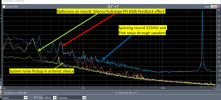
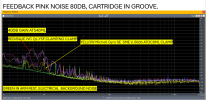
One way of comparing turntables is to record with a stylus on a record, while playing CD or other source with pink poise, and seem how muc sound is picked up by the cartridge/turntable. her is one example comparing my 2 best turntables
and some years ago using the Michell Gyro SE ( less electrical noise then)
, low to high
Sony PS-212
Denon 21F
Fisher MT-6330
Denon 51F
JVC QL-Y5F
Michell Gyro SE with SME V HR supply.
and 3 RIAA and a dozen of cartridges Mm and MC from 20 usd to 1000 usd, I must say that as long the TT does not have a inherent problem like audible rumble or hum or audible speed variation,the thing that matter the most is the cartridge.
But to get the best out of an advanced stylus you need to be able to set Azimuth and align properly. This can be done by shims or fulcrum ( see Wally fulcrum, easy to make your own) .
I really appreciate the Detachable Headshell on JVC and the VTA adjustment, and hate the SME V fixed Headshell even if it measure superior . Simple ellipticals can sound OK , but when you hear a correctly aligned cartridge with MicroLine that is what you want (MC or MM)
To utilise the best profiles above elliptical you should have a TT / arm that allow adjustment of VTA/Azimuth and antiskate and VTF.
Regarding RIAA the important things for me is
1. a good and steep subsonic filter
2.Features and flexibility ( gains MM and MC
Silence an noise free of course
This do not need to cost much. My Park Audio Puffin is fabulous.
Having a good arm like on the JVC and SME V makes me sleep better. At night,
( Both measure better than the rest of my TT)
Ps
I prefer cartridges with low VTA 20-23’ that track well
One way of comparing turntables is to record with a stylus on a record, while playing CD or other source with pink poise, and seem how muc sound is picked up by the cartridge/turntable. her is one example comparing my 2 best turntables
and some years ago using the Michell Gyro SE ( less electrical noise then)
Attachments
Last edited:
Here is 2 different cartridges on to different turntables, which do you prefer if any?
 drive.google.com
VIOLIN AT540ML VS ATOC9ML2.wav
drive.google.com
I prefer the second one: it sounds smoother and more dynamic on my crappy computer speakers.Here is 2 different cartridges on to different turntables, which do you prefer if any?
VIOLIN AT540ML VS ATOC9ML2.wav
Gotta match arm with table; cartridge with arm; the whole works with a phono stage. I’ve had expensive cartridges that didn’t work as well as less expensive cartridges. That said, once you figure out which cartridges will work, going up in price often yields better results. (My experience.)
Last edited: