• The move to the new server is done. There are some software and database maintenance updates in process. This has us passing the hat around to help out. We appreciate any donations. Seriously, even a dollar helps. The payment page may be found here - https://www.audiokarma.org/support.html

Tonearm - straight or curved

thisOne

Listen...
Hello everyone, I have this question gnawing at me regarding the merits of tonearm shape. I see that some TTs have an s-shaped arm and some have a staight arm. WHY??? What's the difference???

I did a search for some answers here, but could not find anything relevant, so if there is already a thread on the subject it would be great for someone to point me to it and then everyone can just ignore me.

Thanks for your help and collective knowledge.
 
Register to hide this ad
I know this has no useable significance.. but I think the S shaped tone arms look more classy than the straight ones... just me.
 
I've always wondered the same thing. If the cartridge is adjustable in the headhell to achieve correct alignment, what does the S curve or the straight arm matter?

At any rate, I found the following through Google. Read with skepticism...I don't swallow the argument about stright arms ALWAYS tracking better....

The "anti-skip", straight tone arm maximises tracking ability at the cost of sound quality and record wear. The position of the stylus within the groove changes on a straight arm deck as it approaches the centre of the record by varying degrees. This effect is known as tracking error - the higher the error, the more distortion within the sound. Although this is not so much of a problem with the spherical styli that DJ cartridges use, it still ensures that the stylus is not resting in the optimal position for audio reproduction over different points of the vinyl during playback. For purely scratch based applications this is an advantage if you can live with the decrease in sound quality and increase in record wear.

The classic 'S' shaped tone arm is optimised to get the best sound quality from the record whilst keeping tracking levels as high as possible. The 'S' curve in the arm is designed to dissipate any external vibrations along its length, whilst positioning the stylus at the correct angle for optimum sound reproduction across the width of the record surface. Thus, you get the best of bold worlds, albeit without the enhanced 'un-skippability' of a straight arm deck but with minimal tracking errors.

In conclusion, if tracking ability is the main criteria for your turntable then a straight arm deck is a must. Be aware that your records will wear quicker whilst sound quality will not be optimum, although it's the ideal solution if your looking for turntable purely for turntablism only. However, for a broader range of DJ'ing applications including turntablism, an 'S' shaped tone arm equipped deck is more versatile. The ideal solution of course comes from turntables which offer interchangeable tone arms - the Numark TTX-1 so far being the only one on the market to date to include this option.


The quote is from a forum talking about DJ tables, mostly. I have listened to many arms of each style...certainly if the cartridge is aligned correctly, I don't think there is any human ear that could tell the difference.

Dave

 
The DJ forum has it wrong. Proper cartridge mounting geometry can be obtained with any arm shape. Designers use S or J arms when interchangeable headshells are needed. Straight arms can have lower mass, necessary for high compliance cartridges. Materials, bearing quality, and dampening have much more to do with sound than shape alone. Trackability is influenced by bearing quality and arm resonant modes, and to some extent by dampening (if equipped), when combined with the cartridge. Arms sound will change with the use of different cartridges.
 
Tracking error will be the same for an s or straight arm if they are the same effective length as the arc the stylus travels in is the same.
 
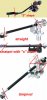
The "S" shape allows the pivot to move up and down at the same angle as the cartridge. though that can be attained by a straight arms also. A straight arm moves up and down at a different angle as the cartridge. A unipivot allows the arm to move up and down at whatever angle the record does.

It's a hard explaination but I made a diagram.
 

Attachments

  • tonearm.jpg
    tonearm.jpg
    38.5 KB · Views: 405
Holst said:
The "S" shape allows the pivot to move up and down at the same angle as the cartridge. though that can be attained by a straight arms also. A straight arm moves up and down at a different angle as the cartridge. A unipivot allows the arm to move up and down at whatever angle the record does.

It's a hard explaination but I made a diagram.
Hmm. Very nice illustration--never thought about that. Now the question is whether that has significance.
 
I always thought that an S-shaped arm has an advantage over a straight arm due to geometry. The S-shape increases the effective length of the tonearm, helping to decrease the tracking angle error that occurs as the arm pivots from the outside to the inside of the record. This would seem to be an advantage over a straight arm, but of course there are other factors that can negate some of this benefit. Alternatively, you could make your plinth three or four feet wide and have a really long tonearm, but then you'd pay a penalty in arm mass.
 
charliemcd said:
I always thought that an S-shaped arm has an advantage over a straight arm due to geometry. The S-shape increases the effective length of the tonearm, helping to decrease the tracking angle error that occurs as the arm pivots from the outside to the inside of the record. This would seem to be an advantage over a straight arm, but of course there are other factors that can negate some of this benefit. Alternatively, you could make your plinth three or four feet wide and have a really long tonearm, but then you'd pay a penalty in arm mass.

Not sure about this I thought Effective Length was a straight measurement from pivot to stylus point

As regards curved v straight arms I have no idea of their differences or respective advantages. I guess that a curved arm being longer over its measured length would be heavier, possibly stiffer
 
Holst said:
The "S" shape allows the pivot to move up and down at the same angle as the cartridge. though that can be attained by a straight arms also. A straight arm moves up and down at a different angle as the cartridge. A unipivot allows the arm to move up and down at whatever angle the record does.

It's a hard explaination but I made a diagram.
Excellent post, Holst. Thanks.
 
I've always figured a 's' shaped arm is better due to that fact also as the warps in records will be easier to track accurately compared to an straight arm with offset shell. Personally a good 's' arm looks infinitely better to me than a skinny little straight arm.
 
I'm afraid all that diagram shows is that the angle of the bearing compared to that of the headhshell makles a difference. Whether the arm is straight or s-shaped makes no difference.

The differenced are basically that s-shaped arms tend to have higher mass as their tubes are longer. The reason that they became less popular was that the increasingly compliant cartridges of the 1970's and 80's required lower mass arms, so thinner, straight tubes became more prevalent.

Ultimately the 'best' arm is the one that is most well designed and made. The shape of the tube should be irrelevant unless you value looks over sonic performance!
 
Maybe it's oversimplification on my part, but I always considered S-arms to have more mass than necessary, and less torsional rigidity than a straight arm. Plus the fact that the shortest distance between two points is a straight line, as well as it being simpler, always made me believe that straight arms are better. :dunno: Note I said "believe". It's an opinion.
Have there ever been any listening tests where a good TT motor and platter had the arms (with the same cart) swapped out and evaluated as to which sort of arm was measureably "better"?
 
hakaplan said:
Hmm. Very nice illustration--never thought about that. Now the question is whether that has significance.

It seems like a fine tonearm can take any shape. Don't worry, be happy, buy records.
 
Take a deep breath … Apparently, there’s a bit of more complex geometry than the easily visualized effective length/swing arc going on here. While swing arcs of both type pivoting tonearms of equal effective lengths are identical. The tangential relationship of the stylus to the groove (that ever changing axis off 90 degrees as the record tracks across the record) is influenced whether its offset (cant) is at the tube end or back 4 to 5 inches.

Take another deep breath… This, in turn affects, not only the tracking behavior of the arms but also each of the two type’s dependency on anti-skate. The straight arm needing much less than the S-curved offset (Rega users will attest to this). Some have it that a 12” straight-arm can perform well enough (with a spherical stylus) to dispense with any skate compensation completely.

Now, I started this with “apparently” because I am spatially challenged and I need wood mock-ups, compass arcs and not words to visually anything beyond the simple plane geometry. So I’m not convinced about this, nor am I, in any way, prepared to defend it. But this is out there and I’m trying to keep my mind open it. I’ve asked for illustrations.

- Mario
 
I have some articles around the place written way back when actual mathematics were important which clearly discuss the reasons, the physics and the superiority of 's' arms with offset bearings parallel with the cartridge over any type of straight arm, offset or 'j' arm. It wasn't written by anyone with a vested interest in anything other than education, unlike arm manufacturers. The 's' didn't just appear by itself, it was the result of a whole lot of physics and some very clever mathematicians. That being said, they all sound good to me when set up right so who cares? :yes:
 
here's a bit I found on the web doesn't really say it makes much difference:

The second effect relates to alignment of the vertical bearings. Modern tonearms are generally designed so that the vertical bearing axis is perpendicular to a line through a projection of the cantilever on the record surface. The significance of this point is that variations in record thickness, or up down movement of the stylus due to warp, will not change the azimuth alignment of the cartridge. If the user sets the cartridge so that the linear offset is different to that intended by the manufacturer, then variations in the height of the stylus on the record surface will have a slight effect on azimuth. However this effect should not be overestimated. It is very small indeed. Moreover it should be remembered that older arm designs (SME 3009 SII) and unipivot arms, do not have aligned bearings to begin with. The SME vertical axis is approximately 30 degrees displaced from perpendicular. Even with such grossly misaligned bearings, the effect on azimuth due to a change in stylus height of 1mm is less than 0.25 degrees. While this effect may be worthy of consideration when choosing between tonearms using aligned or misaligned bearings, the effect on azimuth of an alignment error of a few degrees (which would be typical of selecting an alternative linear offset to the recommended value) is absolutely negligible.

It's all getting too hard for this early in the morning...:yes:
 
Back
Top Bottom