• The move to the new server is done. There are some software and database maintenance updates in process. This has us passing the hat around to help out. We appreciate any donations. Seriously, even a dollar helps. The payment page may be found here - https://www.audiokarma.org/support.html

0.1uf Suzuki 400WV Capacitors

CharlieDont

New Member
Hey there,

I’ve got a TEAC reel-to-reel I’d like to fix up for use to record for fun. I have never run the motor yet. When I first plugged it in I checked the voltage from chassis to ground I got a 50V reading. I figured that meant I should probably (1) add a grounded cord and (2) recap the power section. Before doing anything though, I wanted to make sure too be aware of basic maintenance. Reading a bit on the forums here and saw the 0.1uf Suzuki really need to go. I have some of these on hand and wondered if they would do the job- from what I understand metal-film is good but maybe it specifically needs an a VAC rating. From hearsay it sounded as though if it has a really high DC rating the AC rating should be about two-thirds of the VDC rating? Anyway just wishing for some insight into that question. Do I need to order some of those yellow film caps with an explicit VAC rating or do these panasonic 630VDC film caps do the job just fine?

All the best,
Charlie

https://www.mouser.com/ProductDetail/Panasonic/ECQ-E6104KFB?qs=9ouE0kzBZ2qb/N/pLDqD5Q==
 
Register to hide this ad
If the capacitor is connected to the AC line voltage, you want to get a cap approved just for that application (across the AC line or from AC line to ground) in order to have all of the safety approvals. Otherwise, the 630Vdc cap will work fine.
 
Greetings from RojoLand!

The capacitors you specify will be fine to replace the Suzuki-bombs, though I would suggest axial yellow film capacitors (0.1 µF 630 V) available at outfits such as JustRadios, Sal's Capacitor Corner and others. These caps have the same form factor as the Suzuki-bombs. Radial caps such as the Panasonic parts work electrically but have a slightly greater risk of shorting to the chassis if lead dress isn't done carefully. No AC rating is necessary; these are used as snubber capacitors across switches, relay contacts and solenoids. (Some of the snubbers in your Teac may be green lozenge-shaped Mylar caps which should be fine.)

Be aware that much of the mechanical chassis runs off the primary side of the power transformer, and as such is not isolated from the power line. There shouldn't be any leakage to ground (and don't measure voltages from any part of that circuit to chassis!). Replacing the power-supply capacitors is a good idea. What model is your Teac deck?

Take care,

J. E. Knox "The Victor Freak"
 
Greetings from RojoLand!

The capacitors you specify will be fine to replace the Suzuki-bombs, though I would suggest axial yellow film capacitors (0.1 µF 630 V) available at outfits such as JustRadios, Sal's Capacitor Corner and others. These caps have the same form factor as the Suzuki-bombs. Radial caps such as the Panasonic parts work electrically but have a slightly greater risk of shorting to the chassis if lead dress isn't done carefully. No AC rating is necessary; these are used as snubber capacitors across switches, relay contacts and solenoids. (Some of the snubbers in your Teac may be green lozenge-shaped Mylar caps which should be fine.)

Be aware that much of the mechanical chassis runs off the primary side of the power transformer, and as such is not isolated from the power line. There shouldn't be any leakage to ground (and don't measure voltages from any part of that circuit to chassis!). Replacing the power-supply capacitors is a good idea. What model is your Teac deck?

Take care,

J. E. Knox "The Victor Freak"

Hey there!

Its a Teac a-4010s, has the amplifier in the same cabinet marked ra-40s.

That is really interesting, I guess that design was to save on expense? Does that mean to always be aware and even after all maintenance is done, I should never be touching it with one hand and another piece of grounded gear with the other?

Also thanks for the guidance on the 0.1s!

all the best,
Charlie
 
Greetings from RojoLand!

I figured it might be an A-4010S. (I have one too, S/N 48104.) Service manual is available at HiFi Engine (free membership required to download); get the manual specified for serial numbers 14459 and up. (There are different schemos for this model.)

Using an ohmmeter on high range, and with the set unplugged, power switch on and shutoff arm propped up (and no audio connections to other equipment), measure resistance between each leg of the power plug and the chassis. It should show open circuit. Any leakage must be corrected, and that will be a tough job to suss out the leakage source. You might also unplug the umbilical cords from deck chassis to RA-40S record amplifier if you find leakage. The electronics are powered through transformers so there should be no direct connection to the line. It is possible to have a partially shorted motor winding or power transformer that could leak line AC to the chassis. Hope not!!

The power transformer primary has a direct connection to the AC line, and the power switch is on the opposite side of the primary. That may contribute to that chassis-to-ground reading. Try reversing the plug and re-measuring; it may make the difference.

Take care,

J. E. Knox "The Victor Freak"
 
Greetings from RojoLand!

I figured it might be an A-4010S. (I have one too, S/N 48104.) Service manual is available at HiFi Engine (free membership required to download); get the manual specified for serial numbers 14459 and up. (There are different schemos for this model.)

Using an ohmmeter on high range, and with the set unplugged, power switch on and shutoff arm propped up (and no audio connections to other equipment), measure resistance between each leg of the power plug and the chassis. It should show open circuit. Any leakage must be corrected, and that will be a tough job to suss out the leakage source. You might also unplug the umbilical cords from deck chassis to RA-40S record amplifier if you find leakage. The electronics are powered through transformers so there should be no direct connection to the line. It is possible to have a partially shorted motor winding or power transformer that could leak line AC to the chassis. Hope not!!

The power transformer primary has a direct connection to the AC line, and the power switch is on the opposite side of the primary. That may contribute to that chassis-to-ground reading. Try reversing the plug and re-measuring; it may make the difference.

Take care,

J. E. Knox "The Victor Freak"


Hey! Thanks for the thoughtful responses. It’s been very illuminating. I have one more question about the “WV” ratings.

I ordered the power supply caps based on the schematic and I think most caps are rated for DC. Anyway, I’m a little uncertain about these that I ordered as they are just your typical 50V [DC] and once I got the original cans turned around and could read them they are rated 50V WV, Surge 75V.

Would I be better off getting some rated higher?

—-
Charlie
Galveston, TX
 

Attachments

  • image.jpg
    image.jpg
    67 KB · Views: 25
Greetings from RojoLand!

The 1000 µF 50 V electrolytic caps you ordered should be fine. "WV" means working volts. The 1000/50 'lytic (C 201) is the main filter cap for the 27 V supply and is fed by a 24 VAC transformer secondary and a bridge rectifier. 50 volt rating is A-OKeh. A 1000/63 would be even better, but there's no real reason for that if you have the 1000/50s. Electrolytic caps are much better now than they used to be, as you can tell by the size difference alone. Mounting the replacement will be a little challenge.

Do take note that this is a negative supply; the (—) side of the replacement cap connects to fuse F2 and resistors R 301 and R 302, and the (+) lead to ground. If you also change out C203 (200/50) and the un-numbered 200/50 shown on the schematic, they too connect positive-to-ground (like some pre-1955 car batteries!). The amplifier circuits use PNP germanium transistors; that's why the negative supply.

Take care,

J. E. Knox "The Victor Freak"
 
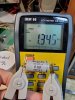
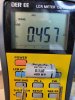
Just finished bringing an A-4010S back to life so I thought I'd share the attached photos. Of the 13 Suzuki 0.1 uF capacitors I replaced, 12 had ESR readings in the 0.3-0.5 Ω range. One, however, measured 1.345 MΩ. . . I guess that was the time bomb in this machine. Fortunately i replaced them before I powered up the deck. Probably saved myself from a stinky mess - both in the cabinet and in my shorts, LOL.

20210525_210431.jpg 20210525_210506.jpg
 
The more critical fail mode with those things is electrical leakage at working voltage. If you could run it up to 400vdc across it and see what sort of leakage current you get, that would tell you more about their functional condition. its a lot more fussy in tube gear though, the high impedance involved make even slight leakage cause a lot of troubles.

Anything going line to chassis I'd sub with a rated safety cap. Those are specifically designed for across the line or line to chassis use. There is an X and a Y, off the top of my head I forget which is which but caps exist in X1Y2 ratings that work fine in both positions.
 
Greetings from RojoLand!

I'd say THIS is the "critical fail mode" for a Suzuki-bomb:

Suzuki-bomb, exploded (small).jpg

Take care,

J. E. Knox "The Victor Freak"
 
Greetings from RojoLand!

I'd say THIS is the "critical fail mode" for a Suzuki-bomb:

View attachment 2250743

Take care,

J. E. Knox "The Victor Freak"
That snubber cap on the left brake microswitch was the very one that blew up on my 4010, with exactly the same failure mode. I replaced them all with the yellow 630 VAC film caps you recommended, bought from Radio Daze.

Rick “now working on a 4300” Denney
 
You got to watch what you believe in some posts. The leakage from a true ground to the chassis can have voltage on it but the voltage should fall to zero value of AC volts when shorted to ground by a 10K resistor. This is just leakage coming from near by wires. Now if you have a deck like mine that burner a 1K 1/4 watt resistor in half when tested, then I had to go find the problem which was a pinched wire behind a motor. After I found that and added some heat shrink tubing to the wire the deck did past the 10K test.
The A4010S is a very old deck from the days of the Vietnam war. This means you are dealing with 60 year old Electrolytics and they all need to go. On top of that they are not just soldered in like a regular part but many leads are bent over and combined. So you have to use a lot of time to take out and put new ones in. First you want to evaluate the heads as to wear. You don't want to recap a deck only to find out that you need another $350 worth of heads and that is if you know how to install them- they just do not snap in like some think There are brake pads to consider changing and Lubrication of the Pinch roller linkage and then even getting the pinch roller re-rubbered by Terry who is now sick with Covid for a while. A new belt and oiling the motors and capstan bearing. There can be 5 to 6 hours of work needed on a deck like this due to age. I know because I have done many of them over the years..
The .1uFd 630 DC is also 125Vac or 250Vac caps from their datasheet. They do not say how they differentiate. The 630Vdc cap will probably work fine as it is only there for spark mitigation across the contacts of a switch or motor field.
 
They do not blow up all that often as I have never seen one blow up yet and in 47 years and working at the factory service you would think I would if it happens all that often. I am just saying.
 
Greetings from RojoLand!

"They do not blow up all that often…" — Sam, I'd have to say you've been lucky not to have seen a Suzuki-bomb blow in 47 years. Granted, I've not seen all that many of those buggers personally, but I can report that I have personally experienced an exploding Suzuki-bomb when evaluating my Concertone S-510R (which was Teac-made), and when rebuilding that rig I tested all the Suzuki caps in the set, found them all leaky (electrically) to some extent, and of course replaced them all. (Indeed, I replaced all the caps and resistors in the set — "Suzuki-ohm" dogbone-style resistors all tested off-value too!) So for me at least, any component that says "Suzuki" on it gets replaced *yesterday*.

Also, caps don't have to be old to be bad. At my former employer, a public-access TV facility, we had video equipment (camera control units) stored in an uninsulated van in our parking lot. During warm weather, it wasn't long before the gear misbehaved — controls wouldn't function, for example. Cameras were fine. What I found was a bunch of 10 µF 35 V 'lytics in the CCUs were leaking (both electrically and physically). Panasonic gear, only a year or two old, with both Pana and Elna caps; it was the Elnas that were croaking. I changed out the Elnas and got the gear working again, then strongly urged the powers-that-be to store the equipment elsewhere instead of in a hot van. Have also had to change out 'lytics in Sony monitors less than two years old.

I retired four years ago and am kinda glad not to have to deal with that sort of stuff so much anymore. My current stable of gear keeps me busy enough.

Take care,

J. E. Knox "The Victor Freak"
 
Yes, Panasonic was known to cheap things out. In Japan they are called National and the Japanese don't buy that stuff I am told. Look what they did to the Technics RS line of decks with all that garbage they put in there. Teac caps last way longer than Technics as long as they are Not Marcon.
cars can get up to 140 degrees in the sun which is how some people kill their dogs left in cars. These consumer grade item are not built like NASA equipment and so you can not stress them like that. Age takes it toll as well as who made it. Chinese caps are expired when they leave the factory- why so many LCD flat panels fail all the time.
 
I am not telling you to keep the Suzuki caps change them all out if you want. I just do not see them blow all that often. The caps on computer boards yes, but then here we are at China again.
 
Greetings from RojoLand!

In the case of our Panasonic cameras and CCUs, those weren't consumer gear — they were industrial WV-F700U cameras and the matching WV-RC700 CCU. But lesser-quality caps won't care what level of gear they're put in, will they? :no: (Elna's on my s**t list too. Have always been a fan of Pana and Nichicon caps.)

Take care,

J. E. Knox "The Victor Freak"
 
I've replaced a fair number of caps in old car electronics. Ford seemed to use mostly Nichicon but after 20+ years in the heat and cold I don't think it matters all that much. Failure mode was the same on all of it, goo leaking out of the bottom and running across the board, causing all sorts of stupid problems. Usually fixable with new caps and scrubbing but once in a while it sits long enough that it rots traces on the PCB.
 
Back
Top Bottom