• The move to the new server is done. There are some software and database maintenance updates in process. This has us passing the hat around to help out. We appreciate any donations. Seriously, even a dollar helps. The payment page may be found here - https://www.audiokarma.org/support.html

18T split/knurled shafts, I have several/many potentiometer's that have broken shafts.

zebulon1

Retired finally and having a blast on the bench
Subscriber
I like to find a new potentiometer with the proper shaft I can cut and use on the original Pioneer pots.
The shafts and split knurled stems are longer than what I can find in new stock.
Finding some cheap original donor pot is difficult, plus I don't want to ruin any possible replacement parts using even a similar part.
Maybe someone has been through this already and has a good source for these longer 18T split shafts?
The pots in question are the tone, balance and volume pots on the big Pioneer 70's equipment.
Below is an example of the shafts that I'm looking for.
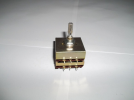
1693147696722.png
 
Register to hide this ad
it doesnt look like that splined section is as long as the oem on the 300mm item. but it could be used with some modification. the chinesium pots are intriguing if all you want to do is scavenge the shaft and pitch the rest. too bad they didnt see fit to provide dimensions or even the resistance value and taper if any and what kind. its cheap enough to order the pots and try it i guess. there was an ebay seller a couple of weeks back that said he was having pots made for lot of different receivers marantz,pioneer, etc. i inquired about a 1010 pot and he said he needed a picture. theres thread sizes that are different from the very early and 70's gear too. i totally understand the motivation to repair and reclaim the vintage originals. it will be hell to do without a lathe. and as watthour pointed out the shaft portion inside the pot will be very difficult to get on center and getting the tap started straight. i have some cheap oriental radio switches that are 6mm splined. the ones i have appear to be zinc alloy shafts where pioneer appears to be aluminum if this affects your game plan is an unknown
 
Sounds like another Spec-1 volume control project is in the offing.

Look at some of the chinese pots that have smd resistors.
 
It’s just the shafts I’m looking for. $4 for a supposed Alps pot is reasonable but I can’t help thinking I can find just the shafts?
I had an idea to make cheap drilling jig that would accommodate centering the threaded hole. A grub screw to capture the pot side of the shaft, to keep from damaging the resistive stop. Mainly - During it drilling/tapping process.
The tool would be more for a shop than a one off repair but it shouldn’t be too expensive to make. I’ll have my brother make it ;)
The cutting and facing would be the most tedious part of the process. A Dremel and file could accomplish the task.
I have six Pioneer pots that are good except for the broken shafts. A days worth of work I’ll have a small fortune in serviceable parts.
 
Last edited:
me just thinking about it the simplest jig would be a drill bushing thats in the end of an elongated cap that uses the pots mounting thread. the cap screwed down until it bottoms on the broken stub. the whole business would be drilled in a drill press to the desired depth. you would need to remove the jig and place the pot back in the press with the tap installed vice the drill bit. start the tap using hand turning of the chuck. so it goes in straight. the broken shaft stub still requires a lathe with a similar procedure. the thread selected could be purchased in a long setscrew instead of cutting off screws maybe 4-40 or 6-32. i see no easy way to get around the torque from the drilling and tapping. you would want to go slow with a sharp bit and clear the chips often
 
Last edited:
me just thinking about it the simplest jig would be a drill bushing thats in the end of an elongated cap that uses the pots mounting thread. the cap screwed down until it bottoms on the broken stub. the whole business would be drilled in a drill press to the desired depth. you would need to remove the jig and place the pot back in the press with the tap installed vice the drill bit. start the tap using hand turning of the chuck. so it goes in straight. the broken shaft stub still requires a lathe with a similar procedure. the thread selected could be purchased in a long setscrew instead of cutting off screws maybe 4-40 or 6-32. i see no easy way to get around the torque from the drilling and tapping. you would want to go slow with a sharp bit and clear the chips often
That is it in a nut shell. I wanted to elevate the lathe. I think a guy can get close enough with hand tools. I thought about a set/grub screw where it could clamp to the shaft, and help keep it from turning. A solid 19mm rod machined with a long drill guide could even eliminate the drill press. The bit would need a drill stop for setting the depth.
The shaft breaks close to the threaded mounting so the grub screw might not work. There might be some pot disassembly need.
I'm visiting my brother this weekend and I know he'll have some really good thoughts on a simple tool arrangement. I'm amazed at how his machinist mind works.
$80 to 100 plus$ for theses parts. I don't blame the sellers when you compare the selling values or the pieces. I personally think we can fix these without removing the supply.
I thought about this as a little side hustle, like Marks clutches.
 
if your drill bush is deep enough there will be less chance of being off center or at an angle. but as for the broken stub a lathe would be best. but a similar holder /drill bush could be made for the replacement and using a setscrew to retain it and prevent rotation. those 300mm plain shafts deserve a 2nd look as their is no neck. and it didnt look like the split went as deep as the original. if you look at a unboken pot you will see there not really much depth to tap and drill above the shoulder to the base of the split only about 3/32'' as the split extends past the spline about the same distance so you dont have much to play with lengthwise and as its necked down not much meat where you need it. i would file the broken necked down portion flush with the shoulder. dont discount HAND drills but only if you have a fixture to insure alignment
 
One possibiity is to hold the potentiometer shaft in the drill press vise, by using a split square fixture with a hole in the center such that the potentiometer shaft passes through it. The thickness of the fixture could be as little as 2 mm so is really a plate. The lateral size of the fixture should be bigger than the largest potentiometer body you need to repair. The fixture embraces the pot shaft and when you clamp the vise, the split fixture holds the shaft but the body of the potentiometer is not grabbed by anything. Note the vertical slit, and top hole acts as a hinge via flexing of the plate at the thin portion at the top:
1693366764792.png

Place the pot in the center hole, put a pair of parallel bars on the vise to hold the plate near the top of the vise, and the pot body and lugs will be safe. Tighten the vise , such that the shaft is tigthly fixed in the center hole, and continue with hand filing and drilling opperations.
If you want to do it on a lathe, then you could make a split round fixture that will hold the pot shaft, and then hold the fixture on the lathe chuck. This is the best way to do it in my opinion, but a drill press and hand tools would work too.
 
Last edited:
it is certainly an intriguing subject for ongoing issue, i will watch this go with great interest as i have a similar issue on an ancient communications radio. its a bit thornier as the shaft is brass and has non standard thread on it and the only way to repair it is to rejoin the broken .160'' shaft
 
Would this work?
I can't find brass but copper is plentiful.
Maybe its brass and the sellers don't know?
 
the chinese use the word copper interchangeably when they mean brass sometimes. a translation problem of some kind. i dont see much if any advantage. i would stay with aluminum myself if for no other reason than cost
 
further study of those blank shafts seems to show they are necked too but hard to see how much just like the spline depth. something to consider as far as knob height goes. i never had a need to discover how deeply the pioneer knob actually engages the shaft spline
 
i fixed a 949 control drilling it a bit oversize and the same with a gleaned stub and used a bit of allen wrench as reinforcement with jb weld. i wasnt too happy with the alignment as it could have been better. but for precise alignment you will need to make a jig or come up with a method to drill on center and parallel to the shaft axis. OP wants to moonlight a bit on the side i think and as soon as money enters the equation people,and reasonably so, have expectations about quality. watt hours approach had a lot of promise, and was excellent work but i bet even he has probably turned this problem over and over in his mind after he was done. the other UNMENTIONED BUT IDENTICAL issue rests with rotary switches and theres a bit (but not much) torque involved, so a bullet proof,one method suits all, approach certainly has its appeal.
 
More like a service for AK members. Probably, slightly more than a favor. If I can make the process simple and perfectly effective.

That would be very welcome. I have an SX-1050 volume pot with a snapped-off shaft that could use a repair, actually. That one uses a round shaft but a ribbed one would work.
 
as this topic is pretty much covered until someone makes something,i'd like to add one final thought. if you concoct a screw on drill bushing/fixture it could be designed to allow the drilling of the pot itself without removing the pot itself just the face plate. and again i would use a hand driven drill. i wish i had a fixture when i did the 949
 
Back
Top Bottom