• The move to the new server is done. There are some software and database maintenance updates in process. This has us passing the hat around to help out. We appreciate any donations. Seriously, even a dollar helps. The payment page may be found here - https://www.audiokarma.org/support.html

2230 left channel crackling

mlannoo

New Member
Was reluctant to post anything but i'm at a loss. I've done a bunch of reading here already and understand what may be the culprit but I could use a little guidance.

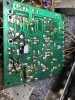
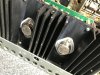
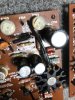
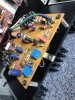
I have crackling coming from the left channel of this 2230. It is not the speaker because I've swapped speaker connections. I ran an ipod into the Main In on the back and the problem persists - so that tells me it's not a problem in the "front end" of the circuit. I recapped both P750 boards (right and left). I also replace both pairs of output transistors - which is what my research led me to believe may have been the problem.

I also read it could be possibly the small transistors on the board? Can those be tested in circuit?

After recapping, I have not yet done the "Audio Adjustment" per the service manual. Should I wait until i resolve the crackling? Or should this be done now?

Thanks for the help!
 

Attachments

  • IMG_9423.JPG
    IMG_9423.JPG
    164.2 KB · Views: 29
  • IMG_9426.JPG
    IMG_9426.JPG
    167.2 KB · Views: 28
  • IMG_9424.JPG
    IMG_9424.JPG
    134.5 KB · Views: 27
Register to hide this ad
Can those be tested in circuit?
Usually they will test good. The semiconductors are breaking down under actual circuit load.
Or should this be done now?
I'd find the problem first.
Get yourself a can of freeze spray. And freeze the other transistors on that channel one at a time.This may help locate the bad actor.
Don't forget to hit the diodes as well, especially the SV-3A's
 
Last edited:
Usually they will test good. The semiconductors are breaking down under actual circuit load.

I'd find the problem first.
Get yourself a can of freeze spray. And freeze the other transistors on that channel one at a time.This may help locate the bad actor.
Don't forget to hit the diodes as well, especially the SV-3A's

Not familiar with that technique - is there a thread on that topic?
I forgot to add that problem persists whether I am using AM, FM, Aux, Phono as input. It isn't the selector switch but that is a good thing to check!
 
I ran an ipod into the Main In on the back and the problem persists -
You eliminated the selector switch and the various source inputs..And narrowed it down to the left channel amplifier circuit. The speaker select is at the output of that amplifier circuit.
 
Last edited:
is there a thread on that topic?
Probably..Use AK forum search.. I've used that method for many years starting back in my late teens. trouble shooting RCA XL-100's. RCA's first 100% solidstate TV chassis.
 
Are you hearing the crackling through headphones? If so..You can eliminate the speaker select switches as a possibility..
 
Last edited:
Not familiar with that technique - is there a thread on that topic?
I forgot to add that problem persists whether I am using AM, FM, Aux, Phono as input. It isn't the selector switch but that is a good thing to check!
I just used freeze spray for the first time to find a wonky small transistor and it worked. Small transistors breaking down under load are often temperature related. Use a product like this with the red straw attached to the nozzle, and while operating the receiver, give each transistor and diode on the suspected bad amp board a small puff of cold. If you are lucky, the crackle may go away while one of them is cold.
https://www.amazon.com/MG-Chemicals...electronic+freeze+spray&qid=1586348850&sr=8-3
 
Probably small transistors on the left amp board. It's not likely to be the outputs or caps, which is why replacing those didn't fix it.
 
Ok parts finally arrived so i was able to get back into this problem with my shotgun approach. And the problem persists.

I tested the unit with headphones (per suggestion) and my findings were interesting. With the Mains-Speaker button disabled, I hear audio through the headphones and the troubled LEFT channel STILL has some faint crackling. And it gets worse when I enable the Speaker Mains. I can describe the sound like the crackling of audio from a tube amplifier that was turned off and slowly runs out of juice.

On the LEFT P750 board I have now replaced all electrolytic caps, all transistors and one diode H757 (the small blob kind). In addition to this and as a reminder, I had already replaced the output transistors (all 4) that mount on the heatsinks.

Not sure where to go from here so any help would be greatly appreciated!
 
I will attempt to adjust DC offset and bias today.

Is it safe to assume that the P750 board that is physically on the left is actually the LEFT channel (when looking at the unit from the front)? Silly question but I'd like to make sure hahaha.
 
Yes, left channel amp is on the left when looking from front. Wasn’t thinking about this being a 2230. There is no idling DC offset to check, being a cap coupled design. Just check the idle current (bias) to see if it is anywhere near spec. Check between J757 and J758 and see if it will adjust to 5mV with R765.
 
Voltage adjusted. Trim resistor R810 was adjusted for a 35.6 vdc reading at J808.

Attempted to adjust Idle Current using the manual and info from this thread:
https://audiokarma.org/forums/index.php?threads/marantz-2230-voltage-adjustment.363753/
"Adjust R810 for +35VDC on J808. If you don't have a scope, set R760 for ≈+30VDC on J758 on both power amps. The 2230 has capacitively coupled outputs, so you will read a phantom voltage on the speaker terminals with no speakers attached." -Tom (catrafter)

Successfully adjusted both channels by setting trim resistor R760 for +30VDC on J758.

then using this method:
"Turn the receiver on it's side. Connect your meter, set to measure DC milli-Volts to J757 and J759 (3rd ones in from each end), volume all the way down. Adjust R765 for 10mV. The voltage is twice what the service manual says because we are measuring across both resistors instead of just one. -Tom (catrafter)"

I was able to adjust R765 to 10mV on the RIGHT channel, although extremely sensitive trim pot made it very difficult.

I was UNABLE to get ANY adjustment from R765 on the LEFT channel. It just read in the 0.67mV range the entire time I turned the trim pot - all the way open to all the way closed.

So what does that tell me? Here's where I need some help from you Pros! :)

 
Bumping this because I'm still stuck and it seems the thread died.

I'm still having distortion on the left channel of this 2230. After recapping both P750 boards, replacing al 4 output transistors, and replacing all the transistors on the left board the problem still persists. I have narrowed down the issue to the LEFT P750 board - eliminating the speaker selection switch and preamp as possible culprits.

"Audio Adjustment" in manual set Voltage adjustment to 30VDC - per instructions in my post directly above.

Adjusted what I assume is the "idle current" for each P750 board also (setting trim pot R765 to 10mV) - again using the method above. This was successfully adjusted on the RIGHT P750 board but I was unable to on the LEFT. The R765 trim pot stayed at 0.67mV no matter which way I turned the adjustment screw.

I also went around on the left P750 board and tested the resistors - most were in spec - only a couple seemed to be a bit off, but not had failed. R778 and R779 are supposed to be 27K and were reading around ~13-15K. Could that be the issue?

Appreciate any help thanks!
 
Lack of 'bias' voltage usually means no current flowing through the small value resistors in the output circuit, in the case of the 2230 those are R774 and R775.
The adjustment of R760 (clipping symmetry) and R765 ('Bias') interact, so you may have to deviate from the +30V 'ball park' setting of R760.

As an aside, H753 and H754, the ASO transistors, can be removed while testing, they should have no effect unless the amp is driving reactive loads.
If they are shorted it could kill the bias, but this is a rare occurrence.

Were you able to set the bias before you worked on the left amp? Maybe there is solder bridge somewhere.
Have you tried removing and testing each transistor using this method?

Tom
 
Just an update - still haven't resolved my issue.
Took the 2230 to a repair shop and they were unable to figure out the problem - without getting deep into pulling/testing each transistor (as suggested in a post above) - so I decided to try to find a working P750 board from a 2230 that had been parted out.

So I found a parted out 2230 and it has both P750 boards - Supposedly the unit was fully functional before being parted out - as the unit chassis/faceplate was physically damaged, but working nonetheless and someone decided to sell it off As-is.

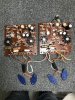
Here's a pic of the pair of P750 power amp boards - Something looks odd to me though. Both have some sort of weird wire going on at H757. Any idea what these are? My 2230 did not have anything like this.

I'm hoping simply swapping one of these boards in will fix the left channel crackling and I can move on - or at least allow me to focus my attention elsewhere to fix this thing!

Thanks!
 

Attachments

  • IMG_9975.JPG
    IMG_9975.JPG
    256.2 KB · Views: 30
  • IMG_9976.JPG
    IMG_9976.JPG
    143.7 KB · Views: 30
That’s a bias diode or thermistor attached to the heat sink. All 2230’s didn’t do it this way, but I’m restoring one right now that has the same feature.
 
Just an update - still haven't resolved my issue.
Took the 2230 to a repair shop and they were unable to figure out the problem - without getting deep into pulling/testing each transistor (as suggested in a post above) - so I decided to try to find a working P750 board from a 2230 that had been parted out.

So I found a parted out 2230 and it has both P750 boards - Supposedly the unit was fully functional before being parted out - as the unit chassis/faceplate was physically damaged, but working nonetheless and someone decided to sell it off As-is.

Here's a pic of the pair of P750 power amp boards - Something looks odd to me though. Both have some sort of weird wire going on at H757. Any idea what these are? My 2230 did not have anything like this.

I'm hoping simply swapping one of these boards in will fix the left channel crackling and I can move on - or at least allow me to focus my attention elsewhere to fix this thing!

Thanks!
That was a service bulletin fix for units that run in hot areas, such as a hot garage in the summer. It is just a thermistor and a resistor for BIAS tracking that replaced the dual diode on "stock" units. If you use the complete board(s), leave it in place. The rest of the boards are the same component-wise.
 
That was a service bulletin fix for units that run in hot areas, such as a hot garage in the summer. It is just a thermistor and a resistor for BIAS tracking that replaced the dual diode on "stock" units. If you use the complete board(s), leave it in place. The rest of the boards are the same component-wise.
Excellent, thank you. I had read that service bulletin some time back and decided not to do it on my 2230 - and had forgotten about it actually. Thanks for the reply!
 
Back
Top Bottom