

Hey y'all, a friend of mine recommended me this community when he heard about my project. It started as a need for an audio solution for my living room tv and became a DIY project.. because I'm a masochist.
I was looking to replicate a horn look and originally considered something like a soundbar, but then figured I'd like the speaker to be an attractive object in its own right and am now considering a tusk/bunch of bananas look. Rough draft sketches below. I will also be 3D printing the enclosure in pieces on a prusa mini using hatchbox wood PLA that I've begun material tests with.
I've also listed the drivers I was thinking of below with the desire to obtain as full an audio range as possible. This has led me to enclosure design software "Speaker Box Lite" which suggests that with my woofers I'll need ~.215 cubic feet of volume and a 1.3" port ~4" long per enclosure to attain an audible 50hz low-end.
Eventually, I'll also need to design and test a crossover, but up to this point, I've been fumbling around in the dark with youtube as my only advisor. So I'd love any feedback from you seasoned audio hobbyists who can help me down the right path
Thanks!
-Zooqi
Woofers x2: Dayton Audio TCP115-4 4"
Tweeter: Peerless by Tymphany BC25SC06-04 1"


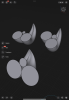
I was looking to replicate a horn look and originally considered something like a soundbar, but then figured I'd like the speaker to be an attractive object in its own right and am now considering a tusk/bunch of bananas look. Rough draft sketches below. I will also be 3D printing the enclosure in pieces on a prusa mini using hatchbox wood PLA that I've begun material tests with.
I've also listed the drivers I was thinking of below with the desire to obtain as full an audio range as possible. This has led me to enclosure design software "Speaker Box Lite" which suggests that with my woofers I'll need ~.215 cubic feet of volume and a 1.3" port ~4" long per enclosure to attain an audible 50hz low-end.
Eventually, I'll also need to design and test a crossover, but up to this point, I've been fumbling around in the dark with youtube as my only advisor. So I'd love any feedback from you seasoned audio hobbyists who can help me down the right path
Thanks!
-Zooqi
Woofers x2: Dayton Audio TCP115-4 4"
Tweeter: Peerless by Tymphany BC25SC06-04 1"
