• The move to the new server is done. There are some software and database maintenance updates in process. This has us passing the hat around to help out. We appreciate any donations. Seriously, even a dollar helps. The payment page may be found here - https://www.audiokarma.org/support.html

610 Custom Electra III (440) Question

The 49T tuner will work only if you do some rewiring of the Molex. As the 49-T doesn't have the heaters set up for cathode bias like the 440-T does, you'll be doing some serious rewiring. Plus it has the MPX-125 2 tube unit which is considered to be a lesser unit than the MPX-65 (3 tube). The 440-T doesn't have Multiplex built in so that might be a no go on that. The 460-T (62)has optional MPX-70 which I believe is the Zenith/GE MPX. But again it's optional. The (63) 490-T/490A combo has multiplex, and is the 1st year with it as built in on all units. MPX-65.
 
Rewiring the filaments to handle cathode bias would not be a problem for me. I still have a donor MPX 65 from my work on the 500C I restored, so that is an option too. Interesting options to consider.

Joe
 
The Custom Electra 610 Head unit got 3 more RCA's for MPX on the top panel just forward of the transformer as I recall. The Consolette in the previous 2 years didn't get them, so I installed them on my 610 in the consolette. I put a Sherwood A3mx MPX unit in the cabinet next to the head unit, spaced the 610 and the 560 about 6 ft apart and fired it up in FM Stereo. Slight separation adjustment with the SG-165 and getting 30-35db of separation. Very nice early stereo unit with MPX. Make the RCA Cables as short as possible (no longer than 3ft) and use low impedance cable.

I have the 440 owners manual in a scanned pdf. it's too large to upload here. If you need the O.M. PM me with your email address and I'll send you a copy email. Here's the page with the Front panel info.

I might have a pic of the front panel. Let me check my pics and I'll get back.

I just sent you my e-mail address so that you could send the 440 owner's manual.

Joe
 
You should now have both the 610 and CE III Owners manuals.

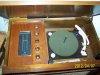
Here's a pic of the panel as used in the 510/610 consolette and the CE III. Overall the measurements should be the same for the CE III. I took this when I 1st got it. I still have to get in the back of the "crap stack" in the 2nd bedroom to get out the panel. 100_3159.JPG

Front to back it's about 15-1/4 to 15-1/2 and about 9-10wide. There are NO Nuts under the knobs, as the amp is attached to the body of the unit and the panel is screwed on top. I'll trace the outline and all the holes on a big sheet of paper. That's easier for me to do than to figure out all the different measurements. And send it to you in the mail.
 
The only nuts on the control shafts then are the ones directly on the chassis itself. Yes, a paper template is ideal. that way there is no guesswork. Thank you very much for going to so much trouble for me! And yes, I did get both owner's manuals by e-mail. Thanks for those too.

Joe
 
Larry;

A question about the Electra VI and VII models - did the EM84 tuning tube also indicate the presence of the MPX signal like it did on some of the more expensive receivers or tuners?

Joe
 
I don't think it was automatic like on the 500c/800c. It was more of a manual control to the tune of the 400. Tune in to a station using the mono setting getting as much of a closed eye as possible and then turn to set to Stereo, and it would close more (or at least it should) like the 400.
 
Larry;

OK, thanks for that extra information.

I have another question about the Electra III; some of the information indicates a set of 3 8" speakers of 8 ohms impedance, however looking at the parts list I see one 10 inch speaker, LS769-103, one 8 inch speakers, LS634-107 and one tweeter, LS769-104. I think that these speakers are associated with the 30-A amplifier chassis for SN 30001-39999 unit. The information in the service manual for SN 20001-29999 chassis which has the 2.5 ohm impedance output transformer secondary does not list the 8" speakers associated with it. One eBay listing of 8" 8 ohm speakers from an Electra III says the 8" speakers are Jensen P8RX speakers. I believe you said there were three of the 8" speakers that mate to this 2.5 ohm output secondary, two of which had simple round cones and the third had a whizzer cone to deliver enhanced high frequencies. Would the Jensen P8RX be correct for the two 8" with simple cones? What would be the Jensen part number for the 8" speaker with the whizzer cone?

Joe

Joe
 
Larry;

As a follow-up, I did find this information listed with the Consolette 610 SN 10001-19999:
8” dual cone 8 ohm speaker, LS703-116
8” 8 ohm speaker, LS634-107
the dual cone 8 ohm speaker has to be the one with the whizzer cone.
However, it does not mention the Jensen nomenclature for those parts.

It also lists the Garrard RC-121 record changer and the companion LRS-4 45rpm adapter spindle for it.

Does the Electra III have one channel with 3 8" speakers the same as the Consolette 610 and the other channel equipped with the 10", one 8" and the tweeter? It appears that the Electra III appeared with the 610 chassis under SN 20001-29999.

Joe
 
You got me there Joe. All I DO know is that on my 510/610 and the 560 they are 3-8" as you described.
Damn! The numbers are right on the spkrs and I never paid attention to them. Center is the P8RX with NO Whizzer.

I would think 6 8" drivers would be a bit crowded in the CE III as it wasn't that much larger (maybe a foot wider) , so the 10" with a 8" mid and a tweeter per side makes more sense.

I just looked at the S.M. and the 10"-8"-Twt is only spkr setup for CE III.
If Jonboy55 was on more he could answer this definitively as he has a couple CE III's.


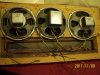
100_2805.JPG

100_2810.JPG


Outer spkr (x2)
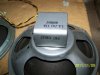
100_2806.JPG


Center Spkr.
Center spkr.JPG
 
Last edited:
Larry;

I believe you are correct that the 510/610 used 3 8" speakers side by side as pictured. I went out to the garage and examined the output transformer on the Electra III 610 chassis and it has no identification marks on it at all, however, the speaker terminal strip near the two 6BQ5 output tubes says 2.5 ohms. If they were still using the 3 8" speakers, they would have had to place two of them side by side and one above them in order to have them fit the available space in the Electra III cabinet. As you noted the speaker mounting area of the Electra III cabinet is not nearly as wide as that of the Consolette 510/610 cabinet.

It is possible that Fisher determined to use up existing stock of the 3 8" 8 ohm speakers by such an arrangement, otherwise, a set of 10", 8" and tweeter all of 8 ohm impedance could have been connected all in parallel on the channel with the 2.5 ohm transformer secondary and connected to the 2.5 ohm terminals on the 610 chassis and to the 4 ohm terminals on the 30-A chassis. There may have been some slight mismatch, but probably not noticeable to the average customer. Any slight difference in levels could be corrected with volume or controls. The volume controls appear to be concentric type knobs indicating individual adjustments. On the 610 chassis there is an R52 250k ohm level control at the grid pin 7 of the V10 driver/phase inverter. On the 30-A chassis the level control at the pin 7 of V1 driver/phase inverter is a 500K ohm control. There are of course the differences in the parts in the negative feedback part of the circuitry also.

Joe
 
On the 610, the Volume controls both sides, although not separately. Fisher recommended in the manual to get the volume on the 610 set to where you want it and then match it using the gain control on the 30A amp in the 560. There was no balance control, so you fiddled withthe volume on the 610 and tried to match it best as you could with the 560. Then when the levels are matched, use the 610's volume control for everything. I would imagine the C.E. III would use something similar as they are using the same amps. The knobs might be concentric looking but I think on the 610 they are connected together.
 
Larry;

Thanks for mentioning Jonboy55, I sent him a PM to ask his input and to possibly get him to examine what he has and see how they are equipped and connected.

The Electra 610 chassis I have is identified as 610-ST, SN 24690 E. The driver stage level control of the 610-ST chassis is a different value from the one on the 30-A chassis and as you said it is likely this is where any slight volume differences were made up. As is typical, no stereo volume control of that era was going to match perfectly as the level is advanced through its normal ranges. Fisher provided separate controls on the driver stage to compensate for this. I know that on my Dynakit ST-70 power amplifier, if one set of speakers is set on the 4 ohm tap and the other on the 8 ohm tap there is not a great amount of difference in the level that can't be taken care of by use of the balance control on the preamp. Jonboy55 may be able to nail down the speaker size and type used on the Electra III for us, unless Fisher made production changes on the fly in these models.

Joe
 
Last edited:
Fisher, like most all of the manufacturers made running line changes that never made the "drawing board". Most times the Service manuals were based off the production prototype and it ended there unless it was a drastic circuit change, and then they made a new manual. But Fisher, did something that almost nobody else did. They serialized their manuals to "fit" a certain series. This kept up with line or engineering changes to an extent as we now know it. They were better than most, and Sansui was absolutely the worst with regard to line changes. Their manuals are horrible, and schematics are almost unreadable at best. Who ever translated the manual from the original Japanese must have had a sense of humor as the translation smacks of a really bad Charlie Chan movie if you try to read it out loud as it's written. It makes you sound like Tojo or one of his buck tooth guards with a MA. or NYC(Brooklyn) Accent .
 
One plus for this 610-ST chassis is that overall it is pretty clean with very little corrosion. The chassis metal is bright and shines. There is some dust, but it will not be difficult to get the chassis in good working order. One 6BQ5 has its tip broken and therefore has air in it. I will probably have to make a custom cabinet for it - lots of possibilities there.

Joe
 
Larry;

Did Fisher ever publish specifications for the Electra series year by year? I know they did for their component lines, but did they do it for the cabinet series?

Some of these units had beautiful cabinets. I liked the modern style at the time, but now I like the other styles as much or more.

Joe
 
Usually basic specs were inserted in the back end of the owners manuals. Other than that I don't think they did. Brochures for the console lines are very scarce and I've only seen one's from '66 on up to 70. All solid state.
 
Larry;

OK, I suppose I should not be surprised they did not publish specifications on the consoles much. They may not have allocated as much advertising money to the console models as the component lines.

Today I looked at the volume control in the 610-ST receiver chassis. The on-off switch was open. As I inspected the control and switch assembly, I discovered that there is a loudness tap on the two sections of the dual-volume control. The resistances of each volume control element are identical as are the loudness taps. There is no loudness on-off switch on the unit, so the loudness circuit was active at all times. I suspect that Fisher may have built-in some bass or low frequency roll-off to prevent acoustic feedback at bass frequencies. I took the control and switch assembly apart and cleaned the center concentric volume shaft as I took it apart. The small diameter shaft is the one that activates the on-off AC switch on the back end of the assembly. There is a small tang on the end plate of the shaft which fits into the slot of the operating lever on the actual AC switch. It is important to get the parts aligned properly when re-assembling. The lubrication of the moving parts was dried out. Some Deoxit cleaned up the AC switch contacts. (Hold the rear pieces together with fingers and check for proper AC switch operation). Lubrication was renewed before the parts were reassembled. Resistance checks and full rotation of each volume element was assured before the fold-over tabs that hold the parts together were secured. The AC switch is a single pole switch instead of the two pole switch used on the component series integrated amplifiers and receivers. The cleaning and re-lubrication of the AC switch cured the open switch issue and it works correctly now.

The current in the AC switch on these models is not as high as on the component series receivers, so it is not stressed as much as the switch of the component receivers and the high wattage integrated amplifiers. Some higher cost Fisher consoles also use the dual switch AC switch on their volume controls. Dave Gillespie has recommended adding a series in-rush current limiting thermistor to the AC input on high AC current units. This is especially good to do in cases where the home AC voltage is higher than the nominal 117VAC that the units were originally built for. Many homes now have AC input voltage over 120VAC.

Some of the Electra series had an AC switch pole on the Garrard record changer which could turn the set on if the changer was turned on. The Electra III does not have this feature. Models that have the feature include an extra customer control that provides for automatic shut-off when the last record has played and the changer tone arm has come to rest on its support post. This feature was added beginning with the Electra V model and is called Automatic Shut-Off. To use the feature the AC switch on the volume control is left turned on and the Automatic Shut-Off switch is turned on. Reactivating the record changer will then turn the set on on Electra V and up models.

Joe
 
Nicely done. The AUTO OFF Feature had been done earlier than that. My C-800 contemporary from 1958 has this feature. The switch is incorporated into the treble pot. I went thru all of the manuals on Fisherconsoles from 1958 and earlier, and the C-800 apparently started this feature as I couldn't see anything on the schematics on any of the earlier units. The AUTO-OFF was later incorporated into most all of the consoles of the 1960's, even the Solid State receiver units that closed out the decade.
 
Larry;

Just when you think you have learned everything about a Fisher product series, someone presents new information you have not seen. I saw this on eBay this morning. It refers to it as an Electra III tube preamp and Stereo Master Audio Control:
Electra III Preamp 01.jpg
Electra III Preamp 02.jpg
Electra III Preamp 03.jpg
Electra III Preamp 04.jpg
It appears that this unit might plug into one of the 9-contact sockets on the Electra III radio/preamp chassis, likely into a 12AX7 socket. It may be a preamp for a magnetic cartridge in the record changer. Has anyone else seen this variant before?

Joe
 
Last edited:
Back
Top Bottom