• The move to the new server is done. There are some software and database maintenance updates in process. This has us passing the hat around to help out. We appreciate any donations. Seriously, even a dollar helps. The payment page may be found here - https://www.audiokarma.org/support.html

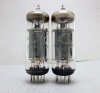
6H8C, 6P14P & 6P14P-EV. Please share your opinion

When were 6H8C's you aquired made? From various posts in a handful of forums I read, it seems that the 6H8C's from the 50's a d 60's are much more consistent and reliable with a better tone. My preamp uses four 6SN7's. I've been wanting to try different tubes in it, but prices for some of the preferred NOS are pretty high.
 
plan to run a few in my newly built amp that uses 3 of 6SN7s. I can compare the output on the scope to the new McShane's tubes.

if thats within a feedback loop you probably won't notice any real difference even with higher gain tubes. Outside a loop you'd see it pretty quickly.


I've been wanting to try different tubes in it, but prices for some of the preferred NOS are pretty high.

should be able to pick those up at non-audio sources for not a lot. I've ended up with a box of the things and I don't think I paid anything for any of them. Lots of early TV sets ran them as vertical oscillators. Usually find lots of them at hamfests and antique radio shows and such. Probably won't find any of the legendary ones but any of the common brands ought to be represented.
 
When I got my VTA SP14 preamp, I wanted to change out the tubes. It uses 4 6SN7's. I had already decided on the Sylvania Chrome Domes for one set of tubes, but didnt know what other tubes to run. After researching, I found that the 6H8C was an equivalent tube. I ordered a quad of old Soviet era tubes from someone in Ukraine. When they got here, I tried two of them in my pre with the chrome domes, that is where they still reside today. I really like the sound of those two sets of tubes in my pre. As for the 6H8C being a replacement for the 6SN7, I'm sold. I have no problems running a 6H8C in place of a 6SN7 in either my pre or VTA ST120. In fact, just the other day, I dropped one of my remaining 6H8C's into the center position of my ST120. As of yet, I have not turned it on so I dont know how it affects the sound.

 
if thats within a feedback loop you probably won't notice any real difference even with higher gain tubes. Outside a loop you'd see it pretty quickly.
It is inside of the feedback loop. So you think I won't see any gain difference on the scope unless feedback is removed? I can try both ways once I get it on the bench.
 
When were 6H8C's you aquired made? From various posts in a handful of forums I read, it seems that the 6H8C's from the 50's a d 60's are much more consistent and reliable with a better tone. My preamp uses four 6SN7's. I've been wanting to try different tubes in it, but prices for some of the preferred NOS are pretty high.
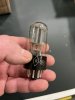
If the appearance of the tube is important, those can't compete with the looks of new production Tung-Sol tubes. See one in the middle between Tung-sols:

1.jpeg

I think those were made in 1990 -1992.

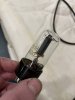
2.jpeg

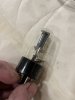
3.jpeg

4.jpeg

There was a tube plant in my birth town, Tashkent. The plant was called Foton. I've seen some Foton tubes on ebay that were apparently valuable. I don't remember what they were.
@Mr Boochie?
 
If the appearance of the tube is important, those can't compete with the looks of new production Tung-Sol tubes. See one in the middle between Tung-sols:

View attachment 2421386

I think those were made in 1990 -1992.

View attachment 2421387

View attachment 2421388

View attachment 2421389

There was a tube plant in my birth town, Tashkent. The plant was called Foton. I've seen some Foton tubes on ebay that were apparently valuable. I don't remember what they were.
@Mr Boochie?

FOTON tubes, Tashkent, Uzbekistan (I believe) --- also made 6N8C tubes. Their logo looks like the later Reflector logo. I believe that this rhombus logo was part of the military/industrial symbols of the 1960-90s, as I see it on sockets and other electronic devices --- which are Soviet mil spec. :idea:

Here's another nice site for Russian tube nomenclature and logos.

https://www.diyaudio.com/community/threads/russian-tubes-classification-of-various-brands.298616/
 
Last edited:
There is another logo on the glass that looks like Novosibirsk. Just a relabled FOTON?

If it's the FOTON rhombus type logo, it maybe a mil spec designation and not the factory logo. These often have other symbols, letters, numbers stamped within the rhombus. The OTK logo is definitely an aftermarket QA stamp. So its style and location along with the rhombus most probably means mil spec. And not FOTON made.

Like these Svetlana made mil spec 6P1P-EB tubes.

Svetlana 6P1P-EB mil spec stamp.jpg

BTW... mil spec Soviet-era tubes are generally excellent. Across most of their manufacturers. Especially from 1960-80s.
 
Last edited:
As I remember, Foton was strictly a military production plant. There were no consumer products made there as far as I know. It looks like Foton logo was horizontal rhombus vs. vertical rhombus with digit(s) inside that is present on many other soviet tubes. OTK stands for Отдел Технического Контроля, Department of Technical Control, basically QC stamp. If I recall all government-approved consumer products had a pentagon sign with CCCP inside as a QC stamp.

5.jpeg
 
BTW... mil spec Soviet-era tubes are generally excellent. Across most of their manufacturers. Especially from 1960-80s.
Most if not all was made to last in that era. Nothing was intended to be made attractive, nice, and appealing. There was no need for that as the majority of consumer products were not readily available off the shelf. There was a shortage of just about anything that could come to mind, but whatever was made - lasted nearly forever. The fridge at my grandparent's house that you could hear from the other side of the house but you can't kill that thing. It was made in the late 40s-early 50s. I bet people that bought the house when my dad sold it and left the country in 1997, still use it. Everything was severely overbuilt, like to survive a nuclear blast. No surprise that military-intended tubes are so good.
 
Some years back someone was going to purchase and import surplus Russian versions of the Jeep. Being a Jeep guy I was exited. I've read they will run on almost anything you pour down the fuel tank thats flammable. They also looked to be over built. But the person was stopped from importing them do to smog laws in the US.
 
Those are real trucks, unlike current Jeep’s offerings are just toys.

I'm looking for one of these. 100,000 miles is the break-in period. :)

1280px-1980_Toyota_Land_Cruiser_%28FJ40%29_hardtop_%2826042130985%29.jpg
 
Those are real trucks, unlike current Jeep’s offerings are just toys.
I agree. I have a modified 2002 TJ at the moment. I bought it new. I've had very little trouble with it. My wife had a 2012 Unlimited for a couple years. The new jeeps are nothing like the older models. That four door beast was just too big and clumsy. Not to mention several recalls and a notice of a 150,000 mile extended engine warranty due to the possibility of the wrong valves being installed in the heads It had horrible gas millage too.
 
It is inside of the feedback loop. So you think I won't see any gain difference on the scope unless feedback is removed? I can try both ways once I get it on the bench.

thats what I'd expect. Maybe there will be some small difference but you'd see a much bigger difference with no feedback.

can also just knock together a dirt simple test circuit if you've got a bench supply to do this. Plate, cathode, grid resistors and a couple of caps at the input and output. Feed it a known signal and see what it does for gain. Should be able to come up with operating parameters right out of the tube datasheets.
 
I sorta have a bench supply. Not really finished the way I wanted it yet. I have all parts to do it.
The main really beefy organ tone cab PT is variac controlled to get needed B+ voltage. SS rectified. 15W rheostat for adjustable screen supply and another for driver circuits, if needed. All nodes are filtered of course. Separate 12.6v/6.3v filament transformer and separate adjustable bias supply.
I've been thinking for a while about putting together a tube test box to use with that. The goal is to test tubes for current at realistic voltages. I'll put a plan together soon and will start a separate thread for support and ideas for additional features. This tube lot will motivate me to get it done.
 
Back
Top Bottom