

You are using an out of date browser. It may not display this or other websites correctly.
You should upgrade or use an alternative browser.
You should upgrade or use an alternative browser.
6p3s vs 6p3s-e 6l6gb replacement.
- Thread starter Carbsandcaps
- Start date

I treat the TungSol (USA) 5881/6L6WGB max at 23 watts/tube. Class AB1, push-pull. Maybe it's conservative? Dunno. But, in the few amps I used 5881s, the Tungsols last forever — sometimes even longer than the 12AX7 (which some amps push hard).
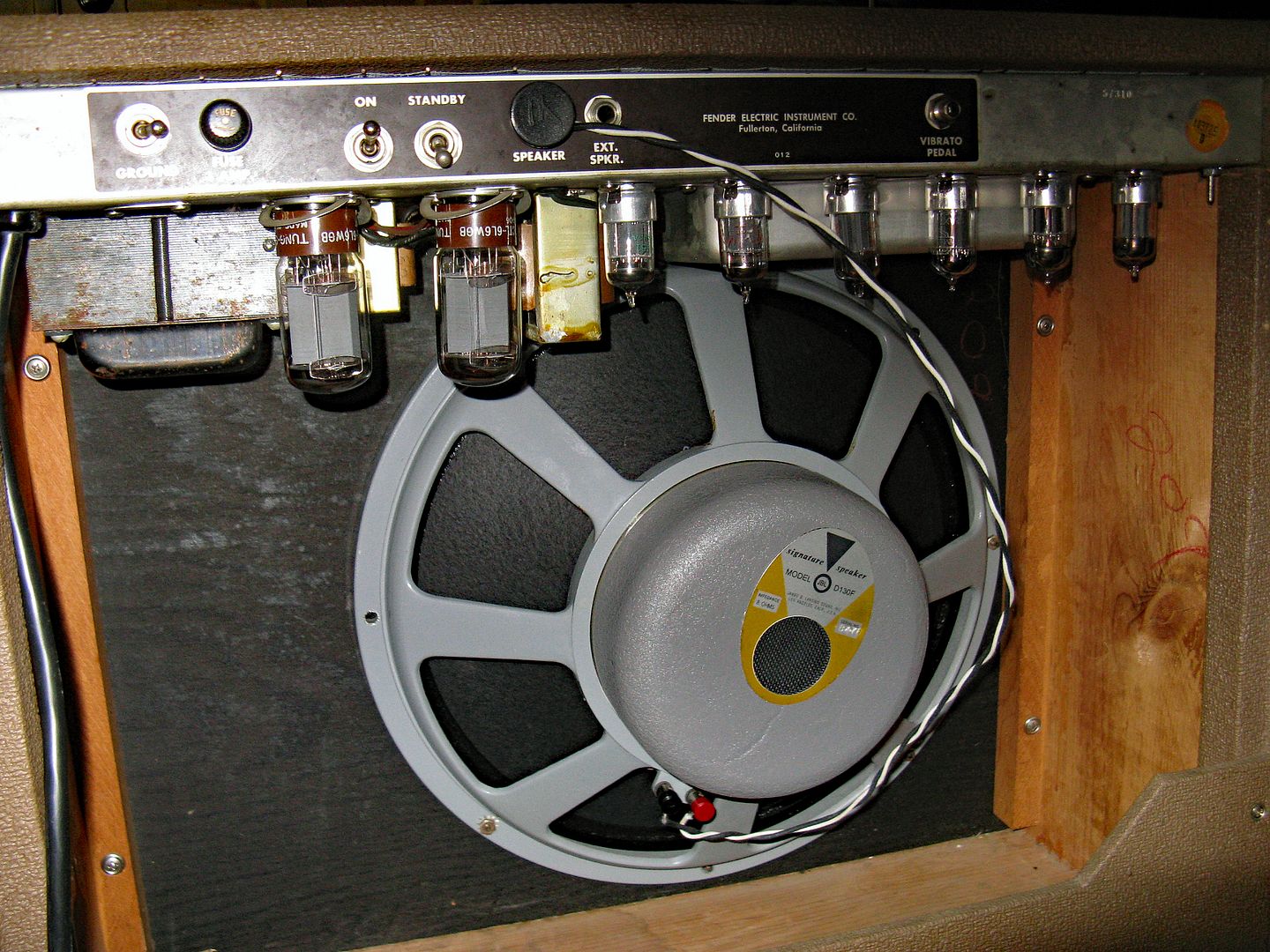
My 1962 Pro has been one of my most reliable amps (knock on my wooden head).
My 1962 Pro has been one of my most reliable amps (knock on my wooden head).

HennieTalja
New Member
Hi,
Can either the Russian 6P3S or 6P3S-E be safely used in the Quad II amp?
Can either the Russian 6P3S or 6P3S-E be safely used in the Quad II amp?

I don't believe either tube is a good choice for the Quad II. The schematic shows B+ of 340V and anode current of 65mA for each output tube. That's about 22W anode dissipation, which is well above the 19W limit of the 6P3S. On the other hand, while the 6P3S-E can handle this dissipation, it needs a higher voltage on the anode and screen to perform well, due to higher internal resistance. If the original KT66 is unavailable to you, the 6L6GC is a good substitute. This change does require a different value cathode bias resistor, according to other users.Hi,
Can either the Russian 6P3S or 6P3S-E be safely used in the Quad II amp?
KT66 Substitution
Jack
HennieTalja
New Member
But what does a 6L6GC look like? The ones Langerex is selling looks like the 6P3S-EI don't believe either tube is a good choice for the Quad II. The schematic shows B+ of 340V and anode current of 65mA for each output tube. That's about 22W anode dissipation, which is well above the 19W limit of the 6P3S. On the other hand, while the 6P3S-E can handle this dissipation, it needs a higher voltage on the anode and screen to perform well, due to higher internal resistance. If the original KT66 is unavailable to you, the 6L6GC is a good substitute. This change does require a different value cathode bias resistor, according to other users.
KT66 Substitution
Jack
You searched for 6L6GC - Langrex
 www.langrex.co.uk
This website claims the 6P3S-E is a direct equivalent of the 6L6GC,
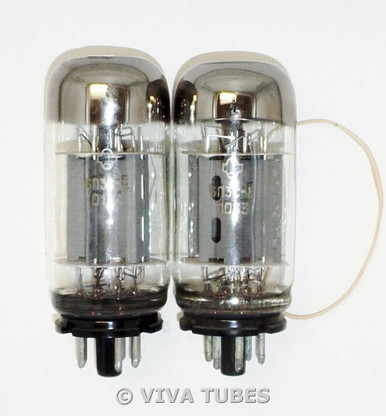
NOS Matched Pair USSR Reflector 6P3S-E / 6L6GC / 6N3C Military Spec Vacuum Tubes
Unbeatable prices on thousands of guaranteed vacuum tubes for sale, vintage NOS hi-fi audio tubes, radio tubes, ham and industrial ready to ship. The only NOS valve dealer with a real webstore. We carry everything from NOS RCA 6L6GC black plates to JJ 12AX7s. We carry brands like Western...
 www.vivatubes.com

Lavane
Lunatic Member
They aren't really, but seem to hold up fine for some folks. It probably depends on the amp design and voltages used.
They're closer to the 5881 from what I've read so far.
My son has a Russian made guitar amp that uses 6P3S-E's. The 5881 is
listed as a direct replacement.
I re-tubed that amp for him and I bought a matched pair for me to play with.
I'll be trying them in an amp I'm building along with some JJ KT-77's,
6L6GC's and 5881's. The B+ will only be 300v though.
Attachments

Last edited:
Langrex is lying. They have relabeled the 6P3S-E with 6L6GC nomenclature. The 6P3S-E is good for about 25W anode dissipation maximum. I have tested them, and there's where they begin to show color. The 6L6GC is a 30W tube.But what does a 6L6GC look like? The ones Langerex is selling looks like the 6P3S-E
VIVA has been making those deceptive claims for years. They include a disclaimer in their eBay sales in an attempt to evade responsibility. They even show the little 19W 6P3S to be equivalent. This is total fiction.This website claims the 6P3S-E is a direct equivalent of the 6L6GC,

If you want a real 6L6GC (other than NOS), you'll have to buy a JJ, Svetlana, Tung-Sol, etc. reissue. Antique Electronic Supply sells an "Apex burned-in matched quad" of JJ for about $120.
Jack
I’ve used 6P3S-E in my Quad IIs for many years. So far they’ve proved to be durable and stable and sound very close to the std issue GEC KT66 (IMO). An added benefit is that the 6P3 draws less filament current than KT66 so somewhat fragile PT gets a break. From a “safety” perspective, 6P3S-E is fine in a properly operating QII. Sound is your call.Hi,
Can either the Russian 6P3S or 6P3S-E be safely used in the Quad II amp?
Yes, if you bias them to 5881 standards (23 watts max per tube, push-pull, AB1), they will last and not go ballistic down the road.They aren't really, but seem to hold up fine for some folks. It probably depends on the amp design and voltages used.
They're closer to the 5881 from what I've read so far.
My son has a Russian made guitar amp that uses 6P3S-E's. The 5881 is
listed as a direct replacement.
I re-tubed that amp for him and I bought a matched pair for me to play with.
I'll be trying them in an amp I'm building along with some JJ KT-77's,
6L6GC's and 5881's. The B+ will only be 300v though.
If you want true 6L6GC standard tubes (30 watts max), I've found the EH the most durable. But, I always bought them from Jim MsShane, who tested and culled out the noisy ones.

Whenever my paint shows up and allows me forward progress on my current project I can do some testing at 6L6G specs. I have NOS metal 6L6, and low hour 6P3S and 6P3S-E tubes around, and I'm curious how they compare to one another. We're talking 360 on the plate and about 245 on the screens into a 6.6K load so this will be quite conservative, nowhere near pushing the limits of a 6L6GC but it still might give some interesting results.
The 6P3S is a copy of the 6L6G/GB. I would expect very little difference between the two generally, although it must be remembered that a small sampling won't be accurate. The same is true of the 6P3S-E in terms of sample size. There is considerable variation form one tube to the next under actual operating conditions.
Jack
Jack
Lavane
Lunatic Member
I haven't looked at the data sheets that closely, but your saying the 6P3S IS a copy of the 6L6GC? But the 6P3S-E isn't?The 6P3S is a copy of the 6L6G/GB. I would expect very little difference between the two generally, although it must be remembered that a small sampling won't be accurate. The same is true of the 6P3S-E in terms of sample size. There is considerable variation form one tube to the next under actual operating conditions.
Jack
The 6P3S is a copy of the early 6L6G. It's limited to 19W dissipation. The 6P3S-E is entirely Russian in design, with different specifications. Neither tube is equal to a 6L6GC in terms of dissipation.I haven't looked at the data sheets that closely, but your saying the 6P3S IS a copy of the 6L6GC? But the 6P3S-E isn't?
Jack
Could someone explain a bias of .35mv. I am used to setting bias at a certain negative voltage on the grids, or for a targeted current flow through the tubes and I don't understand this. Is it a reading across a minimal cathode resistor to indicate tube current? Thanks, Paul.The quad of 6PS-E's I replaced in that old amp my son loves were weak, but still sounded really good. Of course with a fresh set he didn't have to set the gain controls as high as before.
The seller I use does a good job of matching. There's one bias pot for that quad in the old amp, and the same for the pair in the amp I'm working on. Once I set the bias in the amp with a quad, all four tybes were withing 1% of each other.
This new pair I biased at .35mv. One tube biased to .35mv, with the other biasing at .34mv.
Lavane
Lunatic Member
This amp was biased by adjusting the wattage the amp drew from the 120v mains. Anywhere from 120w to 150w. There was a single bias trim pot for all four tubes. The cathode of all four tubes were wired straight to ground.Could someone explain a bias of .35mv. I am used to setting bias at a certain negative voltage on the grids, or for a targeted current flow through the tubes and I don't understand this. Is it a reading across a minimal cathode resistor to indicate tube current? Thanks, Paul.
I added 1 ohm resistor to each cathode of the 6P3S-E's and measured across them. At a 120w draw it came out to that 35 mv measurement.
I guess I could have biased them hotter according to one tech, but I figured the tubes would last longer where I set them. It's a long wait for a new set. All I could find was one schematic from the builder of these amps, and one hand written one someone made.
Nothing written on either how to bias these amps.
The tech I found was one I found on the internet that does a lot of guitar amp repairs and had his own site. I happened on a built thread of his on these amps he posted on his site. So I contacted him asking how you biased these things.
I much prefer setting them by current across a sample resistor than by grid voltage. Using grid voltage assumes the tube closely matches the datasheet, and thats just not a guarantee anymore.
You can do it by current draw from the wall but its less convenient IMO.
You can do it by current draw from the wall but its less convenient IMO.
Thanks Lavane. This makes more sense to me now. If I understand, the 120 volt mains draw tells you the total current draw by the tubes, and the drop across the 1 ohm cathode resistors will tell you the balance between the 4 output tubes. This is why tube matching is so important to you with this amp. Love learning things here. Paul.

Carbsandcaps
Super Member
Something about trying to bias through the entire current draw of the amp especially on the primary side of the transformer seems sketchy to me. An out of spec preamp tube or rectifier tube could throw the whole thing off (even though not by much). I also like the individual cathode resistor method but then you drive yourself nuts trying to get a happy medium between the tubes. This is ok with new tubes that are well matched but doing this always leads me to individual bias adjustments for each output tube which is what I end up doing with almost all my self biased amps.
I posted this somewhere before, but I don't recall exactly where. Seems like a good discussion to do it again. I built a pair of mono blocs 40 some years ago. 6BG6 finals with a pot to adjust the fixed bias. The cathodes are grounded through a 5 watt, 100 ohm pot, center to ground and each side of the pot to a cathode. The cathode wires are each run through a 1/4 inch, 2 conductor, break contact socket, mounted on the rear of the chassis. I have a DC milliamp panel meter wired to a 1/4 inch plug. I can plug the meter in,set the bias pot for 40 ma., and use the 100 ohm pot to balance the 2 6BG6's. Done quickly all from outside of the chassis. I don't know how you would use a circuit like to balance 4 output tubes. You would have to ask someone other than me. Paul.