

You are using an out of date browser. It may not display this or other websites correctly.
You should upgrade or use an alternative browser.
You should upgrade or use an alternative browser.
$70 tube amp what did i get? (Roth)
- Thread starter Audi0
- Start date

The 12AU7's could even be used to add a bit of line stage gain, too, if the higher output impedance is not an issue.I could easily see a circuit using 12AX7s for VAS and 12AU7 for followers.
*2.5 year bump *I didn't have a small enough 220uf on hand i had to bump to 100v. Parts coming in mail with my order for my other amps. So, the oversized cap is getting replaced. I had a nichicon 100uf 25v. To use for the other cap. Those 2 small vaule caps were a point of failure. The green checked out and the brown did as well.
the 220uf was reading 40uf and the 100uf was reading near squat.
Thanks for the heads up - I would have missed the two small caps C37 & C38. I got a fully functional unit, but decided to anyway recap the PSU preemptively.
C39, C41 Su'scon YS 2200uF/25V 85c (metallic green) -> replaced with Samwha VA 3300uF/25V 130c (automotive hi-rel, gold)
C37 Su'scon 220uF/25V 105c (black/gold) -> replaced with Panasonic FM 220uF/25V 105c
C38 Koshin KRM 100uF/25V 105c (black/white) -> replaced with Panasonic FM 100uF/50V 105c
All the replacement caps have a slightly wider lead spacing and/or larger diameter/height, but there is sufficient space to install them after bending the leads a bit. The Samwha was the only iffy value (50% higher), but it works well - maybe with slightly lower DC rail voltages, which won't hurt. The trafo secondary is rated at 16.5-0-16.5, which is too close to the rated DC voltage of the filter cap (16.5 * 1.4142 - 2*0.7 ~= +/- 22V DC, which is too close for comfort under mains overvoltage conditions). Having a slightly larger-valued cap (3300uF instead of 2200uF) won't hurt. Maybe 2200uF/35V is also workable, but I didn't have any with a small-enough diameter.
Anyways, it sounds great and there is no sign of overheating at the PSU. I'm playing it at low power/volume (1st or 2nd notch) anyway.
I didn't bother to open up the main tube/hybrid amp unit at all - I'll deal with it later if it shows signs of overheating.

Yes, and a 13 year hiatus for you! Welcome back to AK!!*2.5 year bump *
if this doesn't have a phono stage, I have a hard time imagining how to make use of 4 triodes per channel to get from the quarter of a volt or so an ipod puts out to the input of a chip amp.
It has a discrete MOS output stage, so those gates need drivers (maybe a cathode follower and CCS, which would use up 2x 12AU7). The 12AX7 could be contributing 2 gain stages, or a VAS and a mu-follower load. Four triodes is not excessive.

Mybig8ohm
Active Member
I actually have one of these Roth amplifiers in working order. It's boxed away at the moment but I bought it a few years ago off my local Marketplace for $40..sealed & unused.
Not a bad sounding unit. I threw some NOS tubes in it, ran a AQ Dragonfly Red from my phone to its input, & used stable 8ohm speakers. I used it for a little awhile on my back patio.
From what I had gathered it seems that people were using it with lower impedance speakers. Venturing too low under 8ohms too often wrecks havoc on the power supply.
I ran the amp for hours everyday for a couple months..never any issues. I trusted it so much I was eventually running a quad of Telefunken tubes. Though my unit came with 4 Chinese 12ax7's..not a pair of au7's in the mix. I initially ran it with the 4 12ax7's because I didn't know any better. It wasn't til after a few days & a little research that I read to use 12au7's in the rear. I don't recall it making a difference but I do remember that replacing the Chinese marked tubes got rid of the noise & sharpness of the sound.
Running it with a pair of speakers about 5 feet apart with a wide open space around the sides & the back of speakers (screened enclosure) it threw a very engaging soundstage. But playing complex or bass heavy music at a slightly high volume the power supply would get extra heated up. So I was gentle with it & kept it to certain genres & modest volume.
I don't know what is going on with the circuit. I bought it because I thought it would be something I could fiddle with for $40 bucks. But it actually sounded pretty nice & I eventually had other projects to work on. I was very surprised by its sound quality & character. I never tube rolled with it except for switching out the China for Germany. So I can't say for sure how much influence the tubes truly have..but clearly a difference when I did switch tubes.
Nice job getting your power supply back in order. From my little bit of user experience the PS is the weak link to attack first.
I could never get the supplied remote control to work though. I ran the Roth between 10 to 11 on the front dial & used my phone for on-the-fly attenuation.
I feel the urge to crack open the power supply & amp now
Not a bad sounding unit. I threw some NOS tubes in it, ran a AQ Dragonfly Red from my phone to its input, & used stable 8ohm speakers. I used it for a little awhile on my back patio.
From what I had gathered it seems that people were using it with lower impedance speakers. Venturing too low under 8ohms too often wrecks havoc on the power supply.
I ran the amp for hours everyday for a couple months..never any issues. I trusted it so much I was eventually running a quad of Telefunken tubes. Though my unit came with 4 Chinese 12ax7's..not a pair of au7's in the mix. I initially ran it with the 4 12ax7's because I didn't know any better. It wasn't til after a few days & a little research that I read to use 12au7's in the rear. I don't recall it making a difference but I do remember that replacing the Chinese marked tubes got rid of the noise & sharpness of the sound.
Running it with a pair of speakers about 5 feet apart with a wide open space around the sides & the back of speakers (screened enclosure) it threw a very engaging soundstage. But playing complex or bass heavy music at a slightly high volume the power supply would get extra heated up. So I was gentle with it & kept it to certain genres & modest volume.
I don't know what is going on with the circuit. I bought it because I thought it would be something I could fiddle with for $40 bucks. But it actually sounded pretty nice & I eventually had other projects to work on. I was very surprised by its sound quality & character. I never tube rolled with it except for switching out the China for Germany. So I can't say for sure how much influence the tubes truly have..but clearly a difference when I did switch tubes.
Nice job getting your power supply back in order. From my little bit of user experience the PS is the weak link to attack first.
I could never get the supplied remote control to work though. I ran the Roth between 10 to 11 on the front dial & used my phone for on-the-fly attenuation.
I feel the urge to crack open the power supply & amp now


I’m prolly not understanding this. He wouldn’t get any sound with all the tubes pulled. Right?Pull the tubes, fire up the amp. If you have no sound, they are in circuit.
Mybig8ohm
Active Member
If the tubes are in circuit & you pulled them the signal would not pass to the amplification stage.
I didn't fire it up but I pulled the top before I had to run my dog to his vet appointment. Just from doing some continuity tests the tubes appear to be in play..otherwise someone went to a lot of trouble to make it look legit. I want to pull the bottom plate to see if I can get those 2 can tops off on the top..they are solidly stuck on. Also I want to see where the weight of this thing is coming from.
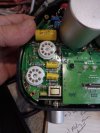


I didn't fire it up but I pulled the top before I had to run my dog to his vet appointment. Just from doing some continuity tests the tubes appear to be in play..otherwise someone went to a lot of trouble to make it look legit. I want to pull the bottom plate to see if I can get those 2 can tops off on the top..they are solidly stuck on. Also I want to see where the weight of this thing is coming from.
Mybig8ohm
Active Member
There is actually a lot going on inside here. Perfectly, tightly spaced. I'm surprised the unit is as quiet as it is. That top PCB is populated with 12 electrolytics & 2 film caps on the underside that I can see. Then the 2nd little half-

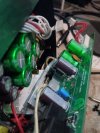
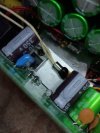
 pcb looks to have 2 mosfets & a bunch of different passive parts.. although maybe one of those 3 legs is a regulator. Hard to tell. I've got thermal grease everywhere. I'll have to disconnect more of the wire connectors if I want a better look. It's late so I'll save this for another time.
pcb looks to have 2 mosfets & a bunch of different passive parts.. although maybe one of those 3 legs is a regulator. Hard to tell. I've got thermal grease everywhere. I'll have to disconnect more of the wire connectors if I want a better look. It's late so I'll save this for another time.

I could never get the supplied remote control to work though.
I got an unused boxed unit on liquidation, so the CR2032 button cell in the remote had died long ago, and I replaced it and the remote worked fine. It was a pain to unscrew the battery compartment lid - the screw had oxidized and locked solid in the intervening ~19 years. WD40 + a few drops of kerosene and a heavy-duty screwdriver did the trick, but I almost fully stripped the head and had to replace the screw - I think a stock M3x8mm flat head should work.
The remote power-on works like the volume-encoder/switch on the amp - hold it down for a few seconds until the soft-start relay in the amp clicks and all the red LEDs light up.
The red LEDs below the tubes should have preferably been amber. Thankfully, they're not blue.
An EM84 magic-eye VU bar-graph would have been a nice touch.
I removed all the black paint on the remote using a sticker-removal solvent. It's now bare aluminium - nicely sculpted die-cast metal, like Marklin/Hornby model train engines from the '50s-'70s - solid, heavy-duty die-cast aluminium. One could slightly buff it with fine emory and spray it with a clearcoat protective layer on the bottom - I'll do that later.
It sounds way better than the tube-buffered gainclones which typically use 6N1P cathode-followers driving a TDA7265 2-channel chipamp.
I haven't tried rolling the 12AX7s, but I have a few NOS Telefunkens and BEL ECC83s lying around somewhere - I don't think they will make a huge difference.
The cathode resistor bypass caps (if any) could potentially be upgraded with solid polymers, OSCONs or Black Gates - I haven't gone down that rabbit hole yet, but it sounds good enough to try to take it to the next level with upgrades to passives.
Mybig8ohm
Active Member
It's an interesting little device. By first glance I thought a gimmicky looking MP3 player but it is actually well thought out. Well I would say the circuit looks thought out but the power supply is under designed & better air flow would have been welcomed inside the amp chassis. A mildly resistant load will eventually cook this sucka. The speakers used will determine how long this amp lasts. Though it's already 19 years old.
The metal heatsink from the bottom with the heaters regulator & I think the MP3 power regulators attached goes up into each of the silver cans on top. 2 mosfet transistors per channel inside the cans. I can't get them totally off yet to see which types.
Looking up the part number on that little transformer in the front turned out to be a custom made coupling transformer from Elytone Electronics Co..supposedly. From what I read these were somewhat popular in the UK. But a year after this launched Apple switched from a 12v MP3 charger & pin-set up to a 5v USB pins type. Within a year this unit became obsolete for any MP3 made after 2007 without some type of adapter. The original $800 price in 2007 isn't exactly pea-nuts either. That's about $1300 today.
I personally don't think this was a good investment/idea by the designer. But I guess that's easier to say now.
Nonetheless I as well found it to sound better than some standard power amps..when using appropriate speakers. An ear-pleasing sound. Maybe when I have nothing else on my plate I'll beef up the PS, disengage the MP3 power section if possible to do without effecting other sections & pass it to my daughter.
This Roth Music Cocoon lives on lol.
The metal heatsink from the bottom with the heaters regulator & I think the MP3 power regulators attached goes up into each of the silver cans on top. 2 mosfet transistors per channel inside the cans. I can't get them totally off yet to see which types.
Looking up the part number on that little transformer in the front turned out to be a custom made coupling transformer from Elytone Electronics Co..supposedly. From what I read these were somewhat popular in the UK. But a year after this launched Apple switched from a 12v MP3 charger & pin-set up to a 5v USB pins type. Within a year this unit became obsolete for any MP3 made after 2007 without some type of adapter. The original $800 price in 2007 isn't exactly pea-nuts either. That's about $1300 today.
I personally don't think this was a good investment/idea by the designer. But I guess that's easier to say now.
Nonetheless I as well found it to sound better than some standard power amps..when using appropriate speakers. An ear-pleasing sound. Maybe when I have nothing else on my plate I'll beef up the PS, disengage the MP3 power section if possible to do without effecting other sections & pass it to my daughter.
This Roth Music Cocoon lives on lol.
The brown 10uF/350V caps (B+ bypass?) seem to be a Nichicon 105c type - they won't fail easily. The metallic green 25v caps are also probably Nichicon (maybe PX or Muse FX ?). If they're 105c rated, they won't fail easily either. There are a fair number of yellow axial-lead film caps - probably MKT types. Probably not the best-sounding, but way better than non-polar electrolytics. The grey MOR resistors could probably use an upgrade to 1W CFRs, but that's not the highest priority either.
Probably best to focus on the reliability of the black PSU brick rather than the main amp unit, which looks well-made.
Probably best to focus on the reliability of the black PSU brick rather than the main amp unit, which looks well-made.
Just for reference, here's how the PSU looks after C37-C39 and C41 are replaced. As can be seen, the new C39 and C41 (Samwha VA) are physically larger than the Su'scon YS that they replace, but they can be comfortably kludged in by bending some leads. C37 and C38 are not a problem. The only slightly short trafo harness is the 0-120V (yellow-yellow) cable, but it's just about long enough to reach its 3-pin PCB connector (rotate the toroidal trafo slightly counter-clockwise to make it reach).
