• The move to the new server is done. There are some software and database maintenance updates in process. This has us passing the hat around to help out. We appreciate any donations. Seriously, even a dollar helps. The payment page may be found here - https://www.audiokarma.org/support.html

8-Track Vs. Cassette

My philosophy prof in college taught us that words like "everyone" and "always" in a statement are automatically rendered invalid.

I don't think you heard him or her correctly. ;)

"Everyone requires oxygen in order to live."
"Circles are always round."
"Causes always precede effects."

I'm sure you can pick it up from here. ;)
 
Sure.

Anaerobic organisms don't require oxygen. The problem lies in your imprecise definition of "everyone".
Yogic thought posits that circles are not always round.
And cause and effect? Well, now we're getting into quantum physics.

:rockon:

Cheers,
Larry B.
 
Pioneer HR-99 here, recapped, new belt , cleaned, cleaned again demag . Sounds ok depends what I play it through. The tapes need to be repair also .
 
8 tracks CAN SOUND MUCH BETTER than a cassette if thier stuff has been recorded right....


1) Most 8 tracks do not have dolby filtering so the sound can come out 100%

2) The source on most 8 tracks IS ANALOGUE(100%) on a cassette it might not be depending on when it came out....

I think they sound gorgeous.... (I love and always have loved analogue :))

Dolby wasn't a filtering technology. It was a noise reduction technology. It didn't filter anything. It increased signal strength at certain frequencies (mostly higher frequencies where hiss was an issue) on recording, and then reduced the signal (and hiss) on playback.

You're right that 8 tracks could be made to sound better than cassettes. The tape was wider and moved across the head at a faster speed. The problem was getting it to keep sounding good over time. The tape is continually wearing against itself, and the heads are constantly moving side to side. Over time the tape will wear, and the heads will move out of alignment.

As for analog/digital, I think the reason you don't find digital 8 tracks is because the format was pretty much obsolete at least a decade before anybody started putting digital content on tape.

bs
 
Dolby wasn't a filtering technology. It was a noise reduction technology. It didn't filter anything. It increased signal strength at certain frequencies (mostly higher frequencies where hiss was an issue) on recording, and then reduced the signal (and hiss) on playback.

One thing to keep in mind is the MPX (19kHz) pilot signal filtering, often used when recording FM stereo radio programs on Dolby equipped recorders, could affect the recording accuracy of other audio frequencies as described here:

https://en.m.wikipedia.org/wiki/MPX_filter
 
Last edited:
I love 8 track threads and eyg2181 started this one 8 years ago.

Wonder if he/she ever dipped a toe in the 8 track pool?
 
I think to truly appreciate 8-track tape carts, you had to be a teenager in the 60's when they came out. What portable music was there other than radio, battery operated manual turntables? FM "Multiplex" in a car was a mixed blessing, everything wigged out as you drove. No question that the track changing...or the music fading out to silence before the track change... was a pain, but in your '64 Ford Galaxie with the windows rolled down and the rear speakers faded up they sounded great. It was a car medium. Probably Radio Schack and others came out with home players so you could record for your car. No question it wasn't an in-home medium...but you didn't hear the tape hiss when driving.

I think the last tape I bought was "Rock And Roll" by Vanilla Fudge...got The Blues Project "Live At The Cafe A Go Go" for Christmas one year and was in heaven! Even had a "bootleg" Layla. Ya gotta think of the age and the technology, it was pretty sweet at the time :)
 
8 Track... !? Did see one recently at a local GoodWill.

Shook my head as if viewing the "departed" and kept right on walking...
 
8 track at its best can get up to about 13kHz, but most units are doing well to make it past 10KHz. Cassette at its best can do between 22kHz and 24kHz. A lower-end 80s vintage deck could typicaly do at least 15kHz. What exactly is there to debate?

Wrong, Sony got 18 Kilohertz top response with their top deck, Akai got 16K, so did Technics, Wollensak, and Pioneer as major known examples. And cassette realistically gets to 20 Khz at best in REAL LIFE. And less at real world operating levels, most cassette deck specs get quoted using -20 VU recording levels which means around 16-17Khz top end recording at levels you and I use. Cassette does have lower wow/flutter numbers. And this is using Metal tape at that. -4 VU spec frequency response which is correlated to a known operating level in nanowebers/meter would be more accurate real world measurements. I am not dissing cassettes when I say this, I use them and am a fan. And I am amazed at the performance which has emanated out of this slow speed recording medium, with such narrow tracks.
 
Wrong, Sony got 18 Kilohertz top response with their top deck, Akai got 16K, so did Technics, Wollensak, and Pioneer as major known examples. And cassette realistically gets to 20 Khz at best in REAL LIFE. And less at real world operating levels, most cassette deck specs get quoted using -20 VU recording levels which means around 16-17Khz top end recording at levels you and I use. Cassette does have lower wow/flutter numbers. And this is using Metal tape at that. -4 VU spec frequency response which is correlated to a known operating level in nanowebers/meter would be more accurate real world measurements. I am not dissing cassettes when I say this, I use them and am a fan. And I am amazed at the performance which has emanated out of this slow speed recording medium, with such narrow tracks.

The thing about hf response at 15khz+ is, there's no music up there, certainly none in non-classical. So as a practical matter, it doesn't matter.
 
Dolby wasn't a filtering technology. It was a noise reduction technology. It didn't filter anything. It increased signal strength at certain frequencies (mostly higher frequencies where hiss was an issue) on recording, and then reduced the signal (and hiss) on playback.

You're right that 8 tracks could be made to sound better than cassettes. The tape was wider and moved across the head at a faster speed. The problem was getting it to keep sounding good over time. The tape is continually wearing against itself, and the heads are constantly moving side to side. Over time the tape will wear, and the heads will move out of alignment.

As for analog/digital, I think the reason you don't find digital 8 tracks is because the format was pretty much obsolete at least a decade before anybody started putting digital content on tape.

bs
To be technical, Columbia House was offering certain titles on 8-track as late as 1988. I have a George Jones and Lee Greenwood from that time frame, and had several others that I sold over on the 'Bay. Was anyone going to put time and effort into a dying medium? Probably not, but the medium was at least alive, if even on life support, in the digital era. I bought several sealed 8-tracks in the 90's at a couple of truck stops, though they were probably NOS, and as late as 1992, TeeVee was advertising Roy Acuff's Greatest Hits as available on cassette, LP, CD, AND 8-track.
 
Yes but by then it was probably digitally sourced even on the 8 track.... THE LATEST 8 TRACK I HAVE IS A 1981 ALBUM......


I WOULD NOT WANT THAT ON MY 8 TRACKS!!! (I want analog on my analogue media)
 
I have some Maxell UD tapes and Chrome tapes for the cassette in my almost 20 year old Dodge ram that sound as good as new, they were made either on my 581z or my 682z starting over 35 years ago. Eight tracks are like old ringer manual washing machines compared to the new automatic machines. The signal to noise was terrible the wow and flutter awful and life expectancy of the tapes could be measured in less than a few hours of play time.
 
the main diff between these 2 tape sources is in the playback, the 8 tracks fidelity downfall is the unpredictable head line up with the large tape, nothing to support the 8 track in position from the rear, it just kind of klunks where you place it, only halfway in a opening, sometimes not in the best spot on the tape until you wiggle it or push it to one side to help lining up the tape head. crude fidelity, fun yes i have many 8 tracks, the cassette in home audio is supported all the way around the cassette, it snaps in for a good positioning on the tape head, consistent and better fidelity. 8 track is really no comparison in sound, only in your choice, or loyalty to one or the other.
 
8 tracks are kinda cool from a mechanical and design standpoint. I do have a decent player and use them occasionally. Most of of the carts I have suffer from crosstalk which is a little annoying. I also had to replace the pads on most of the carts I have. I failed trying to repair the foil splice on several carts. As soon as I popped the casing open, the tape would explode out! Re-spooling an 8 track is damn near impossible by hand. The compact cassette is a MUCH better format, both in sound quality and in functionality.
 
To be technical, Columbia House was offering certain titles on 8-track as late as 1988. I have a George Jones and Lee Greenwood from that time frame, and had several others that I sold over on the 'Bay. Was anyone going to put time and effort into a dying medium? Probably not, but the medium was at least alive, if even on life support, in the digital era. I bought several sealed 8-tracks in the 90's at a couple of truck stops, though they were probably NOS, and as late as 1992, TeeVee was advertising Roy Acuff's Greatest Hits as available on cassette, LP, CD, AND 8-track.

Radio Shack sold 8-track players until 1990:

http://www.radioshackcatalogs.com/html/1990/h019.html

019.jpg
 
Radio Shack sold 8-track players until 1990:

http://www.radioshackcatalogs.com/html/1990/h019.html

019.jpg
I have that exact 8-track deck. I also used to have the $49.95 cassette deck. It really didn't sound all that bad; it was a TSP replacement that was going to be thrown away, but it still worked, so I took it home with management blessing. Anything under a certain price was simply replaced under Tandy Service Plan, so some people used that option to simply get a new unit a time or two.
 
I never liked 8-track because I've seen so few recorders that I started to believe they're like phonographs - only manufacturers could record. Alas I've finally come across recorders, but now tape quality (magnetic particle size and density) of compact cassette is much better than most 8-tracks, so I'm not sure what good they're for nowadays.

All of the 8 track media I've seen all have the "matte brown" magnetic media which I deem "lowest quality". Were there better sealed and higher quality magnetic coating for 8 tracks similar in quality to even modest type I cassettes (not the cheap dictation quality ones, these type I's are probably no better than the 8 tracks I've seen; granted the higher tape speed would still give 8-track the advantage.)
 
I think to truly appreciate 8-track tape carts, you had to be a teenager in the 60's when they came out. What portable music was there other than radio, battery operated manual turntables? FM "Multiplex" in a car was a mixed blessing, everything wigged out as you drove. No question that the track changing...or the music fading out to silence before the track change... was a pain, but in your '64 Ford Galaxie with the windows rolled down and the rear speakers faded up they sounded great. It was a car medium. Probably Radio Schack and others came out with home players so you could record for your car. No question it wasn't an in-home medium...but you didn't hear the tape hiss when driving.

I think the last tape I bought was "Rock And Roll" by Vanilla Fudge...got The Blues Project "Live At The Cafe A Go Go" for Christmas one year and was in heaven! Even had a "bootleg" Layla. Ya gotta think of the age and the technology, it was pretty sweet at the time :)


"What portable music was there other than radio"

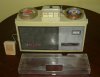
Well for one they had portable battery operated Reel 2 Reels back then by several makers such as Philips and such:)

I had several Philips over the years in the 60's and they all recorded and played fine:)
 

Attachments

  • P1140234_resize.JPG
    P1140234_resize.JPG
    108 KB · Views: 9
Last edited:
Back
Top Bottom