• The move to the new server is done. There are some software and database maintenance updates in process. This has us passing the hat around to help out. We appreciate any donations. Seriously, even a dollar helps. The payment page may be found here - https://www.audiokarma.org/support.html

A Burson Discrete Op Amp For My CDP

********News Flash*******

Ok!

So this morning for just $20 I replaced my stock players 13,200 uf's base supply with 88,000uf's

The results were just shocking Shocked!

Their is nothing like a strong foundation to music!:thmbsp:

The Burson's like to talk! And I'm glad they did!

Cause man they impressed the hell out of me this morning!:yes:

When I installed them I cut the trace on the supply board and inserted a diode to drop ripple over (noise) I took some measurements and my ripple fell from 55 millivolts to 25 millivolts at the rectifier on the other side of the diode I had just a few millivolts.

So as I have been talking about regulators and their sound!

I had bypassed the regulator with 2 uf's this really opened up the body of the player.

But as I listened I wonder about the bass and the effect of the regulators on it!

So my aim was to have enough capacitance so that I could swamp all the negative feedback effects out of the regulator. To do this also causes the regulator to be useless for noise reduction.

But will still regulate the DC voltage!

This essentially creates the very natural sound of an unregulated supply.

Well with the supply having a low enough noise floor I was able to increase the bypass to 47 uf's effectively neutralizing the regulators high AC resistance with its negative feedback effect on the sound.

The results are simply stunning! If I do say so my self!

The resulting sound was like when I listened to my big phono stage with just half of its 900 Joule supply! as it has so much overkill! I was astonished that it was audible!

Just as the Bursons are with an 6x increase in supply at the rectifier.

The foundation increased all the way up to the lower mids. Vocals took on a substantial sense of weight in their lower mids.

I was just floored, and very happy cause the music is so inviting!

And well! I'm not done yet!

I made a mistake in my measurements The 4 caps I replaced. I measured wrong! I don't how, but it doesn't matter as learning this was well worth the $20 so I am going to increase this even more! As the Bursons are reflecting every thing I've tried!

Very exciting!

On the back end of the regulators I have just 6600 uf's a 6x increase as well, which I'm going to increase with Muse's using various values ( some 20,000 uf's plus) which is what Wadia is doing with their Muse power supplies.

I'm also going to pull the Headphone IC's and replace them with sockets as well as the Balanced out IC's with sockets

I want to give the Bursons all the current I can!

I wish you all could hear this!:music:

Me I'm just flipped out man over what I'm hearing and I look forward to your all impressions!

SET12:smoke:
 
Sounds exciting. I got the mod bug with all your talk of your project, so I decided to mod my preamp with a burson for the headphone amp, film caps for bypassing and coupling, ect. Can't wait to hear the results. Working on my X77ES scares me for several reasons...I'm glad things are working out in your project! :)
 
Glad to hear from you Vincei!,

Working on the Sony isn't that bad! it just takes a little getting use to!

If there's one thing that the Burson's have taught me its to listen to them! But you must give them I feel about 200 hrs of real break in time!

The break in period through me for a loop as it was like u shaped in performance. At first things were exciting then seemed to thin out and warmth then appeared again!

But the real kicker has been the supply!

I certainly believe the final total swamping of the regulator along with the volume of capacitance really sent the player into orbit!

:scratch2:If you do anything do the supply as I did as I really think the player will benefit a lot!

You can see the diodes I added and the bipolar 47uf blue caps.

SD530058.JPG

Cheers

SET12
 
I may have missed it, but did you do anything to the diodes? With all the increase of capacitance, I was wonding if you increased the current capability of those. Lookin' good!
 
Not raining on the parade, but I'd be a lot more enthusiastic if these guys would give a few specs on the device.*

Slew rate?
Settling time?
Input offset voltage?
Input bias current?
Equivalent input noise?

Among others. Burson seems to be deliberately (and perhaps suspiciously) silent about such things.

I just hate to see reasonably priced IC solutions which approach ideal amplifiers (and sound excellent by anyone's standards) dismissed simply because they are IC's. There are a LOT of advantages to having the entire 'amplifier' on one common piece of silicon that can't be duplicated by a discrete design.

Anytime you have a supposedly superior solution that costs upwards of 1500% more than a conventional one, scepticism and hard scrutiny are your allies.


*and maybe lower the price

This is exactly the discussion I had with a good friend who works at HP doing some rather advanced DSP circuitry. Good post.
 
I may have missed it, but did you do anything to the diodes? With all the increase of capacitance, I was wonding if you increased the current capability of those. Lookin' good!

Hi Vincei,

The diodes look to be pretty hardy being TO220 devices I just tried finding a data sheet on them but no luck right now. I think I'll replace them with some more modern devices like these. Which is the package our player is using.

http://www2.electronicproducts.com/Diode_pair_improves_EMI_efficiency-article-OCTCS4-OCT2001.aspx

This is exactly the discussion I had with a good friend who works at HP doing some rather advanced DSP circuitry. Good post.

From an objectionist point of view I can see this point made.:yes:

:scratch2:But from subjective point of view.

As of this morning with my last supply mod.

The Burson's hit ball right out of the ballpark!

I'm only interested in results with my ears.

Everything I have done to the player has been heard and reflected back!

And I might add with great reflection! and finest!

I might of paid nearly $300 for them but their performance is worth ten times the price!

Granted I can a test that ones mileage will vary. but give them what they want as I have and they will deliver :music: They are in every sense of the word, Thoroughbreds.

SET12:smoke:
 
Hi everyone!

Well working nights I was up at 3am and got to work while I was planning to do some improvements to my SET amps to get even more steam out of them.

:scratch2:I took my player to my bench for some measurements and discovered a cool way to get my 20,000 uf's of Muse Electrolytic's on board.

The players main audio board has been a bear to work on cause of the heavy ground connections needed to be unsoldered!

As I took the Balanced Audio Module out I discovered that the boards were sitting on removable copper plates.

While I was at it I removed the NE5534 headphone IC amps. And installed sockets without any IC's if in the future I want to use headphones.


So that being the case I just went to town this morning!

And opened up the beast.

sd530063gh5.jpg


This allowed easy access to virtually everthing!

So I removed the balanced audio module which contains to NE5532 IC amps with transformers.

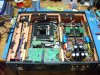
You can also see the group of four 22,000 uf electrolytics that replaced the original 3,300 electrolytics.

sd530065gw6.jpg


So all together I eliminated 4 IC's and created the space to mount my Muse supply caps.

And conveniently the white connector plug wiil be used to what I'm going to call a Flat Pack module of Muse Electrolytic's of various sizes 2200,470,47 uf caps :yes:


sd530066bj8.jpg


A lot of fun! :P

SET12:smoke:
 
Well after 14 hrs of working on the Sony I pretty much have it done.

sd530058bu1.jpg


Pictured are 4 of 10 of the green 2200 uf Muses that I installed and 12 470 uf Muses were installed. using a Radio Shack off the shelf pc board. And a quad of Panasonic 22,000 uf electrolytics for a total of 88,000 uf's replacing the 13,200 stock.

I listened briefly and the Muse seem very,very transparent like a good Polypropylene no wonder why people like them!

So I will be burning them in all week. what you see here is the bottom of the chassis with the Bursons, notice the green Muse caps as what I did was to use a double board stacked on 1/4 inch stand offs allowing the 8 Muse caps to be used! In this tight space.

sd530062kr3.jpg


SET

More later!
 
Last edited:
Hi All,

I had one of my close friends here tonight that hears more live music than anyone I know.

He listened to the Sony, Burson,Muse modified player tonight!:scratch2:

I had fun watching him tap his toes and bop about to the Big Phat Band CD. Which sounded fabulous!:D

And quite frankly I have never seen him bop about as much.:banana:

He concurred with me that the player has no signs of digital artifacts!

Giving the player the thumbs up!:thmbsp:

He also noticed the great dynamics:yes: and depth that the player is resolving as well!:yes:

My last mod was adding the Muse's which are largely responsible for the very smooth sound! These are just fabulous sounding caps!

So it seems the player mods are a great success!

SET12 :smoke:
 
Cool! Congrats on the success. Now I just hope the laser holds out...:worried: Any clue on the amount of hours on it? That is the biggest reason I am holding off on modding mine. I have no clue on the amount on mine as I am not the original owner. However, the machine reads everyting, including CDR's with no problem and is super fast at track access. Fingers are crossed.
 
Cool! Congrats on the success. Now I just hope the laser holds out...:worried: Any clue on the amount of hours on it? That is the biggest reason I am holding off on modding mine. I have no clue on the amount on mine as I am not the original owner. However, the machine reads everyting, including CDR's with no problem and is super fast at track access. Fingers are crossed.

Vincei,

I have no idea how many hrs are on it. but I imagine several thousand hrs at least. I'm not afraid because I think I could find a used one. and swap what I have to.

But anyway everything is salvageable anyway. All the caps the Burson's the transformers if I have to but that would be yrs away yet.

I learned a lot!

Lets face it one can buy these used for under $500 even! So if a DAC went out its just a simple transfer especially after you get your hands in it and you have a feel for things.

I finally got very comfortable working on it. And I can see and appreciate its build quality even more but I also see things that could be improved as well.

I haven't looked, but there maybe an after market laser that could be used!

All told the mods make the player a serious contender with todays $10,000 CDP's no doubt in my mind!

So spending the $400 and just my time make this project a true bargain!

And the issue of the laser is pretty much mute to me cause your not going to beat or contend with this players performance with todays 1-$2,000 machines IMO.

But if you do anything certainly jumper in a bypass for the regulators and listen for the players body just bloom like a flower! :music:

SET12:smoke:
 
My Halloween Scare!

Good man. :thmbsp:

Thanks Mr. Lin!

I was doing some work yesterday, And when I finished I had to of course listen to my work!

Well, I hit play and no music! Talk about a heart stopper!

Anyway I went back to my bench opened the belly of the beast! and discovered a small two pin connector was missed in my reconnection of the digital board. After the surgery of adding the Muse bypasses for my regulators

Pictured below they are the two green capacitors lying horizontally between the two boards at the bottom of the picture.

sd530059tn3.jpg


I have to admit working on this player is a challenge! One has to be careful!

Needless to say the sound was very different again! Harmonics were even more developed yet the smoothness was there yet, even the bass took on another dimension!

I'd say the bypass cap choice may have an influence!

But I also put in some suppression capacitors for the diodes I'm using to drop noise over. They are the two black capacitors in the upper left of the picture below.

sd530064rb6.jpg


Very interesting how the sound changed!:scratch2:

SET12:smoke:
 
One question, how did you secure all the new boards and components? It looks quite nice. I redone my preamp, and it's somewhat of a mess, mind you those 47uf and 22uf film caps are the size of a whale! I had to secure the caps and the Burson (headphone opamp) with nylon ties, not the best, but it holds them in place.
 
One question, how did you secure all the new boards and components? It looks quite nice. I redone my preamp, and it's somewhat of a mess, mind you those 47uf and 22uf film caps are the size of a whale! I had to secure the caps and the Burson (headphone opamp) with nylon ties, not the best, but it holds them in place.

Vincei,

Yes, film caps are nice! And yeah they are whales in solid state gear


But I'll tell you these Muse's are just as good! IMO and I have yrs of experience with film caps. Muse's are so good that they are one of a few that can be used in the signal path. Muse also makes non polar ones as well which I'm using in the regulator bypasses!

Bursons want current supply! without it they can be thin in the bass!

The audio board supply will have a 150,000 uf's when I'm done. Especially with the 6, 25 ma. modules, and thats 200,000 plus for the whole player.

For my bulk electrolytics I'm using Panasonic's from Digikey the stock player was using 3300 uf's x 4 at the rectifier but Panasonic has 33,000 uf ones that will just drop right in! right now I have 22,000's in place my mistake in measuring!

And probably better suited for the space! Also I would replace all your supply with these!

I got mine from Michael Percy Audio

http://www.percyaudio.com/

So how did I fasten it all!

Well the Bursons are only supported by the 8 solid core wires they don't really move and I have a 1/2 inch clearance before any possible contact with the chassis

I used perforated for the 8- 2200 (green caps) uf Muses this board I used stand offs to create a double sided board 4 Muses on each side, plus the two on the audio board itself for a total of 22,000 uf's.

I used the headphone 4- 10uf cap locations to connect the 8 muse's this distributes the reserve's symmetrically to the audio board!

And the other 12- 470 uf Muse's use the pcb with copper traces I utilized the two ground traces for + and - rails and used the Balanced boards connector to connect the supply to unsoldering the balance boards connector to use on the new board.

The bypasses 47 uf BP's actually will rest on the foam pad that is on the copper plate used to isolate the two boards so no issues but I will put some shrink wrap on them in the next time I'm in the chassis this will insure no contact with any traces.


And pcb boards that had ground traces from radio shack, I custom sized the board cutting it with a Dremal tool

As to the additional cap boards are fastened down on stand offs and 4-40 screws I drilled a couple of holes for each board carefully cleaned the filings up watching where any debris was falling.

Using the cap leads themselves as leads to other leads.

Today, I am hosting a get together hear of some of my local audio club members so it should be interesting to their thoughts!

SET12:smoke:
 
My Local Audio Club Meeting And Their Response to the Burson's

Hi People,

My club members responded very favorably to the Bursons commenting that the system had a lot of involvement and detail which was certainly one of my goals with the Burson's.

sd530058editedsl9.jpg


After the meeting just before we were to leave to hear another members system I opened up the hood's of my gear to show some of the work that I did.

sd530057editedwn5.jpg


So my motto with the Burson's is give the Burson's what they want and they will deliver!

Namely energy reserves! Both CDP and Amplifiers.

SET12:smoke:
 
The Machine to have Sony X777ES

Well I'd like to find me one of these! For its variable remote controlled outs.

sonyx777esinside7vn7.jpg


I found this guy's testimonial on Audiogon for this!

Beautiful piece of hardware. Well built, heavy and made to last. The date stamp on my unit reads Sept.1991. I change components often and I can say that this Sony has one of the most enjoyable sounds I've ever heard. The sound has character. It brings out that true "live" feeling in the music whereas most other CD players, no matter how good they are, don't even come close. It extracts tons of bass from every track and due to it's massive twin power supplies, sends out a strong signal that can make a good power amp really boogie. The best way to listen to this unit is to connect it directly to a power amp (yes it has variable outputs). I tried using the XLR outs and then the fixed RCA outs through good preamps, but the best sound always came through the variable outputs, straight to the power amp.
Recently a friend convinced me to sell the 777es unit and try more exotic, newer cd players. All I can say is that nothing compares to the pleasure of listening to this player. I've sold all the so called exotics and just completed a deal to get a champagne color Sony CDP-X779es, the same as the 777es except made in 1992. I can't wait to hook up the 779es and enjoy music again. It will be a very long time before I sell that baby. No matter what other CD players I get I will always keep the Sony. There's nothing like it.


Basically it has the same layout as my X77ES! But I think better looking!

And as he does I run mine direct as well!

I was able to hear it through a $1800 Peach II tube preamp before I installed the upgrades. But sorry! The active line stage just couldn't compete with the transparency or the fast tight bass. To much in the way! Switches, wire another gain stage and so on.

And now with the Burson's and supply upgrade, with regulator AC bypass the Peach just wouldn't have a prayer!

SET12 :smoke:
 
Last edited:
Resolution Audio Opus 21 vs Sony X77ES Burson and Mods

Well, What an interesting comparison. The Opus can drive amp direct:thmbsp: Which is how we listened to the two of them.

The Opus has been around a few yrs now and is some $4000 new used may be about $2000. And my Sony is some 18yrs of age. was $2000 new which I bought new in a box when it was 2yrs old for $600 and have about another $400 stuck in various mods into it.

The Opus was a charmer alright. It has liquidity all over it! A smoothness that has to be heard to be appreciated.

In the liquidity department it won hands down. Made the Sony sound rough in contrast.

One certainly could listen for a long time to it and listen to a very wide variety of even early digital without fatigue.

I guess I could say it was extremely musical and yet their was micro detail to be heard easy enough but just how much is another story!

In regards to the Sony and its many Mods it made it self be known as well.

While the Sony could not compete with the Opus's Liquidity it wasn't embarrassed either.

I have had my share of musical products through the yrs none of which stayed with me long. Frankly because I found myself just wanting more information.

Right off the first thing apparent was Opus's sound stage was what I would call drastically compressed not only in width which can be lived with IMO but unfortunately the depth as well! While I found the presentation very easy to listen to tonally, But I found the presentation to be very flat.

The Sony in contrast was very wide well past the speaker boundaries for the majority of the music played through it. The Sony's depth was substantially more layered IMO and very deep.

And speaking of information one of the things I noticed was how the Bursons resolve the grain on old master tapes is to the point of distinguishing coarse vs fine grain. The Opus would resolve that fact of analog master tape but not to the level of its grain. Also the Burson was able to clearly define the acoustic environment with very defined ambient ques giving a sense of true size to the recorded space. Something the Opus seemed to ignore nearly all together IMO.


Another area was the presentations weight where the Sony just trumped the Opus easily and it might be expected with a 10x increase in power supply reserve capacitance be handled by Muse and Panasonic.

I really adore the Opus's liquidity and in an attempt to get some of it I will be adding a Burson Clock in the near future to be sure.

The Opus is going to be getting some modifications called the Reference Mod. its some $1700

http://www.greatnorthernsound.com/resolution.html

Besides the Clock I will be going using some special shielding material called TI shield developed for the military that is capable of absorbing a very wide bandwidth which is composed of an alloy material of copper and iron.

In the end here nothing is perfect but I'd still chose the Sony.

I'm hoping the new clock will move the Sony closer to the fabulous liquidity :thmbsp: of the Opus!

SET12
 
Back
Top Bottom