• The move to the new server is done. There are some software and database maintenance updates in process. This has us passing the hat around to help out. We appreciate any donations. Seriously, even a dollar helps. The payment page may be found here - https://www.audiokarma.org/support.html

A Garrard Lab 80 Question

Quadaptor!

Active Member
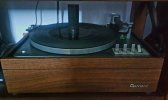
So about a year ago I broke down and bought a new stylus for the Shure M44-7 on my Lab 80. When I removed the head shell from the tonearm the plastic block into which the wires go broke into two pieces. This breakage caused a minor breakdown in me as I had just replaced and greased the bearings, put in a new idler wheel and received a new stylus. Because of these events I decided it would be best for my state of mind and the table to shelve the project and wait for a calmer day. Last week I received a new head shell but alas there's another frustration. When I went to install the head shell I noticed that the male prongs on the backside of the block that had broken in two on the first head shell came nowhere close to lining up with the female receptacles in the tonearm. The plastic block in the tonearm with the receptacles sit way high in relation to where the head shell would slide into it. I have a parts table and the relationship of the head shell and tonearm in respect to the plastic blocks is exactly the same. They simply don't line up horizontally and I fear applying any pressure will just result in disaster. Is there some sort of voodoo magic needed to get the head shell of my Lab 80 back into the tonearm or am I just missing something here.? I'd appreciate some advice from you Lab 80 guys as I don't want to end up being the proud owner of two broken head shells! May thanks in advance.
 
Register to hide this ad
So about a year ago I broke down and bought a new stylus for the Shure M44-7 on my Lab 80. When I removed the head shell from the tonearm the plastic block into which the wires go broke into two pieces. This breakage caused a minor breakdown in me as I had just replaced and greased the bearings, put in a new idler wheel and received a new stylus. Because of these events I decided it would be best for my state of mind and the table to shelve the project and wait for a calmer day. Last week I received a new head shell but alas there's another frustration. When I went to install the head shell I noticed that the male prongs on the backside of the block that had broken in two on the first head shell came nowhere close to lining up with the female receptacles in the tonearm. The plastic block in the tonearm with the receptacles sit way high in relation to where the head shell would slide into it. I have a parts table and the relationship of the head shell and tonearm in respect to the plastic blocks is exactly the same. They simply don't line up horizontally and I fear applying any pressure will just result in disaster. Is there some sort of voodoo magic needed to get the head shell of my Lab 80 back into the tonearm or am I just missing something here.? I'd appreciate some advice from you Lab 80 guys as I don't want to end up being the proud owner of two broken head shells! May thanks in advance.
You are not alone. My Lab 80 plastic connector block split right down the middle but I was able to push the connectors back together with a small screwdriver. They will not be taken apart again, because if I do take them apart they will probably crumble into tiny bits!

My long term solution was to install a p-mount adapter as I have many p-mount cartridges and styli.

I considered adding a small aftermarket connector, but decided it was not worth the hassle. Went with the p-mount instead.

Hope you get it sorted out.
 
Thanks guys. I loosened the screw that holds the plastic block in the head shell. That provided enough slop to get the two blocks together. I have a Pickering XVX 3000 cartridge I want to use on the Lab 80 and now all it has to do is survive one more round of removal and reinstallation. I cut my motoring teeth on British cars (Triumph Spitfire and MGB) and one bike (Triumph T100R Trophy) from that era and everything seemed to require a "different" set of sensibilities to work on. You know the old name for Lucas Electronics; "Prince of Darkness." I hope that won't apply to my Lab 80 adventure.
 
XSV 3000 is a great cartridge. I was lucky to be gifted one with a nude mount black diamond stylus.

I know what you mean about Lucas "The Prince of Darkness". My 1967 MGB went dark on my second day of ownership due to a faulty Lucas voltage regulator. Went to the junk yard and pulled US made regulator from another MGB installed it in mine and no more darkness! Took a while to figure out the dual 6 volt battery setup with positive ground.
 
XSV 3000 is a great cartridge. I was lucky to be gifted one with a nude mount black diamond stylus.

I know what you mean about Lucas "The Prince of Darkness". My 1967 MGB went dark on my second day of ownership due to a faulty Lucas voltage regulator. Went to the junk yard and pulled US made regulator from another MGB installed it in mine and no more darkness! Took a while to figure out the dual 6 volt battery setup with positive ground.
There's all sorts of crazy stories with British cars and bikes from that era!
 
There's all sorts of crazy stories with British cars and bikes from that era!
As for the cartridge, I bought it new from a chain called GEMCO back in the 80s and I hardly ever used it. I have two tables. One is the Lab 80 and the other is a belt drive KLH Model Sixty, which is a lot like an AR XA in the drive department. However, it has a much lighter and more complicated tonearm. I also have two cartridges; one being the Pickering and the other a Shure M91ED. Correct me if I'm wrong, but I figure the Pickering would work best on the Lab 80 and the Shure would work best on the Model Sixty.
 
Maybe a dab of glue to hold the broken halves of the plastic block together?
Maybe I muddied the waters in my description. I'm not using the head shell with the broken block, although I think I'll try fixing it as you suggested. But I have two others that have the same problem. I got one of the head shells to fit last night by loosening the screw that holds it in place. This created enough movement/wiggle room to get the pins to align. I think the real problem is working with a table with plastic parts that date back to the Johnson administration. And that was a long time ago.
 
Maybe I muddied the waters in my description. I'm not using the head shell with the broken block, although I think I'll try fixing it as you suggested. But I have two others that have the same problem. I got one of the head shells to fit last night by loosening the screw that holds it in place. This created enough movement/wiggle room to get the pins to align. I think the real problem is working with a table with plastic parts that date back to the Johnson administration. And that was a long time ago.
Just to be clear, you did loosen the screw BEFORE you tried to push the headshell in, correct?
 
Just to be clear, you did loosen the screw BEFORE you tried to push the headshell in, correct?
Took it completely out. I just detached and reattached the head shell again this morning to mount a Shure M91ED cart and the only way to do it is take the binding screw all the way out to get enough upward angle for the pins and block to align. And at that, I have to keep the screw that holds the pin block to the head shell a bit loose to get it all to come together.
 
Last edited:
This seems like the sort of thing that could be 3d printed I wouldn't be upset at one that was straight pins that allowed for use of easily-obtained headshell leads rather than the permanently installed original type.

on some level though we're just dealing with really old gear that was just not ever expected to live this long. The fact that it does is almost more surprising than the fact that sometimes bits like this break.
 
This seems like the sort of thing that could be 3d printed I wouldn't be upset at one that was straight pins that allowed for use of easily-obtained headshell leads rather than the permanently installed original type.

on some level though we're just dealing with really old gear that was just not ever expected to live this long. The fact that it does is almost more surprising than the fact that sometimes bits like this break.
Yep, old stuff. The way I look at it is that using a Lab 80 today in many ways is like using a turn of the century hand crank record player in the mid 60s. 1900 to 1965 equals the same approximate time interval as 1965 to 2026. And how many people were seriously using hand crank tables in the mid 60s? It is amazing that we still consider integrating tables such as Lab 80s, AR XAs, Garrard 301s and 401s, and TD 124s into our current hifis!
 
The two weak points of this tt are the plastic in the headshell/tonearm and the tonarm rest/cueing down stand.

The rest of the tt is built like a friggin' tank. It's worth it to get it back into service.

20260907_071505.jpg
 
Just curious if any Lab 80 or Type A owners have tried aligning their cartridges to Baerwald or other geometries. There is usually enough wiggle room in the mounting holes (depending on cartridge) to allow for some cartridge movement. I have had good success in getting carts lined up, not only in geometry but also azimuth and SRA. The more I tinker with these old machines, the more I enjoy them!

I have 2 type A's, a Lab 80, Magnavox Imperial (converted to MM) and they all sound really good after much experimenting and tuning. Idler wheel noise and motor vibrations entering the tonearm have been the biggest obstacles for me. Happy to report they are all running near silent. You really have to listen closely between tracks for any noise. Can't hear any rumble or motor hum while music is playing except for extremely quiet passages and even then it is barely noticeable.
 
I dunno, maybe its me but idler drives seem to dig in really well. I once read an explanation for this. The argument was that idler drive tables provided more torque than say a belt drive, and that the torque was beneficial when the stylus was tracking through deep grooves in the record. The torque better overcame the drag of the record when compared to a belt driven rig. I don't know how a direct drive would fit into this scenario as I've had two belt drives (AR XB and KLH Model Sixty) and one other idler (a Garrard Type A in a Fisher Futura console). But never a good direct drive. Maybe someone can chime in on that one.
 
So I noticed that the head shell I got to fit has a different plastic block than the original. The head shell that came off my Lab 80 has a clear plastic block with connectors for the jumper wires pressed through its body. Much of the block s embedded in the head shell. It also has a mounting screw that inserts from the backside and vertical to the length of the head shell and tonearm. The head shell I got to work has a relatively thinner black plastic block that affixes to the back side of the head shell and is held in place with a screw that inserts horizontally to the length of the head shell and tone arm. None of the black plastic mounting block is embedded into the body of the head shell. My Lab 80 is a early unit. The head shell I got to work is, I assume, from a later or Mk II unit. Also, to get the head shell I got to work up and running I'll need to find someone to solder the jumper cables onto the mounting studs and purchase a new stylus for the M91ED cartridge. Long story short, it's likely going to be some time before I see this project actually come to fruition.

PS - someone mentioned this would be a good project for a 3D printer. I agree!
 
only two things that use this headshell that I know of are the Lab 80 and the A70. I actually have a shell I got from a junk A70. Just had a look through my collection, they all appear identical, but some are numbered BDC1 and some are BDC2. I can't tell any difference between them though. All have the clear plastic block. I have a Mark 1 and a Mark 2.
 
only two things that use this headshell that I know of are the Lab 80 and the A70. I actually have a shell I got from a junk A70. Just had a look through my collection, they all appear identical, but some are numbered BDC1 and some are BDC2. I can't tell any difference between them though. All have the clear plastic block. I have a Mark 1 and a Mark 2.
Interesting. I'll try posting a picture.

PS - I just did a "google" search and all images for A70 head shells have the clear plastic block. I hate saying it, but I may have just hit a brick wall with this project. The price of entry is going to include a new stylus and some work by a tech to get it all together. Its a great table that I already put money into with a new bearing set and idler wheel, but the head shell I have may be a gamble not worth the money.
 
Last edited:
Back
Top Bottom