• The move to the new server is done. There are some software and database maintenance updates in process. This has us passing the hat around to help out. We appreciate any donations. Seriously, even a dollar helps. The payment page may be found here - https://www.audiokarma.org/support.html

A horn design using Fusion 360

mboxler

Well-Known Member
A number of members have reached out to me regarding 3D horns. As I'm still a novice, it's great to know how excited others are about this process.

@Herr Grau asked how I created a horn in another thread, so here goes.

I use Fusion 360 for my designs and am self-taught. I'm sure there are better ways of doing this, but...

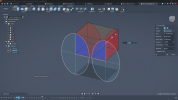
First, I created a solid block equal to the height, width, and depth of the horn. I center a line on the bottom of the width and height sketches equal to the throat diameter.
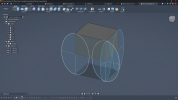
I then draw ellipses as shown...
Screenshot 2026-06-22 121027.png

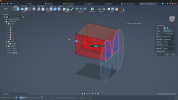
Next steps cut out the ellipses...

Screenshot 2026-06-22 121115.png

Screenshot 2026-06-22 121132.png

Leaving what looks like a horn :)

Screenshot 2026-06-22 121238.png

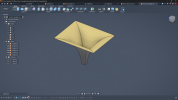
This is still solid, so I use the Surface command to break it down into individual parts with no thickness. I hid the front and back to show the hollow horn which I stitched back together...
Screenshot 2026-06-22 121332.png

The throat is still a square. I use the variable Fillet command to both round out the opening and gently convert the horn from a round throat to a rectangular mouth...

Screenshot 2026-06-22 121416.png

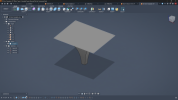
Now I need thicker walls! The Thicken command allows me to add any amount of thickness to the outside walls...

Screenshot 2026-06-22 121500.png

Still more work to be done, but I'll stop here. Will gladly continue if anyone is interested.

Mike
 
Register to hide this ad
What did you use to get your horn flair calculations?

Initially I used the free program on ALK's website to generate an Edgar horn. It worked well but was time consuming.

Hybrid Horn 1.4 inch v5 Sketches.png

My ellipse approach simplified the build. I ended up using the free program to get the depth of the horn and connected the ellipse to those points. I really didn't focus on anything else at the time but did realize I had no control over the throat entry angle or the mouth exit angle. My latest model allows for more control over these angles.

I'm SLOWLY learning how to use AKABAK to simulate the horn's output. As I understand it, I can simulate the Fc of a horn and its directivity without printing it. Needless to say, I'm really pushing the limits of my old brain, but it's fun, nonetheless.
 
That is the same program I am using. The ellipse looks like it simplifies the design and make a smoother transition as you are not flaring in segments then smoothing.
 
Every design has advantages and disadvantages. There usually is no 'best' solution overall, only the best compromise for your specific situation.

I am by no means an expert in horn design, I am myself a beginner. Dave Harris would propably be best equipped to answer this question. As far as understand it, the advantages of an elliptical horn are:
1. Better aspect-ratio matching to typical rooms; wider horizontal than vertical dispersion reduces floor/ceiling reflections while keeping a broad listening area.
2. Smoother directivity transition than many rectangular horns with fewer sharp-edge diffraction effects.
3. Often more uniform wavefront loading than rectangular geometries.
4. Can give a larger effective mouth width in one axis without making the horn excessively tall.
5. Subjectively often perceived as more natural or less “horn-like” than aggressive CD designs.
Disadvantages:
1. Directivity control is usually less constant with frequency than a well-designed constant-directivity waveguide.
2. More complex to design and optimize; the two axes interact. Harder to model analytically than circular geometries.
3. Manufacturing is more difficult than simple conical or round horns.
4. Depending on design, asymmetry can introduce different behavior in horizontal vs. vertical planes.
 
I really couldn’t have said it any better. The only point I’d add is that the elliptical geometry I was referring to is the method Mike Boxler uses to generate the tractrix flare. While the finished horn has a rectangular mouth, the flare itself is created from elliptical profiles, which are then lofted into the final horn geometry.
 
So this elliptical design is for achieving the look of a horn but not the performance of a properly designed horn? What's the point?
“I don’t think that’s the intent. The elliptical geometry isn’t cosmetic—it’s one method of defining the flare. The horn still needs to be evaluated by its measured performance: frequency response, impedance loading, directivity, and distortion. The geometry is simply one of the tools used to achieve those results.”
 
Just to be clear. The elliptical design I posted was in response to a question by @Herr Grau. Since then, I have experimented with numerous other designs.

The horn I'm currently listening to is an Edgar horn. An issue I've noticed is a buzzing of my 3D printed horns, so I designed one that could be partially filled with sand. That seems to help a lot. Still trying to perfect that technique.

Here's my latest design, which gives me more control. The blue curves are my lofting paths.

Back to Basics Horn v5.png

Back to Basics Horn v5 Lofted.png

I can now mirror this into a complete horn.
 
Yes, it was claimed in a patent that was granted...very-much not-funny. Years ago.

Roy had his Points. C'mon, man. We love ya, but you guys are now in "biz" by about anybody's definition. There's only so-far that the "hayseed routine" works, IMO.

@mboxler is half-half by my eye in these areas. Whomever he dances with...yunno. We all grew-up with that standard.

Dude (boxler), -- yer almost "there". Pick a side of the fence so that we may choose at which level/arrangement at we wish to participate.

You're right there -- by my feel -- where Dana or ALK or Greg (Volti) or ... < Bob Crites is excepted as his body of work stands alone in context of That Time >.

You keep fishing...or dancing on the edge so others might...study horns for 40 years and it leaps-out...

Pick a side. The Hounds will be unleashed appropriately.

This is the gray zone. It's exactly the _difference_ between why ThePrinter cannot directly print+sell other products. This is the line. You hit the line. We have all-manner of contributions to make (or not make, depending). You (mbox) have been crazy-generous with Science and advanced the condition of the DIY'er and for that I am sincerely in your debt and grateful.
 
Last edited:
Nothing like being able to do things yourself from design to part. I know someone who is doing plastic deposition horns and there are a lot of variables that go into the medium used to how hot the deposit is and stock diameter. He has not run into the buzzing problem yet but I figure that is the drawback to these. A cast plastic horn is more homogeneous and more able to resist vibration I would think. Buzzing or vibration is not something I have to worry with thankfully.

Tractrix curves are not elliptic nor round and are superior to anything else I have tried. There are curve calculators online that work well.
 
“I don’t think that’s the intent. The elliptical geometry isn’t cosmetic—it’s one method of defining the flare. The horn still needs to be evaluated by its measured performance: frequency response, impedance loading, directivity, and distortion. The geometry is simply one of the tools used to achieve those results.”
Surely there's a simulator out there that will optimize the curve for a given compression driver. You shouldn't have to create an infinite number of prototype horns and then test all of them to see which works best.

Nothing like being able to do things yourself from design to part. I know someone who is doing plastic deposition horns and there are a lot of variables that go into the medium used to how hot the deposit is and stock diameter. He has not run into the buzzing problem yet but I figure that is the drawback to these. A cast plastic horn is more homogeneous and more able to resist vibration I would think. Buzzing or vibration is not something I have to worry with thankfully.

Tractrix curves are not elliptic nor round and are superior to anything else I have tried. There are curve calculators online that work well.
I don't know what would cause buzzing in a 3D print unless the layers were delaminated, indicating a poor quality/failed print. Maybe the print was hollow and filled after assembly with something loose (sand, gravel, buckshot?) that buzzes or rattles inside the print.

Back when I used to pay a lot more attention to this stuff, I remember seeing info on the tractrix curves. I was under the impression that a lot of commercial horn speakers used the tractrix curve. F360 allows parametric modeling so it should be possible to enter a formula and have F360 draw any desired tractrix curve.
 
Surely there's a simulator out there that will optimize the curve for a given compression driver. You shouldn't have to create an infinite number of prototype horns and then test all of them to see which works best.


I don't know what would cause buzzing in a 3D print unless the layers were delaminated, indicating a poor quality/failed print. Maybe the print was hollow and filled after assembly with something loose (sand, gravel, buckshot?) that buzzes or rattles inside the print.

Back when I used to pay a lot more attention to this stuff, I remember seeing info on the tractrix curves. I was under the impression that a lot of commercial horn speakers used the tractrix curve. F360 allows parametric modeling so it should be possible to enter a formula and have F360 draw any desired tractrix curve.

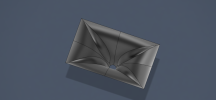
This is why I'm trying to learn BEM solving tools, like AKABAK. I purchased a horn plan from Troy Crowe, turned it into a surface, and created a mesh file.

Horn Mesh.jpg

@DirtyErnie understands this better than I, but since compression drivers seldom have T/S parameters, I believe this treats the driver as a constant velocity motor.

At least I should be able to test the horn characteristics without printing it :)
 
Back
Top Bottom