• The move to the new server is done. There are some software and database maintenance updates in process. This has us passing the hat around to help out. We appreciate any donations. Seriously, even a dollar helps. The payment page may be found here - https://www.audiokarma.org/support.html

A list of amps that have pre out / main in ?

Noisypot

Member
:yes: :no:

I've been hunting for a good vintage amp (50 wpc or more) that has the pre outs / main ins. It really takes a lot of time to sort through listings. Did anyone ever make a list of vintage amps that have these jacks ? It's okay to laugh. I'm guessing the answer is no and this can be deleted.

Thanks everyone
 
Last edited:
Register to hide this ad
The list would be very very very long. This is a feature offered on older equipment that seems to have disappeared for the most part, to bad as it just makes the unit so much more flexible.
 
Last edited:
I've been hunting for a good vintage amp (50 wpc or more) that has the pre outs / main ins.

Well first thing, you should clarify exactly what you are talking about when you say "amp", because really, that could mean 3 different things.

Receivers - Generally a tuner, pre-amp, and power-amp all combined into one.
Integrated Amplifiers- Generally just a pre-amp and power-amp combined.
Power Amplifiers- Just an amplifier. Generally requires the use of a seperate pre-amp, or a reciever/integrated amp with pre-outs.

Your reference to pre-out / main-in jacks makes me think you are talking about receivers or integrated amps, perhaps both?

Also, what is your goal in searching for a device with these jacks? Are you looking for something to use as a pre-amp or as a power amp? Or just want the extra flexibility for the future?
 
Well first thing, you should clarify exactly what you are talking about when you say "amp", because really, that could mean 3 different things. etc etc

Noisypot : You're correct. Sorry. It would be an integrated amp and the pre / main deal would give me more versatility .... EQs and such.
 
Every single one of my vintage receivers/integrateds have pre out/main in. The list of every single one would be crazy long. As long as it was not a bottom of the line offering, it most likely has the feature.
 
Main reason I expect the feature disappeared is that it just wasn't needed. Any signal processors can be hooked into a tape loop with the same results. Maybe a shorter signal chain, but who's to notice?

I'm rebuilding a QRX-9001 right now and was going to add a pre/amp loop but was advised against it as it could ADD noise to the chain.

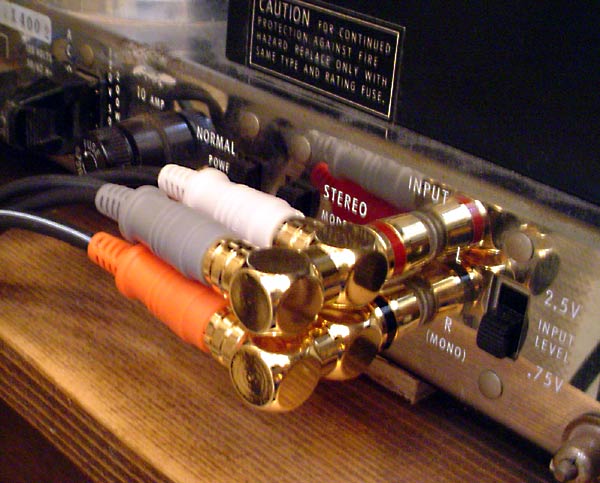
That said, I always ran my signal processors off the pre/amp loop on my Sansui QR-4500 quad - mostly because it was there. Now I just use a tape loop on my QRX receivers and use hard "Y" adapters to close the loop.

tapeloop-mc2205.jpg


The signal is routed into the amp and a dbx200 switchbox. That allows me to feed both the processors AND an external amp using the same loop, passing the enhancements down the chain and back to the receiver. The switcher also allows me some extra control as to what's switched in and out, and replaces the original tape loop with THREE loops ... win win.

I set up my latest custom build tuber with two sets of input jacks that are bridged internally and accomplish the same thing ... call it an "innie" vs an "outie" ... <G>

assembly-back-panel.jpg


Short version ... nice to have, but not a deal breaker. I wouldn't consider the lack of a dedicated pre/amp loop a deal breaker when selecting your gear.
 
Last edited:
Well this is what I expected, but no harm in asking. I'll deal with it on a case by case basis. sKiZo, that's a neat setup. A functional thing of beauty, worth considering. I might have some questions for you later. Thanks everyone .... Alan :-)
 
Last edited:
I have a Pioneer SA-600 (19 wpc - WOW) with the pre/main deal, so the dual mono amps sounds interesting. Tell me about it. I might want to do a slightly cruder approximation of what sKZo set up because I want to be able to run an EQ, my old tape deck (once in a while) and yes, possibly hook up a power amp. Now I'm getting confused.
:-)))
P.S. The SA-600 does have a Noisy POTentiometer. It's the volume control.
 
Every single one of my vintage receivers/integrateds have pre out/main in. The list of every single one would be crazy long. As long as it was not a bottom of the line offering, it most likely has the feature.

Its not a rare feature by any measure, but I don't think its the most common thing either. My two largest vintage receivers, a Sansui 7070 and a Kenwood KR-6030 (60W an 80W, respectively) don't have them. Not TOTL, but not BOTL either. Whereas my 20W HK 330a does have them. Of the 20 or so odd receivers and integrateds that I've waded through in my (albeit) short vintage audio tenure, I can count on one hand the ones that have had pre-outs.

NAD seems to include them more often than most brands.

BTW pre-out main-in is not a good place to hook up an EQ from a S/N perspective. The amplifier applies constant gain to any signal at the main-in connection, so it amplifies all of the noise added by the EQ at 100% even with the volume down low. Tape loops come before the volume control in the pre-amp, so this is a better option for connecting an EQ.
 
I have a Pioneer SA-600 (19 wpc - WOW) with the pre/main deal, so the dual mono amps sounds interesting. Tell me about it. I might want to do a slightly cruder approximation of what sKZo set up because I want to be able to run an EQ, my old tape deck (once in a while) and yes, possibly hook up a power amp. Now I'm getting confused.
:-)))
P.S. The SA-600 does have a Noisy POTentiometer. It's the volume control.

Something to remember ... a tape loop normally bypasses any tone and volume controls, so you'll need to come up with another way of controlling the output. Tone controls are covered with the use of an external eq, and a DAC with analog I/O works well for volume.

I went with dual volume pots for the amp itself ...

finished-001.jpg


... AND a DAC with a volume control AND analog I/O. I also use the HTPC's software volume to adjust the line level. This allows me more control over signal levels to match the components and reduce any possibility of distortion.

So ... HTPC software at 93%, DAC down three clicks, and the amp at 8ish equals ... perfect!

PS ... these work just as well for tapping into the loop ...
10650531.jpg

... but the hard adapters give you bonus bling points ... <G>
 
Hi ... My pessimistic side says: I don't want things to get too complex or it will be like my computer. I spend too much time trying to figure out how to work things. I went over to evilbay and looked at the rather intimidating DBX 200. Is there something a little simpler that will let me chain everything together as you suggest? BTW, what happens to the phono section ?
My optimistic side says: Maybe when it's correctly hooked up, I won't have to touch the switch box, just the usual stuff on the amp and EQ. Thx
 
Last edited:
Something to remember ... a tape loop normally bypasses any tone and volume controls, so you'll need to come up with another way of controlling the output. Tone controls are covered with the use of an external eq, and a DAC with analog I/O works well for volume.

False. :nono:

The tape-out (rec) connection bypasses the volume control, so you can't use an integrated amp/receiver with no pre-out as a preamp.

If you run a tape loop, you feed the signal back into the tape-in (play) connection, mash the tape monitor button, and presto--your volume control and tone controls work.

Edit: Re-reading your first post, presumably you meant to say tape-out instead of tape-loop. In most cases I have seen the tape-out is a simple pass through for the input. Meaning that using only the tape-out connection turns your receiver into a glorified passive switch box.
 
Last edited:
Amps that have pre out / main in (or not) or ... or ?

You fellows obviously know a lot more than I do. Assuming that noise reduction is part of my goal, a link to an easy tutorial about it would be appreciated. Also, I'd like to ask if it would be better for me to buy a good preamp and power amp combination. I've seen some power amps that only have input and speaker connections. Seems kinda bare bones. Do some power amps have additional jacks on them and if they do, what would be the advantage ? Thanks :scratch2:

Sound system wiring is sort of like plumbing - It goes round and round :-))

so ein pech ..... so one bad luck ?
 
Something to remember ... a tape loop normally bypasses any tone and volume controls, so you'll need to come up with another way of controlling the output. Tone controls are covered with the use of an external eq, and a DAC with analog I/O works well for volume.

I went with dual volume pots for the amp itself ...

finished-001.jpg


... AND a DAC with a volume control AND analog I/O. I also use the HTPC's software volume to adjust the line level. This allows me more control over signal levels to match the components and reduce any possibility of distortion.

So ... HTPC software at 93%, DAC down three clicks, and the amp at 8ish equals ... perfect!

PS ... these work just as well for tapping into the loop ...
10650531.jpg

... but the hard adapters give you bonus bling points ... <G>
I believe the y adaptor may not be an optimal solution, as it theoretically splits the impedance.
 
False. :nono:

The tape-out (rec) connection bypasses the volume control, so you can't use an integrated amp/receiver with no pre-out as a preamp.

If you run a tape loop, you feed the signal back into the tape-in (play) connection, mash the tape monitor button, and presto--your volume control and tone controls work.

Edit: Re-reading your first post, presumably you meant to say tape-out instead of tape-loop. In most cases I have seen the tape-out is a simple pass through for the input. Meaning that using only the tape-out connection turns your receiver into a glorified passive switch box.

A bit of clarification is in order I expect ... :scratch2:

If you complete the loop (tape out, processor or deck, tape in), your receiver or integrated volume and tone controls still work, and your processors or decks (or both) will be ... er ... processing.

HOWEVER

Adding an external amplifer was mentioned. The amplifier's input is tapped rather than looped. The amplifier's output is fed directly to the speakers instead of back thru the loop. Think of it as "listening in" rather than becoming an actual part of the loop. Sort of an off ramp for sound. The other processors stay completely inside the loop, so they DO return the processed signal back to the receiver, and that's what gets fed to the amp PRIOR to the onboard tone and volume controls. What goes around, comes around.

I expect a lot would depend on how exactly your receiver's tape loops are implemented, but that's the way it's worked on any system I've worked with.

So, short version. An external amp can be fed with a tape loop but will require it's own volume controls. If you don't complete the return loop to the tape in of the receiver, you lose the internal amps and it then becomes a glorified switchbox. If you complete the loop, that once again feeds the signal (now processed by any components completely within the loop) to the internal amps also. Those can either be used for ambiance in the main listening area or used to feed additional rooms. I've got three rooms as well as the back channels on my quad system hooked up for whole house sound.

So, shorter version. It can be a bit hard to wrap one's head around, but trust me on this one ...
 
I believe the y adaptor may not be an optimal solution, as it theoretically splits the impedance.

Good point and important for output ... but not really much of a concern on the low level signal side. That can run anywhere for a few ohms to K-ohms, so we're talking a LOT of range and flexibility here, depending on design.

Line level is the important consideration here ...
 
Hi ... My pessimistic side says: I don't want things to get too complex or it will be like my computer. I spend too much time trying to figure out how to work things. I went over to evilbay and looked at the rather intimidating DBX 200. Is there something a little simpler that will let me chain everything together as you suggest? BTW, what happens to the phono section ?
My optimistic side says: Maybe when it's correctly hooked up, I won't have to touch the switch box, just the usual stuff on the amp and EQ. Thx

The dbx200 and it's kissing cousins aren't required - you can just daisy chain components and the signal gets passed and processed by each. The switch just adds some flexibility AND goes into the bonus round by replicating the original tape loop that might otherwise be lost. Granted, a lot of external processors already have that feature, but then there's the problem of trying to remember what's hooked to what and where ... ARGHH!! Where did I put that CD player!!! That kinda thing ...

PS ... the phono section and tuner still work as they're before the loop.

A switcher also allows you to reconfigure for different sources. Basically, you end up with multiple loops that can be enabled or bypassed. For instance, you might not want to do hardware expansion on a high resolution digital file from an HTPC ...

The additional loops also make it a whole lot easier to track down any problems. Always a good thing with a "classic" system.

One word of caution. The more complex a system becomes, the more important it becomes to have your processors in the correct sequence. Rule of thumb is tone, all else, and then range and bass enhancement last. Doesn't always work that way either, so be prepared to fiddle about until you get it right.

Speaking of complex ... here's where I'm at right now ... you can see where the dbx200 comes in handy.

Stereo-Block-Diagram-2013.jpg


Actually picked up another switcher a bit back to give me a bit more flexibility. Haven't installed it yet ...

And more on topic ... it's all run off a tape loop on the big Sui ... as you can see in the block diagram, I didn't think things were complicated enough, so I added another phono stage - driven off the external loop. <G>
 
Back
Top Bottom