Hi folks ! Just registered at this forum, seems such a nice / 'sympathic' one

.
I like the AT95E as well, I got two of them, both completely new. One is the AT95SE (finer needle, 0.3x0.7) from LP Gear and the other is the regular AT95E one, which I bought and owned at first.
The disadvantage seem to be, that there can be (if you're unlucky) worse ones between them, because of the lack of enough quality control at such a high produced number: I quickly recognized that the cartridge that came with LP Gear has an quite intolerable channel balance :thumbsdn:, the left channel is much to silent compared to the right channel. My other org. AT95E cartridge has an almost balanced channel volume and also for some reason the output volume level (mV) seem to be quite much higher on that one (my org. AT95e which I bought first and seems to work better). Both generally sound the same, but with those mentioned differences, the lack of an appropriate channel balance on some of them (like the one I got from LP Gear, LP Gear is not guilty of course, it's just bad luck with that cartridge I guess).
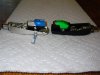
So my conclusion was, that I at least put the LP Gear SE needle from that unbalanced AT95 cartridge on my org./first bought AT95 cartridge, to compare the 95SE needle with the original AT95E needle:
And you could say that there is indeed a notable difference. The finer SE needle definately picks up a little bit more details and especially more of the high tones of course.. (but also a bit the common "spoken S-disortion" of the vinyl playback can be heard now here and there -in some rare cases, but that does not disturb me-, here the org. AT95E needle forgives more of course..). But the org. needle that comes with the AT95E is very good either, first I thought, it might even deliver a very little bit more dynamic or sounds more musical than the SE, but now after the SE needle has been played a bit more and got better, I think it is quite equal regarding this points to the org. needle, so because it delivers more frequencies (high tones) and puts out some other finer details, because of its higher sensitivity just here and there compared to the org. needle, I'll leave that SE needle put on my working AT95 cartridge (until I may get a HE -hyper elliptical- to try out one day

).
I rather track both of this AT95 needles at a minimum of 2g, up to 2,4g. I found out that 2g and more delivers at least more 'inner' depth/detail than 1,8g in my set, but 2,4g sometimes can be a bit 'too much' in some very few passages as well (it seemed like, when I compared my recordings of 2g and 2,4g playback, but just almost unrecognizeable
, generally 2,4g was still 'better'). So somewhere between 2g and 2,4g seems to be my preferred tracking force at the moment.
Just some general things about me, wrote it as an addidion:
I'm new on collecting vinyls and new on turntables in general, but you can trust me that I'm a very conscious person (trying to adjust things as perfect as it -under my given/owned equipment- could be..), I recorded / encoded and compared MP3s and stuff all the way through my life, so I'm adopted to hear specific differences quite well. Also I cleaned all my Vinyls with the Knosti, not using the (agressive and so in my eyes useless) alcohol antistat-mixture it comes with, instead I used L' art du Son or just simple detergent by the öko-mark 'frosch'
, I pre-cleaned every Vinyl in distilled water, to get rid of the lose garbage on the vinlys at a first step -before putting them into the Knosti for the main / the groove cleaning-, I achived good results with this method (no crackles to hear on the vinlys anymore).
My turntable is a Technics SL-D3, which I first cleaned up completely and put some oil on the middle axis stright after I got it and before I used it and it works great.
I also have a Grundig Prisma XL (is the same as Dual 450/455), but that one has no pitch regulator, just the two holes/screws on the bottom of the motor to adjust it to the the right rpm via a strobo.. and belive me it's a pain to do that :thumbsdn: (just because you can't see and feel the screws while turning them, also both potis are connected to one another, so when you got one rpm (33, for e.g.) right you screw it up again by just adjusting the other poti standing for the other rpm (45).
Can't really understand why such quite good turntables as the Dual 455 and all those weren't equipped with a simple pitch regulator :sigh:, now when you use those, the rpm will never be exactly correct. It could also be a good turntable, but with wrong rpm -even if it's just slightly wrong- it is pretty useless.. unfortunately, because you want your LPs played at the 100% correct speed of course. -But that all is of course a whole other story you can 'discuss'.