• The move to the new server is done. There are some software and database maintenance updates in process. This has us passing the hat around to help out. We appreciate any donations. Seriously, even a dollar helps. The payment page may be found here - https://www.audiokarma.org/support.html

A Zenith 7D30 (7D31 family) Console Tube Amp Troubleshooting Thread...

Brianbo

New Member
Hello everyone,

First let me say that I am very new to audio and tube based electronics. With that said, I recently recapped my first tube amp and preamp in a 59 Zenith SFD220. I also replaced every resistor as there were many pretty far out of spec. This is the "weird" Zenith, as I have come to learn - with the extended stereo control pot. The output transformers are tied together in a way that, in my understanding, does not result in a functional balance control (even though the preamp has one) and other general weird-ness that comes with early stereo implementation. While I can replace components like caps and resistors based on the schematic and existing components I am removing, the fundamental understanding of this circuitry is a bit over my head.

After doing the repair work, the unit powers on and plays audio through the tape inputs, but in my testing I have discovered an issue with the fidelity of the unit. One channel is just... subpar to my ears. I am not really sure how else to describe it. It has weak highs and mids - just not a full bodied sound. I have uploaded a video to YouTube where I play both channels through the same reference speaker (the companion speaker) to show what I am talking about. It might not be the clearest example, but I think through a decent speaker (like a laptop), you can hear the differences between the two channels. I have a switch that I'm using to alternate between the two channels on the amp approximately every 10 seconds. I've added a caption that switches every 10 seconds to help visualize this. The caption and switch don't line up perfectly, but I think its good enough to get the idea - and ideally, you can hear the difference. I should also add that this video was recorded with the balance control centered and the extended stereo pot in the "standard stereo" region of the controls interface. Also I have swapped the tubes channel to channel and not had the "good" channel move with them.


Part of my confusion, is that with the way the output transformers are wired, maybe this is an intention of the design? Perhaps Zenith was going for different sounds on each channel, that when played through the main cabinet (gets one channel) and the companion speaker (gets the other channel) together, produce a full bodied stereo mix? As I said before, I don't understand the schematic (https://drive.google.com/file/d/1U7AmVkRBPBeVmjmBgTd-rzSOOuc2ymgN/view?usp=sharing) well enough to do anything but blindly speculate.

I am unsure of what steps to go through next in order to troubleshoot. I have read a few good threads here about modifying this particular amp for discrete channel stereo operation with both the original output transformers and replacement ones, but none have really gone into much detail about how I can go about doing so WHILE keeping the pre-amp and presence control (which has connections in both the preamp and output transformers) in place. I want to keep this as a functioning stereo console unit, making this important to me. The extended stereo control is not of any use to me, however, and would much prefer that this console operated like a conventional stereo with two discrete channels. It is unclear, however, if the fidelity issue I have is even related to this weird OT arrangement that I would be asking for guidance in modifying. I am hoping some of you can shine some light on that.

If you have any other ideas, experiences, input, or suggestions I would greatly appreciate hearing them. This full restoration has been a year long on and off project for me, and I would really like to finally put this unit into service, but the extended stereo control, balance control, and linked OTs are very confusing to me, and they have made the actual intentions of this design unclear and difficult to troubleshoot. I'm hoping there is someone out there who has a better grasp on them that can help. Thank you for your help, and thanks for taking the time to read!
 
Register to hide this ad
Your thread title lists a "Zenith ZD31" my guess is the amp you're referring to is a 7D31?

The schematic in the link you provided is for the 7D30 not sure what the differences are if any.

You might want to provide pictures of the amp and the work you did to it so folks can get a better idea of what's going on as the vid link doesn't show the amps
 
if you're running it in the original config, there isn't any need to change anything about it, beyond the usual bad parts

sounds like something is out of phase. Does messing with the stereo dimension control change that? Looking at the schematic this is sort of a weird amp. The presence control seems to be a variable feedback thing but because of how its wired I think it would inject some out of phase signal to "widen" the stereo sound by cancelling the stuff that is common to both. If anything around that circuit were funky it might do this. I'd probably ohm out the control and the resistors attached to it to verify they aren't bad or just grossly off value. Sounds like one channel is working normally and the other has the vocals being cancelled.
 
Your thread title lists a "Zenith ZD31" my guess is the amp you're referring to is a 7D31?

The schematic in the link you provided is for the 7D30 not sure what the differences are if any.

You might want to provide pictures of the amp and the work you did to it so folks can get a better idea of what's going on as the vid link doesn't show the amps

Good point about the Amp Model. As far as I encountered when comparing the components on the amp, it is indeed the 7D30, not a 7D31 as you have correctly pointed out. When I was researching the output transformer configuration on this forum with keywords, all the threads I personally found were referencing the 7D31. When I made this post, I wasn't looking back at my schematic to cross reference my model number, I was just excited that there were people posting about the linked OTs that I found so unique and strange. It looks like the 7D31 has one OT that has a 3rd secondary winding, compared to the 2 that each of my OTs has. The title having a Z instead of a 7 is just me typing the wrong thing after making the post way too late at night lol. I wish I could edit the title, but it doesn't seem possible. Also, as a sidenote - the schematics/model number was pulled based on an assumption, IMO a good assumption, but an assumption nonetheless. The model isn't printed anywhere on the back of or inside the main unit. I got SFD220 as the model number because the companion speaker says its "for use with SFD220 and SFD280 models". When I looked up the SFD280, it was listed as a 12 tube model and the SFD220 was a 9 tube model. My unit has 9. I will look through my pictures and try to find images of the work done in the amp and pre-amp. I have the chassis bolted back into the unit for testing, so when I remove it again I can definitely take more pictures then as well.
 
if you're running it in the original config, there isn't any need to change anything about it, beyond the usual bad parts

sounds like something is out of phase. Does messing with the stereo dimension control change that? Looking at the schematic this is sort of a weird amp. The presence control seems to be a variable feedback thing but because of how its wired I think it would inject some out of phase signal to "widen" the stereo sound by cancelling the stuff that is common to both. If anything around that circuit were funky it might do this. I'd probably ohm out the control and the resistors attached to it to verify they aren't bad or just grossly off value. Sounds like one channel is working normally and the other has the vocals being cancelled.

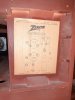
Good note, and a much better description of the sound coming out of that channel. I just uploaded some documentation I found that (I think) describes this extended stereo control. You are indeed correct about it injecting out of phase information. I guess part of the intention behind my original mess of questions was to figure out, without being able to ask the original engineers, if what I am hearing is part of that design. It doesn't seem like it, but I also saw a thread in another forum with someone describing the tied together OTs as resulting in one channel having most of the bass, and one channel having most of the trebles (https://www.diyaudio.com/community/threads/zenith-console-amplifier-a-stereo-mono-amplifier.269757/) which is what my unit sounds like. The channel that sounds like it has thin treble, is a lot more bassy to my ear. I just don't have enough of a fundamental understanding to say whether or not this behavior is accurate, and what specifically about the circuitry would cause it. When I set the stereo control al the way down to mono, the "issue" I'm experiencing is much less pronounced, but I can still hear a difference in the two channels if I listen closely with one being SLIGHTLY more bassy and the other more trebly to my ears, but it is very close. And in extended stereo, naturally, they both sound like total crap individually, being that you're listening to a mess of in and out of phase channel information - I have to admit I do not understand why anyone would want this compared to normal discrete L and R stereo channels. That's mainly why I asked about modification - I don't know enough to narrow down the problem I have with this unit to the extended stereo design, but I do know that it serves no practical purpose to me at the very least.

59 zenith 1(2).jpg

59 zenith 2(2).jpg

59 zenith 3.jpg
 
I can't quite get my head wrapped around all that right now but what are you using for a source? I'm not sure if this one does it, but some of these bonkers early stereo rigs required a phono cartridge that was out of phase to work right. If you feed in a "normal" stereo signal to the phono inputs it will act really strange as a result.
 
.. it is indeed the 7D30...I wish I could edit the title, but it doesn't seem possible.

Hit the "Report" link in (lower left hand corner) of your post and ask one of the Moderators to edit it for you, which they will.

.. it is indeed the 7D30, When I looked up the SFD280, it was listed as a 12 tube model and the SFD220 was a 9 tube model. My unit has 9.

If it were me going forward just refer to the amp (7D30) itself, adding the console model number and referring to it a 12 or 9 tube model can be confusing for folks who come along.

Fwiw you have one of AK's finest chiming in already so he should be able to help you out as you go along. Here's hoping you can get this sorted out
 
I can't quite get my head wrapped around all that right now but what are you using for a source? I'm not sure if this one does it, but some of these bonkers early stereo rigs required a phono cartridge that was out of phase to work right. If you feed in a "normal" stereo signal to the phono inputs it will act really strange as a result.

I am using a phone with a headphone jack (the most uncommon piece of hardware in this whole thread) playing through a 3.5mm stereo male to dual RCA males that are plugged into the tape inputs. While I haven't pulled the preamp again to double check this is the case, the schematic says the tape inputs go into the circuit exactly like the phono input channels do, with the one difference being that the tape inputs have .00068 mf caps right after the input, while the phono inputs do not. Not sure what the function of these caps would be. The two sources are switched by a control on the unit. So if there is something funky with the cartridge this was designed around, I'd assume that also applies to the tape inputs. Hmmm.
 
Hit the "Report" link in (lower left hand corner) of your post and ask one of the Moderators to edit it for you, which they will.


If it were me going forward just refer to the amp (7D30) itself, adding the console model number and referring to it a 12 or 9 tube model can be confusing for folks who come along.

Fwiw you have one of AK's finest chiming in already so he should be able to help you out as you go along. Here's hoping you can get this sorted out

Thanks! I submitted a report to change it. And I probably will do that, thanks for the feedback. Although a big part of my reason for making a new thread was that I'm trying to troubleshoot the preamp/amp combo as it exists in the console, while the other threads I found were troubleshooting the amp for standalone use. But I didn't want to just put the console model (SFD220) in the title, because it's not recognizable to someone who has worked on the standalone amp (7D30/7D31 or similar) - and someone who has worked on the standalone amp will probably have some insight on the extended stereo control and tied together OTs that they had to bypass in order to modify the amp for standalone use. So I'm trying to grab people's attention who recognize the standalone amp model so they can help me troubleshoot the whole unit LOL.
 
I am using a phone with a headphone jack (the most uncommon piece of hardware in this whole thread) playing through a 3.5mm stereo male to dual RCA males that are plugged into the tape inputs. While I haven't pulled the preamp again to double check this is the case, the schematic says the tape inputs go into the circuit exactly like the phono input channels do, with the one difference being that the tape inputs have .00068 mf caps right after the input, while the phono inputs do not. Not sure what the function of these caps would be. The two sources are switched by a control on the unit. So if there is something funky with the cartridge this was designed around, I'd assume that also applies to the tape inputs. Hmmm.

ok, tape inputs should be fine to connect to a "normal" source. Only ever heard of goofy out of phase phono cartridges, usually specific to RCA. Phono cart probably also not an out of phase thing if you have the option of other inputs.

caps are probably DC blocking caps just to make sure the tape doesn't have any DC leakage which will upset the bias on the tubes it feeds in to.

anyway, still think I'd be having a poke around at the stuff in the presence circuit just to see if anything is fishy there. Might also be worth checking R9. I think thats where it starts to generate the L-R signal, and high value carbon resistors are somewhat bad about going completely open. making sure R13 and R24 are reasonably on value wouldn't hurt either.
 
ok, tape inputs should be fine to connect to a "normal" source. Only ever heard of goofy out of phase phono cartridges, usually specific to RCA. Phono cart probably also not an out of phase thing if you have the option of other inputs.

caps are probably DC blocking caps just to make sure the tape doesn't have any DC leakage which will upset the bias on the tubes it feeds in to.

anyway, still think I'd be having a poke around at the stuff in the presence circuit just to see if anything is fishy there. Might also be worth checking R9. I think thats where it starts to generate the L-R signal, and high value carbon resistors are somewhat bad about going completely open. making sure R13 and R24 are reasonably on value wouldn't hurt either.

Good info, thank you! I am going to pull the pre-amp and check the presence circuit to the best of my abilities. Although I did already replace every carbon resistor in the unit because there were quite a few off value. Was quite a bit of work so you can imagine a little disappointing when it didn't fix it haha. I only left a couple of ceramic resistors in the amp alone, everything in the pre-amp was replaced and checked for spec before being put in circuit.
 
Good info, thank you! I am going to pull the pre-amp and check the presence circuit to the best of my abilities. Although I did already replace every carbon resistor in the unit because there were quite a few off value. Was quite a bit of work so you can imagine a little disappointing when it didn't fix it haha. I only left a couple of ceramic resistors in the amp alone, everything in the pre-amp was replaced and checked for spec before being put in circuit.

So immediately one thing I noticed is that the 10k presence pots (stacked) read different. One is 9.18K and the other is 7.56K when maxed out. Is this enough of a spread to matter significantly?
 
So immediately one thing I noticed is that the 10k presence pots (stacked) read different. One is 9.18K and the other is 7.56K when maxed out. Is this enough of a spread to matter significantly?

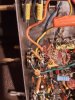
More developments, WOW this is weird. Something very strange is going on with the balance control wiring. The pots are reversed to each other (probably a better word for this) because they are a balance control after all. The yellow cloth covered wire crossing the two opposite terminals is bridging the ground connection to those sides of the pots as the schematic shows. However, there is a JF680 cap going between the two balance control pots (one leg connected to the ground on one pot, and the other leg connected to the non-ground on the other pot) that is not listed anywhere in the schematic, unless I am missing something. In fact, trying to trace the circuitry all around the balance control in the unit itself is showing a very different circuit than what is listed in the schematic. Similar components, but just a different circuit. One of the legs of the R9 is wired directly to a pot leg (missing a cap listed in the schematic), the other leg of R9 goes through a disc cap (not on the schematic), then a 12K resistor (not 15K as listed in the schematic), before finally landing on pin 6 of the V1 tube. So perhaps I have the wrong schematic here.... I don't really understand how though, as there is faded printing on the chassis that seems to say 2D30, and the back of the main cabinet lists 2D30 as the chassis number for the preamp, which is what my schematic also lists. So maybe my chassis is just butchered? But the components and solder joints sure do look original to me, so perhaps factory errors? But so many compounding seems very unlikely. Not sure what to think.

Another note - I have 5 or so of these dark brown zenith disc caps with various different colored writing on them. In my research for this project tonight, I've come across a couple of threads on other forums saying they are notoriously unreliable/problematic and should be replaced. Is this also the experience of those here?

20230601_002840.jpg

20230601_020942.jpg

20230601_025618.jpg
 
Last edited:
the balance control being wired like that is typical. Its probably a log / antilog pot so they work in opposite directions. I really have no idea what they're on about calling it an "automatic balance control", it looks like just a common type so far as I can see.

The slight variations from the schematic may be a running production change, possibly your unit is later than the schematic or vise-versa. It happens. Normally I go with whatever is in the unit if it appears to be original since it probably worked correctly with those parts when new.

not sure if the presence pots being different in value would cause any particular issue or not. Might make "normal" a bit off-center but that should be about it. I wouldn't expect it to not work right at all. Mostly I was thinking if one pot was open end to end or end to wiper it might explain this.
 
I have said this a few years back but I think this might also be one of those Zenith's in which the balance and volume control in one unit is actually just two separate right and left volume controls.

If I could see a pic, I could confirm how yours is configured.

I have a Zenith console amp with separate tuner/preamp which has the bass and treble controls as two stacked pots for each channel while the volume and balance controls are only two stacked pots in which you would think should be three, one for the balance and two for the volume. The vron panel has an inner and outer control which is labeled "Volume" and "Balance".

This labeling would normally lead you to believe that the inner knob is volume and the outer knob is balance but if you turn both separately, you get separate left and right volume control.

I think their engineers probably thought that this design makes both the volume control but adjusting them individually would give you a type of balance controls.

After all, some old stereo suitcase record players did not have a balance control but rather two separate left and right volume controls.

I think a Zenith user manual might explain how their labeled balance & volume controls work but I have not been able to find one to document it.

I actually have a single ended amp which is designed this way along with the above mentioned stereo console with the same control configuration.

I studied the above schematic but just can't seem to wrap my head around Zenith's take on this design.
 
Last edited:
based on the schematic it seems like the balance and loudness (doesn't have a volume, but does the same thing) control are different and in different places in the circuit. Balance at the very front end, loudness between the preamp and power amp.

I know the sort of split volume control you're talking about, those are different and (IMO) extremely annoying. I don't care for split volume controls though.
 
the balance control being wired like that is typical. Its probably a log / antilog pot so they work in opposite directions. I really have no idea what they're on about calling it an "automatic balance control", it looks like just a common type so far as I can see.

The slight variations from the schematic may be a running production change, possibly your unit is later than the schematic or vise-versa. It happens. Normally I go with whatever is in the unit if it appears to be original since it probably worked correctly with those parts when new.

not sure if the presence pots being different in value would cause any particular issue or not. Might make "normal" a bit off-center but that should be about it. I wouldn't expect it to not work right at all. Mostly I was thinking if one pot was open end to end or end to wiper it might explain this.

Log/antilog is the word I was looking for I think, thank you! I replaced component by component by pulling them out and soldering in the new one piece by piece. I double checked at the time and tested each as it was coming out/going in, so I don't think I made a mistake. Of course with the schematic being different, I don't think I can really confirm now that there were no mistakes.

Do you have any insight on why the signal coming off the one balance pot (green wire going to the tube) would be tied to the balance pot(s) ground side with that little disc cap? My balance control has always behaved very strangely. I could never isolate one side from the other, there was a lot of signal bleeding through from either channel and setting to to extreme min or max made the unit sound very bad. Balanced to one side max has almost all bass, and balanced to the other side max has almost all treble. I don't think it works like a regular balance control at all, which makes me wonder what the intended function even is.

Edit: Perhaps the balance control is behaving normally and I just can't tell because of the way the output transformers are tied together making the info from either channel bleed over to the other?
 
Last edited:
Back
Top Bottom