• The move to the new server is done. There are some software and database maintenance updates in process. This has us passing the hat around to help out. We appreciate any donations. Seriously, even a dollar helps. The payment page may be found here - https://www.audiokarma.org/support.html

ACI Titan II sub problem

ronrico

Well-Known Member
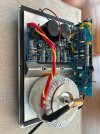
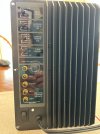
I recently picked up a pair of ACI (Acoustic Concepts) Saffire 3 speakers with a Titan II subwoofer. Unfortunately the amp for the sub is not functioning. All I get is a loud buzz. One of the filter caps has a bit of a bulge at the top and I think that this may be part of the problem. Has anyone had any experience with this sub?
 
Register to hide this ad
Repairing a plate amp has a low success rate.

Take the opening measurements and shop for a new one.

Cheaper than having a tech fix the old one. Plus you get a fresh new design...
 
Last edited:
Buck, I'm curious as to why the success rate for repair so low. It appears to be of a higher quality then the other plate amps that I have seen, toroidal trans, Alps pots, Nichicon caps. The amp was made by Triad, model 11.0 if that means anything.
 
Excessive complexity, Planned limited lifetime.

Powered speakers are the same deal, Low cost SMD components, Cheap drivers, Planned short lifetime.

I'd rather have a fresh design and build.
 
Last edited:
No, As far as I know Audio Concepts has been out of business for a long time.

And I've never even heard of Triad except in Jackie Chan movies.

Too bad I liked their construction and design, They are from Wisconsin just a little west from me.
 
Audio Concepts appears to have bought the plate amps from Triad, who are well regarded from what I can tell. They make speakers and stand alone rack amps also. I have filled the opening in the speaker cabinet where the amp was located and what ever amp I use will be remotely placed.
 
I’ve owned the passive ACI subs and they are quite nice. Not much money lost by trying to fix the plate amp, just your time and maybe a little of your mental health. Caps are a big failure item. Vibration is a killer, too. Micro cracks in the PWB, transistor cases cracked at the lead frames, that kind of thing. Devilishly hard to find.

The recommendation to find a suitable new replacement is a good one. Many people also buy an external amp.
 
Buck, I'm curious as to why the success rate for repair so low. It appears to be of a higher quality then the other plate amps that I have seen, toroidal trans, Alps pots, Nichicon caps. The amp was made by Triad, model 11.0 if that means anything.
Can't speak to these specifically, but a lot of gear has three criteria against it:

Undocumented

Offshore

Junk
 
Audio Concepts appears to have bought the plate amps from Triad, who are well regarded from what I can tell. They make speakers and stand alone rack amps also. I have filled the opening in the speaker cabinet where the amp was located and what ever amp I use will be remotely placed.
If you've got it out why not replace that cap, and test it again, if that fixes it the best thing would be
to do a full recap. You say that it is a good quality amp which is refreshing given how so many
plate amps are really cheap.
 
I will replace a bunch of small caps in critical circuits but if that doesn't fix it...

Another brick in the wall.

Every tech service center has a stack of Denon receivers at least 5 feet tall.

I had two stacks. Used to piss techs off by saying it's probably just a bad capacitor...

Because inside every full featured AV receiver there is at Least 60 very small 20 cent capacitors or More!

Had several customers who replaced every one... Still did not fix it!

Modern electronics is simply too complex for normal trouble shooting.

"Shotgun and Pray"...
 
As requested.....
I'd probably try to fix it, but I have gear to test stuff so I wouldn't be paying someone else to do it.

Far as that cap, maybe, but sometimes the appearance of the bulge can be just the plastic disc is bowing, not the actual aluminum top of the cap underneath. You can try pressing it firmly to see if you can tell which it is, if you have not already.
 
No experience but the bulging cap almost certainly points to a problem and that one should be replaced at the very least.

Do you have access to schematics? I've just bumped up against that problem..no schematics. I have a B.I.C. F12 and the amp recently died although mine blows the input fuse right away.
 
Yikes look how overly complicated it is. None of these circuits make it sound better. "Explicative"...

Common great sounding 100 watt amplifier driver board from 1970... Same goes for all electronics.

iu


It's probably a bad yellow or maroon capacitor... I count 54 visible yellow capacitors.

1434077-2539196d-boulder-power-amplifier-model-500.jpg
 
Last edited:
First, I'd like to thank those who have responded. I may wind up trying to fix this myself if I can't find someone to come to my rescue. The reality is that electronics repair is not my skill set, but attempt a repair or just junk it, I'd try repair.
To answer questions, I've found, on another site, someone with the same SW with a slightly older version of the same amp. He posted the schematics. The bulge on the top of the one cap is the aluminum can not the plastic.
The I'm no expert, but the amp appears to be well laid out of better build quality than most that I have seen. This makes me want to get it repaired.
 
I have found that a lot of times when a switching power supply won't start (or tries, and you hear tic . . . tic . . . tic . . . ) that that *IS* frequently cap related. Blowing fuses usually means dead semiconductors and carnage . . . . caps are cheap, and you can't make it any more dead, so might be worth a try . . .
I guess I spent a bunch of my career doing abnormal troubleshooting.
 
Back
Top Bottom