David_NC
Super Member
I've posted previously about converting my M12's to be bi-ampable. It seems that this is one of the few larger ADS towers that didn't have that option from the factory. My motivation for doing this is to be able to use a Dynaco ST-70 for the mids and highs and a 200 WPC Parasound SS amp for the woofers. These speakers like lots of power, and while the Dynaco sounds great, it's limited in ultimate loudness and dynamics.
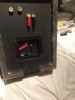
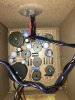
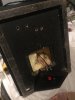
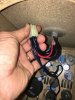
I considered using a DPDT switch to switch the dual woofers between the soon to be installed second inputs like ADS did from the factory, but this would be more involved due to having to mount a plate for. the switch (the speakers panels are 3/4" MDF - not good for mounting a toggle switch. I ended up adding two new sets of banana jacks. One comes from the crossover, and the other is connected directly to the woofers. For normal operation, jumpers are installed in the new jacks. The other issue is that the inputs are on the bottom of this model, and my jacks would not be recessed like the normal ones, so I needed low-profile jacks as well as right-angle plugs. The process was straightforward, once I got inside the speakers and figured out a game plan. There are the various stages and the final product:
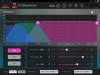
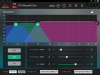
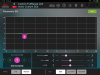
I'd completely bypassed the chokes on the crossover, so I'd need an electronic crossover of some sort. I also use a subwoofer, so it'd have to be a 3-way model. I have a 2-way analog dbx unit that I've been using for this setup for the subwoofer, so I looked for a 3-way unit. I settled on a dbx DriveRack PA2. This is way more than crossover - parametric equalizer, graphic equalizer, 3-way crossover, subharmonic synthesizer, channel delays, auto eq with a microphone (similar to Audyssey), and some others I'm not recalling. This model has an Ethernet port, so it can be controlled via PC / Mac, phone, or tablet. The iPad app is really easy to use, and it's way cool to be able to configure and adjust this from the listening position vs kneeling in front of the unit. It allows for infinite adjustment of low and high pass points for the low, mid, and hi output pairs, about 8 combinations of crossover types and slopes, and output gain. I used the parametric eq to help tame an annoying 'bump' due to speaker placement and room layout.

I'd call this project a success! The highs and mods sound even better. The ST-70 really is a good sounding amp, but it really shines when not having to power the bass for the M12's four woofers. It does well with bass, but a relatively high powered solid state amp really does this job better, in my opinion. The whose thing just sounds more dynamic and has greater clarity (likely due to the ST-70 not having to power everything). The Parasound HCA-1000A is a nice sounding amp and easily powers the 4 ohm loads of the woofers. I was concerned that the DriveRack would have some negative affects, but it doesn't seem to, in this setup. The old dbx 223XL seems to mask the music a bit, unlike the new one. I'm listening to familiar tracks and hearing things I recognize and some new ones - something I always look for in an upgrade. One nice thing is that I'm using my preamp's remote trigger to control power to the two amps, which is far more convenient than having to crawl down, reach around, and flip the switch on the Dynaco.
Some general observations - mixing tube and solid state amps in a bi-amp setup can really improve a system's sound, especially with inefficient speakers. It also allows one to use existing or affordable lower powered tube amps in a situation where it might not be powerful enough on its own. Electronic crossovers can really be pretty amazing. They can also be really flexible, in terms of adjustments. I don't think one can appreciate how great it is having an app on a tablet to configure and tweak all these settings; it's so intuitive that I was able to do it rather quickly without any instructions.
I'm sure that some systems are so revealing that they'd be negatively affected by an electronic crossover with DSP, but mine is not one of those. Still, I notice no increased noise from any drivers from all this. I'm honestly surprised that I'm not picking up any hum at all - these amps, crossover, and cables are mixed with an AVR, server, HTPC, UPS, Ethernet switch and access point, and Ethernet, HDMI, and power cables in a less than ideal location. It'll be fun to see how well I have the levels and crossover points set when the RTA mic arrives and I use the analyze function.
I considered using a DPDT switch to switch the dual woofers between the soon to be installed second inputs like ADS did from the factory, but this would be more involved due to having to mount a plate for. the switch (the speakers panels are 3/4" MDF - not good for mounting a toggle switch. I ended up adding two new sets of banana jacks. One comes from the crossover, and the other is connected directly to the woofers. For normal operation, jumpers are installed in the new jacks. The other issue is that the inputs are on the bottom of this model, and my jacks would not be recessed like the normal ones, so I needed low-profile jacks as well as right-angle plugs. The process was straightforward, once I got inside the speakers and figured out a game plan. There are the various stages and the final product:
I'd completely bypassed the chokes on the crossover, so I'd need an electronic crossover of some sort. I also use a subwoofer, so it'd have to be a 3-way model. I have a 2-way analog dbx unit that I've been using for this setup for the subwoofer, so I looked for a 3-way unit. I settled on a dbx DriveRack PA2. This is way more than crossover - parametric equalizer, graphic equalizer, 3-way crossover, subharmonic synthesizer, channel delays, auto eq with a microphone (similar to Audyssey), and some others I'm not recalling. This model has an Ethernet port, so it can be controlled via PC / Mac, phone, or tablet. The iPad app is really easy to use, and it's way cool to be able to configure and adjust this from the listening position vs kneeling in front of the unit. It allows for infinite adjustment of low and high pass points for the low, mid, and hi output pairs, about 8 combinations of crossover types and slopes, and output gain. I used the parametric eq to help tame an annoying 'bump' due to speaker placement and room layout.
I'd call this project a success! The highs and mods sound even better. The ST-70 really is a good sounding amp, but it really shines when not having to power the bass for the M12's four woofers. It does well with bass, but a relatively high powered solid state amp really does this job better, in my opinion. The whose thing just sounds more dynamic and has greater clarity (likely due to the ST-70 not having to power everything). The Parasound HCA-1000A is a nice sounding amp and easily powers the 4 ohm loads of the woofers. I was concerned that the DriveRack would have some negative affects, but it doesn't seem to, in this setup. The old dbx 223XL seems to mask the music a bit, unlike the new one. I'm listening to familiar tracks and hearing things I recognize and some new ones - something I always look for in an upgrade. One nice thing is that I'm using my preamp's remote trigger to control power to the two amps, which is far more convenient than having to crawl down, reach around, and flip the switch on the Dynaco.
Some general observations - mixing tube and solid state amps in a bi-amp setup can really improve a system's sound, especially with inefficient speakers. It also allows one to use existing or affordable lower powered tube amps in a situation where it might not be powerful enough on its own. Electronic crossovers can really be pretty amazing. They can also be really flexible, in terms of adjustments. I don't think one can appreciate how great it is having an app on a tablet to configure and tweak all these settings; it's so intuitive that I was able to do it rather quickly without any instructions.
I'm sure that some systems are so revealing that they'd be negatively affected by an electronic crossover with DSP, but mine is not one of those. Still, I notice no increased noise from any drivers from all this. I'm honestly surprised that I'm not picking up any hum at all - these amps, crossover, and cables are mixed with an AVR, server, HTPC, UPS, Ethernet switch and access point, and Ethernet, HDMI, and power cables in a less than ideal location. It'll be fun to see how well I have the levels and crossover points set when the RTA mic arrives and I use the analyze function.