• Please note that Audiokarma will be offline briefly for updates early on Monday morning, September 28th.

Advice needed: EPI 100 restoration gone sideways

Maybe, but what I'm seeing be advised is exactly so. Guess work. Just stuff full of fiberglass and call it good so it is not exactly, exactly so. There appears to be more to it than that. You can very well now have a speaker in a box that is too little for its intended purpose for all intent and purposes. It is one thing to show the backup to the theory and quite another to use it properly in practice. But like I mentioned above it looks daunting but I will study so as to avoid the contempt prior to investigation bug-a-boo. This is just my common sense going, huh? I just have a problem when a practice becomes part of the company language like what I'm seeing here with Pete and Repeat. Looks like one person truly understands the theory and has the backup for it. Not exactly hundreds of scientists so be careful what you are agreeing with or least be educational about it. There is no crying in audio when somebody disagrees with something. We all know that. :)
 
Okay, perhaps designed is not the correct term but according to company literature, the optimal performance is achieved by placing against two surfaces.

From EPI owners manual. https://www.hifiengine.com/manual_library/epi/100.shtml
View attachment 1186219

From the EPI Brown Booklet. http://www.humanspeakers.com/e/epi100.htm
View attachment 1186220

Manufacturer literature is one thing what they told a testing lab is another.

Epicure felt that the best approach would be to design the speaker to be as flat as possible, and then depend on amplifier tone controls to modify the system response.

Although Epicure claims a flat response to 18,000 Hz and supplies individual machine-run curves with each speaker to demonstrate this, they recommend placing the speakers facing each other, angled 90 degrees away from the listening area. This is quite consistent with our findings, since the high-frequency balance at a conventional listening position is just about right when they are so installed, and the encouragement of reflected sound from the walls imparts a pleasing sense of spaciousness. With the speakers facing the listener they are noticeable bright at the extreme high end. This was clearly audible in direct comparison with other speakers we have tested that had a wide, flat frequency response.


http://www.loudspeakerrepairservice.com/epi 100.html

What they are trying to achieve here is a two way box with the sound of a single full range speaker. I'm going to go out on a limb and say that Huw has tried to fix the tone control and orientation of the boxes problem with a gnarly midbass and midrange response in the form of a tweeter along with a long throw woofer and still stay within the listening experience as described above.
 
Last edited:
That LRS link I have posted on another thread states we should place these boxes facing each other and use the tone controls.
Well I understand the tone control use but the placing them facing each other, nope. I don't think we have enough info to say those guys are nuts without having the manual to see what they read to want to say that.
 
This thread seems to have gone off the deep end. Nothing from EPI says to place the speakers facing each other. As for the May 1970 Stereo review article, it is full of inaccurate statements and I give it little creedance. For example, they say "an 18-dB-per-octave slope is achieved by a single capacitor and the inherent responses of the woofer and the 1-inch dome tweeter." The single cap forms a first order filter with a 6 dB per octave slope. As for the article's statement that Epicure "recommend placing the speakers facing each other, angled 90 degrees away from the listening area," I would like to see some proof backing up that statement. Maybe that article is the 1970 version of today's fake news.
 
Well, the article is from that period and that is Huw's website. I see no reason for him to put that out there if he thought it was wrong. For example, they were providing response curves for every loudspeaker at that time. I've been measuring the Model 81 and what I'm getting with the loudspeakers facing the listener is what the article describe they are getting with the EPI boxes facing each other. Also, the article from H&H Labs is stating the specs and placement are from EPI.
 
Last edited:
The combination of the natural roll off of the drivers and the cap might very well give something like an 18 dB roll off. Which would help explain why these speakers seem to appeal so widely.
I remember reading a friend's manual when he bought a pair of EPIs in 1974 or 75, and I don't remember anything about using them facing each other, which is not surprising, since it's stupid (if I may speak bluntly). What I do remember is being surprised that EPI suggested breaking in the foam surrounds by playing them loud for a day or so. I suspect that what has happened is that the advice to make this racket tolerable by facing the speakers into each other and wiring one driver out of phase has been misinterpreted as advice for actual use. It is not. At all. Next they'll be saying that EPI recommends having the speakers out of phase...
 
The combination of the natural roll off of the drivers and the cap might very well give something like an 18 dB roll off. Which would help explain why these speakers seem to appeal so widely.

I wish I had the test equipment to test the drivers properly. I've never seen any frequency graphs of the individual EPI drivers.

I have an Epicure 20+ spread out at home rebuilding it. I believe the woofer and tweeter are matched to complement each other. I also believe that the cap acts as a high-pass filter to prevent the tweeter from seeing the low frequencies. I don't think the cap provides a crossover point between the woofer and the tweeter because there is a 10 mfd cap isolating the tweeter, regardless of the speaker having a single tweeter (EPI M100) or a pair of tweeters in parallel (Epicure 20+). The tweeters are identical. With the same cap, tweeters in parallel raise the crossover point to double. Also, when I refoamed my EPI woofers, I used a 30 Hz tone, but, just for grins, I was able to play well over 3kHz with minimal dropoff.
 
I hate to think they were testing speakers in the lab without a break in period. If so, it makes the entire review null and void. Nevertheless, Mr. Hirsch was no stranger to criticize or be criticized. The fact that the review appears to positive for the EPI is a good sign. Also, notice this is an early review of the EPI 100 (1970). They eventually stopped providing printed curves for each box and made further improvements through the remainder of the production years. There is a copy of a 1983 review on eBay with a response curve. The only thing of value is the graph and it is visible enough on the pics.

https://www.stereophile.com/news/120803hirsch/index.html
 
Last edited:
This thread seems to have gone off the deep end.

This.

And not that the discussion ISN'T "interesting"... there are probably thousands of these 100s still out there, tens of thousands, if not more, were sold during the EPI heyday, MAYBE, JUST MAYBE, the sound isn't for everyone. :dunno:
But I LOVE, LOVE all seven sets of mine. :music:

They are not perfect, they are not everything, they are not THE best.

But what they ARE is great! They JAM, I can listen to ANY OF THEM FOR HOURS ON END, they fill the space with FANTASTIC sound, I often do FEEL the music and don't FEEL that I'm missing much.

I have lots of speakers, many do "rock" better though mostly I suspect this is what I've read online as a mild "hole" in the midrange frequencies. Also has ALOT to do with how a lot of rock was mixed while recorded, eh? That being said, unless I am ABing them against other "more revealing" speakers I don't necessarily hear or miss anything too specific.

This comment isn't directed to the OP at all but just comments that n general for future reference...

Fix em up, plug them in and play them, if the sound ain't for you, move them on, there are others out there that will surely enjoy them! :hug: :beerchug:
 
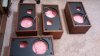
I got the gaskets cut out and put in place:

IMG_20180525_221442153.jpg

I tested all the woofers for correct polarity with a C cell and they all check out as being labeled correctly. Next step is to put the woofers and tweeters back into the cabinets. I carefully used my fingers to get behind the cones themselves and stretch the surrounds every so slightly to make them a little more compliant like try were before I put the protectant on them. Once they are all back together I am going to hook then back up and will report back.
 
Well, out seems to have worked! I definitely have bass now. Don't know how much I like the overall sound. With the Advent/3s' up on the shelves and the EPIs' on the floor I would say I like the bass of the EPI but the treble of the Advents. Will see how they sound up on the shelves when I have a chance.

I will say that I get the impression that the bass on the EPIs is probably not the same as it would be originally because of the woofers being the way they are now, but I would guess that it is close. I really can't say other than it is definitely an improvement. I have no reference to how EPIs are supposed to sound (to my ears) but the fiberglass made all the difference!
 
Last edited:
I wish I had the test equipment to test the drivers properly. I've never seen any frequency graphs of the individual EPI drivers.

I have an Epicure 20+ spread out at home rebuilding it. I believe the woofer and tweeter are matched to complement each other. I also believe that the cap acts as a high-pass filter to prevent the tweeter from seeing the low frequencies. I don't think the cap provides a crossover point between the woofer and the tweeter because there is a 10 mfd cap isolating the tweeter, regardless of the speaker having a single tweeter (EPI M100) or a pair of tweeters in parallel (Epicure 20+). The tweeters are identical. With the same cap, tweeters in parallel raise the crossover point to double. Also, when I refoamed my EPI woofers, I used a 30 Hz tone, but, just for grins, I was able to play well over 3kHz with minimal dropoff.

The cap is indeed the crossover. The system level response of the woofer and tweeter are
what's called in engineering the cascade (complex product) of the crossover transfer function
and the driver's acoustical transfer function.
You can compute the electrical response from here, enter 8 ohms 2KHZ crossover and 9.9uF will be the high pass value:
http://www.erseaudio.com/First-Order-2-Way

Marshall Leach wrote about this in the AES in 1980, good engineers knew this decades before
but Leach formalized the theory:
Loudspeaker Driver Phase Response: The Neglected Factor in Crossover Network Design
http://www.aes.org/e-lib/browse.cfm?elib=3978
Item 28 under Publications: https://leachlegacy.ece.gatech.edu/bio.html

That should have read Loudspeaker driver transfer function rather than just phase response.
 
Glad you got that polyfill out and proper fiberglass into the speakers to give them back their low tones. Now with some use they should be sounding good. The tweeter, you just have the one cap as a high pass filter. The general consensus is the tweeters do a fine job. Maybe you need to spend some time listening to see if you hear the benefits of the inverted dome tweeter vs. the Advent/3. But your opinion is all that matters.
 
The cap is indeed the crossover. The system level response of the woofer and tweeter are
what's called in engineering the cascade (complex product) of the crossover transfer function
and the driver's acoustical transfer function.
You can compute the electrical response from here, enter 8 ohms 2KHZ crossover and 9.9uF will be the high pass value:
http://www.erseaudio.com/First-Order-2-Way

Marshall Leach wrote about this in the AES in 1980, good engineers knew this decades before
but Leach formalized the theory:
Loudspeaker Driver Phase Response: The Neglected Factor in Crossover Network Design
http://www.aes.org/e-lib/browse.cfm?elib=3978
Item 28 under Publications: https://leachlegacy.ece.gatech.edu/bio.html

That should have read Loudspeaker driver transfer function rather than just phase response.

Thanks for the info. I have some reading ahead of me. :)
 
Maybe you need to spend some time listening to see if you hear the benefits of the inverted dome tweeter vs. the Advent/3. But your opinion is all that matters.

I like to think myself open minded when it comes to these sorts of things. I think there may be an issue with the tweeters. When I had all the speakers apart I checked all the tweeters using a signal generator set to 2khz with the volume/gain at max, which it's not a lot, but enough for checking drivers with. As I checked each tweeter I measured the sound pressure of each one. I noticed that one of them was "hotter" than they others, by about 6 or a DB. Now I know this was not a proper benchmark, but I was just trying to measure the output of the tweeters relative to reach other, to try to match them up into pairs. I remembered the "hot" tweeter and hooked up the pair of speakers that it was a part of and they sounded better to me. I am wondering if the other three tweeters are worn out and if that is the reason for the lackluster performance of the highs or if I just don't like the sound as much as the Advents?
 
Based on my experience with the much improved tweeters by Human there isn't much on the HF side by design.

Think of a three way loudspeaker with high sensitive midrange unchoked and the tweeter disconnected.
 
Last edited:
The general rule of thumb is to stuff CLOSED boxes with polyfil or fiberglass batting. Line the walls of ported cabinets with sound deadening material like No Rez or convoluted foam. And another's recommendation to check polarity is a good one. Both woofer and tweeter should be connected to positive polarity. Lastly, although I don't particularly subscribe as much significance to it as some others might, maybe 50 hours or so of break-in may help as well.
 
Thanks for the info. I have some reading ahead of me. :)

Sure, I probably should have also mentioned that any sealed back driver, including a tweeter
will have a 2nd order high pass frequency response with the corner at Fc. I've measured the
EPI tweeter to have about a 2KHz Fc so the total system response is 3rd order, 1st from the
cap, and 2nd from the acoustical transfer function.
 
Back
Top Bottom