• The move to the new server is done. There are some software and database maintenance updates in process. This has us passing the hat around to help out. We appreciate any donations. Seriously, even a dollar helps. The payment page may be found here - https://www.audiokarma.org/support.html

Advice on tuning for multiway

Sam Edwards

New Member
Hello,


I'm new to this forum, although have been reading a lot of posts on here, but now need to reach out for some specific help!


I have been designing a system that is quite large, and am right about at the stage to build test cabs to take measurements from to then fine tune before the actual build begins.


I have been doing as much homework as possible over the past couple of years, reading, researching, and recently plotting on WinISD.


But have some questions regarding tuning and cut offs of the bass cabs and how they should work together that I cant find the answer too, or rather get my head around!


The system will be a 4-way to be used as a pa at various small events and eventually finding a permanent home in a venue.


The drivers are as follows:


Woofer: JBL 2241G

Mid Bass: TAD 1601A

Mid High: Altec 299 mated to JBL 2360a Horn (I will also build and test multicell horn in future)

High: JBL 2405


These will be bi-amped with active crossover / DSP


The actual construction / carpentry design of the cabs is not an issue at all, but rather the physics of tuning and cut off etc.


Because I have taken T&S parameters from each driver using DATS V3, there are slight differences between the two JBLs and the two TADs. So I have plotted all 4 drivers in WinISD to get a good median design. The parameters also differ from the official JBL literature.


JBL 2241G:

My parameters:

Fs 44.18Hz & 40.51Hz

Vas 271L & 318L

Qts 0.48 & 0.44


Official:

Fs 35Hz

Vas 310L

Qts 0.40


TAD 1601a:

My parameters:

Fs 32.33Hz & 33.24Hz

Vas 394L & 388L

Qts 0.37 & 0.38


Official:

Fs 28Hz

Vas 307L

Qts 0.34


The differences between the respective drivers when plotted in WinISD with the same tuning and volume are minimal, so I am not too worried about that.

Below are some screen shots from WinISD for both the JBL (Yellow) and TAD (Blue).


Current enclosure plots are:

JBL 2241G - 300L / 38Hz

F3 around 39Hz


TAD - 150L / 35Hz

F3 around 48Hz


Transfer Function

1678453187074-png.1151926


Group Delay

1678453201947-png.1151927


Rear Port Velocity

1678453214347-png.1151928


I am not completely fixed with the volume or tuning, and I am sure these will change after some input from others. size of enclosures is not an issue either.


Obviously this does not take into account where the x-over points will be, and that is where I need some advice: The relationship of tuning depending on x-overs


I can see that both the JBL and TAD drivers are not too dissimilar with what can be achieved.


The 18" JBL will purely be for the additional low end, where as the 15" TAD will be crossed higher for mid bass, which is not plotted. crossover point are yet to solved / decided!!


Say for example I crossed these drivers at 100hz (that may be completely wrong) Does that mean I do not have to worry so much about the tuning of the 15" TAD as it will cut off above tuning? How will this affect tuning and response etc?


Should I be designing with crossover points in mind? and too what degree or tolerance?


I also have read differing info on whether to tune above or below F3?


And how does tuning the enclosure relate to the Fs? Does it matter how close they are?


Any help or advice is very much appreciated.

I have tried to clearly explain as much as possible!


Thank you
 
Last edited by a moderator:
Register to hide this ad
Hello,


I'm new to this forum, although have been reading a lot of posts on here, but now need to reach out for some specific help!


I have been designing a system that is quite large, and am right about at the stage to build test cabs to take measurements from to then fine tune before the actual build begins.


I have been doing as much homework as possible over the past couple of years, reading, researching, and recently plotting on WinISD.


But have some questions regarding tuning and cut offs of the bass cabs and how they should work together that I cant find the answer too, or rather get my head around!


The system will be a 4-way to be used as a pa at various small events and eventually finding a permanent home in a venue.


The drivers are as follows:


Woofer: JBL 2241G

Mid Bass: TAD 1601A

Mid High: Altec 299 mated to JBL 2360a Horn (I will also build and test multicell horn in future)

High: JBL 2405


These will be bi-amped with active crossover / DSP


The actual construction / carpentry design of the cabs is not an issue at all, but rather the physics of tuning and cut off etc.


Because I have taken T&S parameters from each driver using DATS V3, there are slight differences between the two JBLs and the two TADs. So I have plotted all 4 drivers in WinISD to get a good median design. The parameters also differ from the official JBL literature.


JBL 2241G:

My parameters:

Fs 44.18Hz & 40.51Hz

Vas 271L & 318L

Qts 0.48 & 0.44


Official:

Fs 35Hz

Vas 310L

Qts 0.40


TAD 1601a:

My parameters:

Fs 32.33Hz & 33.24Hz

Vas 394L & 388L

Qts 0.37 & 0.38


Official:

Fs 28Hz

Vas 307L

Qts 0.34


The differences between the respective drivers when plotted in WinISD with the same tuning and volume are minimal, so I am not too worried about that.

Below are some screen shots from WinISD for both the JBL (Yellow) and TAD (Blue).


Current enclosure plots are:

JBL 2241G - 300L / 38Hz

F3 around 39Hz


TAD - 150L / 35Hz

F3 around 48Hz


Transfer Function

1678453187074-png.1151926


Group Delay

1678453201947-png.1151927


Rear Port Velocity

1678453214347-png.1151928


I am not completely fixed with the volume or tuning, and I am sure these will change after some input from others. size of enclosures is not an issue either.


Obviously this does not take into account where the x-over points will be, and that is where I need some advice: The relationship of tuning depending on x-overs


I can see that both the JBL and TAD drivers are not too dissimilar with what can be achieved.


The 18" JBL will purely be for the additional low end, where as the 15" TAD will be crossed higher for mid bass, which is not plotted. crossover point are yet to solved / decided!!


Say for example I crossed these drivers at 100hz (that may be completely wrong) Does that mean I do not have to worry so much about the tuning of the 15" TAD as it will cut off above tuning? How will this affect tuning and response etc?


Should I be designing with crossover points in mind? and too what degree or tolerance?


I also have read differing info on whether to tune above or below F3?


And how does tuning the enclosure relate to the Fs? Does it matter how close they are?


Any help or advice is very much appreciated.

I have tried to clearly explain as much as possible!


Thank you
I think your thoughtful approach should yield good speakers. I use DATS and WinISD. Also Omnimic. You might consider getting that or some other measurement system too. (Maybe you already have something?) Your upper mid and hi drivers will likely have response irregularities in the passband. DSP can correct that if you don't mind using it for that, and if you can measure.

You say you will biamp. Do you mean multiamp? I would go active XO top to bottom if possible.

DSP would allow a Linkwitz transform or a vented assisted alignment (Google those) on the low end if you want to extend it. Cutoff does not need to be above Fs if power handling stays reasonable. You can do a partial Linkwitz if you don't want to use as much boost.

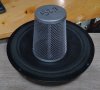
Your drivers are closer to spec than I would expect, you should be fine on the calcs if measurements are accurate. Which method did you use for Vas? I use a "pencil holder cup" to add mass evenly around the voice coil without adding air mass.

IMG_20230310_195252.jpg

You probably know that a solid, well braced enclosure is important.

With a DSP active XO you can play around with frequencies, slopes, parametric EQ etc and find a good combo. Plus you can change your mind any time.

Keep us posted, have fun!
 
Last edited by a moderator:
I think your thoughtful approach should yield good speakers. I use DATS and WinISD. Also Omnimic. You might consider getting that or some other measurement system too. (Maybe you already have something?) Your upper mid and hi drivers will likely have response irregularities in the passband. DSP can correct that if you don't mind using it for that, and if you can measure.

You say you will biamp. Do you mean multiamp? I would go active XO top to bottom if possible.

DSP would allow a Linkwitz transform or a vented assisted alignment (Google those) on the low end if you want to extend it. Cutoff does not need to be above Fs if power handling stays reasonable. You can do a partial Linkwitz if you don't want to use as much boost.

Your drivers are closer to spec than I would expect, you should be fine on the calcs if measurements are accurate. Which method did you use for Vas? I use a "pencil holder cup" to add mass evenly around the voice coil without adding air mass.

View attachment 2823205

You probably know that a solid, well braced enclosure is important.

With a DSP active XO you can play around with frequencies, slopes, parametric EQ etc and find a good combo. Plus you can change your mind any time.

Keep us posted, have fun!


Hello,

Thank you for the kind and honest response and helpful information.

Yes sorry I meant multi amp! Already have 3 amps, just need 2 more... One for the high and one for the DJ monitors which I didn't mention. They are tannoy gold 3LZ which I'm making better cabs for.

Yes after I build MDF test cabs I will order the Dayton omnimic to take measurements.

Plan is to build 2 rectangular test cabs using golden ratio and well braced. This keeps cost down. Then final build will be 25mm birch ply. But I plan to build these similar to tannoy autograph shape so there is least amount of parallel surfaces. Also should be very rigid. I have a workshop and am a carpenter / modelmaker so the construction will most likely be over engineered

The dats gave me the vas although you recommend using the cup method? I have seen that method.. will do that today. Cheers.

Yes active xo dsp all the way so I can play around and adjust.

To clarify about the tuning of the mid bass... If xo is well above tuning, will the ports actually help?

I have been asked elsewhere if I have considered using a sealed enclosure for the mid bass. Any thoughts on doing that?

Thank you again, and yes I will keep an update going.

All the best
 
I think your thoughtful approach should yield good speakers. I use DATS and WinISD. Also Omnimic. You might consider getting that or some other measurement system too. (Maybe you already have something?) Your upper mid and hi drivers will likely have response irregularities in the passband. DSP can correct that if you don't mind using it for that, and if you can measure.

You say you will biamp. Do you mean multiamp? I would go active XO top to bottom if possible.

DSP would allow a Linkwitz transform or a vented assisted alignment (Google those) on the low end if you want to extend it. Cutoff does not need to be above Fs if power handling stays reasonable. You can do a partial Linkwitz if you don't want to use as much boost.

Your drivers are closer to spec than I would expect, you should be fine on the calcs if measurements are accurate. Which method did you use for Vas? I use a "pencil holder cup" to add mass evenly around the voice coil without adding air mass.

View attachment 2823205

You probably know that a solid, well braced enclosure is important.

With a DSP active XO you can play around with frequencies, slopes, parametric EQ etc and find a good combo. Plus you can change your mind any time.

Keep us posted, have fun!

I LOL'd at that image of the pencil holder cup- as, I've got several objects here, in my garage, with what look, to most people, like random numbers written on them..

Knowing the measured weight, in grams, of commonly available, suitably-sized objects, is a great thing, when measuring driver parameters!!

Regards,
Gordon.
 
I LOL'd at that image of the pencil holder cup- as, I've got several objects here, in my garage, with what look, to most people, like random numbers written on them..

Knowing the measured weight, in grams, of commonly available, suitably-sized objects, is a great thing, when measuring driver parameters!!

Regards,
Gordon.
I can picture my sons looking through my stuff after I'm gone, asking "what does 52.7 mean?" (They're not involved in the hobby.)

:idea:
 
Say for example I crossed these drivers at 100hz (that may be completely wrong) Does that mean I do not have to worry so much about the tuning of the 15" TAD as it will cut off above tuning? How will this affect tuning and response etc?

I would take a look at the maximum excursion, and the flatness of the response on the TAD, at the lower end of its frequency response, regardless of whether it's high-passed and used with the JBL subwoofer, or not. Frequency and phase response of a system can be affected to sometimes a significant degree, by driver response irregularities, even up to a couple octaves away from the crossover point.

Should I be designing with crossover points in mind? and too what degree or tolerance?

The most important thing to keep in mind, is making sure to account for the response of the driver (rolloff and such) when designing a crossover. You probably want to either incorporate the driver rolloff INTO the crossover acoustic response (making the effective crossover the product of both the electrical and mechanical rolloff), or position the crossover where it's far enough from the driver rolloff, for it not to be a factor (minimum one octave, preferably two, away from the crossover point). Same goes for driver response anomalies at higher frequencies. For example, I've dealt with rising response on a driver (where the frequency response starts to go up with frequency), by using a lower effective electrical crossover point, and or a lower Q crossover (i.e, a Linkwitz-Riley alignment instead of Butterworth, possibly). The rolloff of the electrical crossover can, to an extent, be used to "EQ" the rising response down to something more flat, out to the desired acoustic crossover point...

I also have read differing info on whether to tune above or below F3?


And how does tuning the enclosure relate to the Fs? Does it matter how close they are?

Totally depends on the driver parameters- the value of Qts, primarily. Low Q (less than Qts = 0.44) drivers, in reflex boxes, tend to be tuned at or above the Fs point- while high-Q drivers (higher than Qts= 0.44) tend to wind up tuned for a box resonance below the Fs point. In short, whatever results in the flattest frequency response in the actual system in use, is the right box frequency. Sometimes, that takes some trial and error experimentation, once you build the whole thing. This is why I hardly ever bond the ports into a new system enclosure, until I've listened to it- many times, a bit of port shortening (higher frequency) or port lengthening (lower frequency) will make things sound better...

Regards,
Gordon.
 
I would take a look at the maximum excursion, and the flatness of the response on the TAD, at the lower end of its frequency response, regardless of whether it's high-passed and used with the JBL subwoofer, or not. Frequency and phase response of a system can be affected to sometimes a significant degree, by driver response irregularities, even up to a couple octaves away from the crossover point.


The most important thing to keep in mind, is making sure to account for the response of the driver (rolloff and such) when designing a crossover. You probably want to either incorporate the driver rolloff INTO the crossover acoustic response (making the effective crossover the product of both the electrical and mechanical rolloff), or position the crossover where it's far enough from the driver rolloff, for it not to be a factor (minimum one octave, preferably two, away from the crossover point). Same goes for driver response anomalies at higher frequencies. For example, I've dealt with rising response on a driver (where the frequency response starts to go up with frequency), by using a lower effective electrical crossover point, and or a lower Q crossover (i.e, a Linkwitz-Riley alignment instead of Butterworth, possibly). The rolloff of the electrical crossover can, to an extent, be used to "EQ" the rising response down to something more flat, out to the desired acoustic crossover point...


Totally depends on the driver parameters- the value of Qts, primarily. Low Q (less than Qts = 0.44) drivers, in reflex boxes, tend to be tuned at or above the Fs point- while high-Q drivers (higher than Qts= 0.44) tend to wind up tuned for a box resonance below the Fs point. In short, whatever results in the flattest frequency response in the actual system in use, is the right box frequency. Sometimes, that takes some trial and error experimentation, once you build the whole thing. This is why I hardly ever bond the ports into a new system enclosure, until I've listened to it- many times, a bit of port shortening (higher frequency) or port lengthening (lower frequency) will make things sound better...

Regards,
Gordon.


Gordon,

Thank you very much for the in depth reply. Really appreciate the help and input.

Sam
 
Back
Top Bottom