
• The move to the new server is done. There are some software and database maintenance updates in process. This has us passing the hat around to help out. We appreciate any donations. Seriously, even a dollar helps. The payment page may be found here - https://www.audiokarma.org/support.html

After speaker recap. Problem?

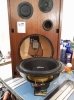
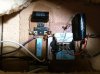
IMG_20160803_182921.jpg IMG_20160725_143801.jpg IMG_20160731_175428.jpg I'm not understanding cause of possible problem, unless it is the caps. Parts Express assured me all thier Dayton caps were bipolar. I replaced two caps in each with like values. Should be pretty straight forward. Same meter reading on both speakers after.
(There is additional circuitry as part of OEM upgraded woofers on woofer magnet. Those have been in use for year.)
I took before and after pics just in case I get distracted. Had to relocate larger cap slightly.
Thanks for your comments.
 
Last edited:
So it appears that the green and black wires go directly from the input terminals to the woofer, correct? If true, then we need to know more about that auxiliary circuit mounted on the woofer. Is there a big cap in that circuit?
 
External input terminals to the speaker are the black and green wires at the bottom of the picture two? Conductors to the woofers are white and purple? Please specify in order to understand the signal path to the woofer. In the picture there are no inductors in series with the woofer, probably are in the module below the woofer ...
 
This is why you take lots of before pics, and do one speaker at a time. Hopefully someone has recapped theirs and has pics, or is ready to recap theirs. Or has a schematic.
 
Yet looking at the pictures before and after surgery seems that the connections have been made correctly! It could instead be a design choice to have put a large capacitor in series with the woofer to operate a subsonic filtering .. The English speakers 80s often used in series with the woofer a capacitor 800-1000 uF... so no mistakes!
 
The capacitor in series with the woofer is also used to give + a bit of vitality to the low range, virtually increases the Qtc of small speakers in pneumatic suspension.
 
Last edited:
Thanks for comments The picture #2, is the before picture. #3 is the after. I replaced the 4uf cap. Also replaced the 8.2uf cap. This one I had to shift I little for larger size. In pic #2 the black and green wires at bottom go to the circuit glued to woofer magnet. That circuit and woofer was an OEM Ohm Accoustics made upgrade. Do not have schematic of it. It has at least one cap in its circuit. Ohm said it extends base when music calls for it, reduces distortion, and increases dynamic range. Also has protection that cuts out woofer in overload and then resets itself. Prior to woofer upgrade last year, the black and green wires went directly to woofer. Also in pic #2, the four wires leaving out top of pic are going to mid and tweeter.
The speakers have been in use at least 40 hours since rcap. Have not noticed any operational problems. All drivers and three position switch work.
 
Last edited:
If bass response is normal, then we might conclude that there's a big series cap in the woofer's auxiliary circuit. This cap may be part of a resonant circuit that boosts bass just above the final low-end dropoff. If so, then its value is relatively critical and it sees fairly large voltages across its terminals at times. That's not an ideal operating environment for electrolytic caps, so I would be inclined to replace it at the slightest provocation. A final comment: Electrolytic caps used in this way tend to produce maximum distortion due to innate characteristics. That distortion might still be less than the woofer's acoustic distortion, but perhaps there's an opportunity for performance enhancement here.
 
If bass response is normal, then we might conclude that there's a big series cap in the woofer's auxiliary circuit. This cap may be part of a resonant circuit that boosts bass just above the final low-end dropoff. If so, then its value is relatively critical and it sees fairly large voltages across its terminals at times. That's not an ideal operating environment for electrolytic caps, so I would be inclined to replace it at the slightest provocation. A final comment: Electrolytic caps used in this way tend to produce maximum distortion due to innate characteristics. That distortion might still be less than the woofer's acoustic distortion, but perhaps there's an opportunity for performance enhancement here.
Binary, The caps I added are said to be polypropeline. The circuit glued to the woofer was made only last year. Hopefully Ohm used better quallity cap(s). I paid about $325+ for that upgrade. They do sound pretty good.
Thank you for your support and others who posted. Again AK members came through.
One more thing. I know thst woofer upgrade was expensive. Speakers were in nesr perfect condition and one of favorites.
 
Last edited:
Back
Top Bottom