

You are using an out of date browser. It may not display this or other websites correctly.
You should upgrade or use an alternative browser.
You should upgrade or use an alternative browser.
All Anti-skating mechanisms are wrong!
- Thread starter ear4audio
- Start date

AvFan
Super Member
How do the magnetic antiskates compare to the other methods?
I don't have first-hand experience with magnetic AS but it could be designed to either be constant or variable. If the magnets stay the same distance apart during the tonearm's swing the AS force would remain constant and if they don't the AS force would decrease. One advantage of magnets is their use removes a vibration path that might negatively impact the sound.
I looked at photos of the Reed 3P which uses magnetic AS and the location of the magnet on the gimbal and the shape of the gimbal appear to create a variable AS force. But the Reed's instruction manual is vague on how to set AS, "Adjust antiskating force (using a test record) by turning the handle", in contrast to what was obviously considerable design into the issue. It would be helpful if they had provided some insights into how the AS force varies during the arm's swing. Curious, but they do say AS can be adjusted on the fly!
This is the AS on my Audiomods:
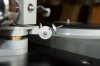
There is a monofilament line from the back of the yoke, through the pigtail guide and then over the pulley. The AS force is at its maximum when the threaded rod attached to the pulley is horizontal and decreases an equal amount when the rod is above or below horizontal. The AS force is zero when the rod is vertical, either up or down. The complicating factor with this approach is the change from max to min is not linear but is sinusoidal. For example when the rod is at 45 degrees the AS force is 71% of the maximum. The little arm that the connects the pulley to the tonearm's base is used to adjust the threaded rod's position during the arm's swing. This makes it very adjustable but it is also the definition of fiddly.

Thunderbox
Super Member
Because the most anti skating is required at the inner most grooves every test record I have seen uses a track on the inner part of the record to set anti skate. As you go out the requirement for anti skate is reduced. Most TTs adjust the anti skate automatically using springs or a weight that varies the geometry. I prefer a properly set up weight and line system because it is simple, adjustable and effective over the whole record.

I read through a 1967 paper by Shure’s Chief Engineer James Kogen on the topic of tonearm skating. I was able to discover some interesting findings that the turntable/tonearm manufacturers didn’t get quite right in designing effective anti-skating mechanisms.
• Skating is the result of the friction generated between the stylus tip and the groove wall.
• The greater the friction, the greater the skating force.
• Skating is not the same as the centripetal force that is generated by the tonearm and the rotating record. (see Centripetal Force Graph)
• Using a blank record to set the anti-skating will result in a 5% error since this action is a demonstration of centripetal force and not skating.
• The skating force decreases as the tonearm travels toward the spindle. Skating is greatest at the lead-in groove and curves downward to its lowest about 15 mm before the lead-out groove. This is the opposite of centripetal force since that force increases as the tonearm gets closer to the spindle. (see Skating Graph)
• Most turntable mechanisms calibrate the anti-skating force to counteract the centripetal force of the tonearm: Increasing anti-skating as the arm travels toward the spindle. This includes mechanisms using springs and weights. So, for most tonearm designs, too little anti-skating is applied at the lead-in groove and too much force is applied toward the spindle.
Summary:
• The blank record test shows the centripetal force of the tonearm which does not reflect the actual skating force. Stylus shape has no effect on centripetal force but radius size does.
• The stylus must be tracking in a record groove to create skating. It is depended on stylus shape as well as radius size.
• Centripetal force increases as the tonearm moves toward the spindle.
• Skating force decreases as the tonearm moves toward the record label.
• Tonearm anti-skating mechanisms are designed to counteract the effects of centripetal force; increasing as the tonearm moves toward the spindle.
• It is not known how the mechanism is calibrated: Is it an average, minimum, maximum value? What stylus shape is it optimized for?
• Assuming the setting is the average force across the record; the initial setting will be lower than the optimum force and higher as the tonearm moves toward the spindle.
• Re-adjust (lower) anti-skating settings is necessary as tonearm bearings become worn and dirty.
• If “less is better than more”, use a line contact stylus and set the anti-skating amount ¾ to ½ of the VTF amount. Anti-skating will be insufficient at the beginning but will be a closer match as the tonearm approaches the middle of the record. This could be totally off base depending on the design of the tonearm mechanism.
I’m not a perfectionist and I’m not going to lose sleep over this. I suppose it’s the best tonearm designers can do. It’s like cartridge alignment: There are only two points on the record where the alignment is perfect and we just live with imperfection for the majority of the record. With anti-skating there is probably only one point were the forces are perfect; and that lasts for less than a second.
One of the best summaries I've found on the Net. PLUS, the skating force (friction on stylus) varies throughout the record depending on complexity and volume level of the recording.


I adjusted mine using a blank record setting the A/S to run in about 1 inch per 2 seconds. Sounds fine. Originally I had it set to the turntable recommendations, which ran in rather quickly, then asked Peter at Soundsmith about it. He suggested the current setting and it works for me.
https://www.sound-smith.com/faq/how-do-i-adjust-anti-skating-my-cartridge
https://www.sound-smith.com/faq/how-do-i-adjust-anti-skating-my-cartridge


Pio1980
AK Member
One reason I'm interested in LT arms is this.Good arguments for linear tracking tone arms. They do work if maintained and used properly. VPI was against anti skating for years and Harry always said if you did use it much less was required than most people thought.
What a correct anti-skating design would look like for various mechanisms.How do the magnetic antiskates compare to the other methods?
Spring: As the tonearm travels toward the spindle, the spring should slowly compress. The spring should be fully extended when the arm is positioned at the edge of the record.
Weight: As the tonearm travels toward the spindle, the weight should slowly drop and hang from its lowest position at the end of the record. When the arm starts playing at the edge of the record, the weight should be hanging at its highest position.
Magnet. The force is strongest when the poles of the magnets are close to each other, therefore as the tonearm travels toward the spindle, the space between the two poles should move further apart.
Of all the designs out there, the magnetic mechanism seems to be the easiest to tweak to make it work correctly.

lini
just me...
• Skating is the result of the friction generated between the stylus tip and the groove wall.
Wrong/incomplete - 'cause there is no skating without an angular deviation between the virtual arm axis and the groove drag vector.
• The greater the friction, the greater the skating force.
Again incomplete (see above!).
• Skating is not the same as the centripetal force that is generated by the tonearm and the rotating record. (see Centripetal Force Graph)
A radial-tracking arm only rotates around its pivot, not around the record, so speaking of a centripetal force would seem pretty inappropriate - and due to record excentricity, even that motion is pretty non-linear, so in my view that centripetal force graph doesn't makes all too much sense.
• Using a blank record to set the anti-skating will result in a 5% error since this action is a demonstration of centripetal force and not skating.
Highly questionable (5 %) and wrong (demonstration of centripetal force). On a blank record you'd get skating as well, but a somewhat different one. Basically, if one does a vector analysis, one can see, that the friction in an unmodulated groove would be higher by factor 2^0.5 = ca. 1.414 than on a blank record. However, in practice the very tip of the needle might already be sharp enough to slightly cut into the record surface, so that this wouldn't really qualify as sliding friction anymore and the error percentage could be all over the place.
• The skating force decreases as the tonearm travels toward the spindle. Skating is greatest at the lead-in groove and curves downward to its lowest about 15 mm before the lead-out groove. This is the opposite of centripetal force since that force increases as the tonearm gets closer to the spindle. (see Skating Graph)
Actually, on a typical radial tracking arm for hifi (i.e., with overhang and offset angle) the aforementioned angular deviation between the virtual arm axis and the groove drag vector can be split into the offset angle, which would contribute the dominant part, and the remaining, positive or negative tracking error angle, which would add or subtract a little. However, how much the remaining tracking error angle would add or subtract at a certain playback radius, would depend on the chosen alignment geometry - just as the constant, dominant contribution by the offset angle also would depend on the chosen alighment geometry.
• Most turntable mechanisms calibrate the anti-skating force to counteract the centripetal force of the tonearm: Increasing anti-skating as the arm travels toward the spindle. This includes mechanisms using springs and weights. So, for most tonearm designs, too little anti-skating is applied at the lead-in groove and too much force is applied toward the spindle.
Imo, that's a stupid claim - especially the part about counteracting the centripetal force of the tonearm. And a lot of antiskating implementations actually are quite refined. For example, just look at the typical spring-based antiskating implemenations of many Dual turntable models - you might be surprised. What really remains, though, is the problem with the modulation-dependent influence on the skating.
Greetings from Munich!
Manfred / lini


cabalaska
Member
What a correct anti-skating design would look like for various mechanisms.
Spring: As the tonearm travels toward the spindle, the spring should slowly compress. The spring should be fully extended when the arm is positioned at the edge of the record.
Weight: As the tonearm travels toward the spindle, the weight should slowly drop and hang from its lowest position at the end of the record. When the arm starts playing at the edge of the record, the weight should be hanging at its highest position.
Magnet. The force is strongest when the poles of the magnets are close to each other, therefore as the tonearm travels toward the spindle, the space between the two poles should move further apart.
Of all the designs out there, the magnetic mechanism seems to be the easiest to tweak to make it work correctly.
If that's true for weights/string, then it seems that the majority are configured in reverse? The weight actually hangs at it's lowest position at the start of the record and is pulled upward as the tonearm moves towards the spindle. Is there a way to reconfigure that?


This is how I feel with EQ's...lol.Yeah. I'll never understand this mentality. It certainly can't add to the enjoyment of playing music. Takes tweaking to whole new level.
Dealing with analogue playback problems like this, tip alignments and wear, timebase instabilities, mechanical resonances, and the others is what many folks found compelling of the potential of digital storage when CDs appeared.
And then there are those of us who enjoy playing records on pre-1930 equipment as well as stuff from the 1970s and 1980s.
Pio1980
AK Member
I'm one of those who still wonder at how well it works, and as a time machine miracle of moments permanently frozen, to be recalled at will, anytime.And then there are those of us who enjoy playing records on pre-1930 equipment as well as stuff from the 1970s and 1980s.

Dealing with analogue playback problems like this, tip alignments and wear, timebase instabilities, mechanical resonances, and the others is what many folks found compelling of the potential of digital storage when CDs appeared.
This is the fun part of analog. CD is so predictable and somewhat boring. No?
It's like keeping the old Fender Deluxe working during a gig.
