• Please note that Audiokarma will be offline briefly for updates early on Monday morning, September 28th.

All Anti-skating mechanisms are wrong!

Furtheluva.....the scope.

Why didn't I think of that?

I use the scope to lay curves over each other for my cassette decks so the TT should have been obvious.

I don't really care about all the rest of the "antiskate" stuff guys go on about, I just want the sound to be "balanced". Laying two traces over each other has got to be about as close to that as you can get.

Thanks for helping kick my rusty old brain into moving again.

:bigok:
Rust never sleeps as Mr. Young says.

Going on was just my brain sorting out why and how to address skating.

Yeah, thread made me engage my old brain cells.
 
I gave up guessing on the antiskate and now do it by one or both of the following methods - you need a test record for this -

1. Zero the antiskate (or remove the weight on some TTs). Play the vtf adjustment track on a test record. Typically its 400hz. Set the vtf where the left channel just stops distorting. If the right channel does not distort you are set. If it does then add antiskate until it stops distorting.

2. Same as above except you use a spectrum analyzer instead of your ears and "look" for least distortion on the spectrum as you adjust the weights/forces.
Its quite easy to use a soundcard and some software to do this.

This works for carts with or without brush and takes the guesswork out. Make sure the test track is not worn out which is not too unusual for the high amplitude vtf test track.


One other thing that hasnt been mentioned yet in this thread (unless I missed it) is the leveling of the TT. It greatly affects antiskate force so a perfectly level tt is where you start otherwise all bets are off.
 
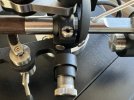
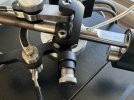
This is such a great topic and threads like this do increase our understanding of the dilemma skating force presents. I sold my Audiomods tonearm in part because of the difficulty setting anti skate and purchased my personal endgame tonearm, a Reed 3P. It has variable magnetic anti skate that applies more AS force at the beginning and end of the record. Since magnetic AS has been discussed I thought it might be helpful to see how Reed addressed it:

At the beginning of the record the adjustable barrel is very close to the front magnet:

IMG_4884.jpeg

The adjustment barrel is midway between the magnets when the stylus is about 2/3 or 3/4 across the record side:

IMG_4886.jpeg

Lastly at the runout groove the adjustment barrel is not quite in front of the rear magnet:

IMG_4885.jpeg

I have no idea if Reed used the same or different strength magnets but it is clear that they wanted the AS force to be higher at the ends of the record versus at about the 2/3rds point. If anyone is contemplating the purchase of a tonearm with magnetic AS it would be a good idea to see how it is implemented beforehand. For example Korf uses magnetic AS and has indexed it to the VTF. Is it a constant or variable AS force? No clue.

I start with SoundSmith's compromise method of setting AS but I always make adjustments by ear (and on the fly) during songs in the middle of the record. Maybe I should make my initial AS setting at the 2/3 point of the blank record versus toward the inner part as SoundSmith describes. Yup, it is a dilemma.
 
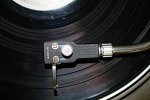
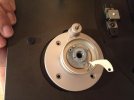
The Sony PUA-7 is a superb arm, but I have serious reservations about the cam system for the anti-skate comp. The forward motion flows fine, but there is considerable drag in reverse. Maybe fine for preventing lateral oscillation under certain cdx, but stressful for the stylus suspension on a less than perfectly concentric record. Of course, nobody wants to play an off-center record, however slight. Ref Nakamichi Dragon.
PSX70ArmBaseAS.jpg
PSX70Arm.jpgIMG_20171207_203141801.jpg
 
Last edited:
I gave up guessing on the antiskate and now do it by one or both of the following methods - you need a test record for this -

1. Zero the antiskate (or remove the weight on some TTs). Play the vtf adjustment track on a test record. Typically its 400hz. Set the vtf where the left channel just stops distorting. If the right channel does not distort you are set. If it does then add antiskate until it stops distorting.

I don't think this is a good idea.

What will happen is that you will have excessive antiskate for normal music. Because you are compensating for good tracking in a worst-scenario case, which is what those loud 400Hz/300Hz cuts are.
 
If VTF is set using those tracks then ATF would have to be set on that as well.

What will happen is that you will have excessive antiskate for normal music. Because you are compensating for good tracking in a worst-scenario case, which is what those loud 400Hz/300Hz cuts are.
Also, would the centripetal and antiskate forces differ between loud or quiet passages ? I can't imagine how unless you can please explain.
 
Last edited:
I'm going to revisit this a bit later.

One point would be that you would want the stylus to be positioned correctly (so the magnets or coils are where the manufacturer designed them to be). With VTF and, assuming that the rubber bung or whatever that acts as the pivot for the stylus still is as flexible as it was originally, the VTF prescribed by the manufacturer would (you assume) align the magnets/coils properly.

Anti-skate comes into the equation when you think about L/R mag/coil alignment. Not sure how much would actually move the mags/coils far enough to make a difference.

What I called TTF (tangential tracking force) or, basically, the drag on the stylus tip as it glides along the groove, is going to be a function of its contact area (shape - conical, elliptical, etc.) and the amplitude/frequency of the music. Lacking a sensor (think strain gauge on the tonearm) you might be able to measure how long it takes for a record to coast down without the stylus tip on the record (Tcoastfree) and how long it takes to coast down with (Tcoastengaged). Probably more accurate and easier to do to actually measure the difference in degrees of rotation.
 
If VTF is set using those tracks then ATF would have to be set on that as well.
Also, would the centripetal and antiskate forces differ between loud or quiet passages ? I can't imagine how unless you can please explain.
Yes, sortof.

It's all relative (as they say in West Virginia). We're talking about forces relative to the stylus tip.

Consider three dimensions - X, Y and Z.

Z: vertical plane through the record
X: horizontal plane tangent to record groove - quasi-parallel to the cartridge alignment
Y: horizontal plane perpendicular to the record groove - quasi-parallel to a line extending from the center spindle outwards

VTF is acting along Z
TTF (tangential tracking force) is acting along X and is a function of VTF and the friction between the record and the stylus tip
ATF (axial tracking force) is acting along Y and is a function of TTF and the offest between a line extending outwards along X and the tonearm pivot.

VTF is constant
TTF varies with VTF and friction (amplitude/frequency of sound passage in groove, angle of stylus tip in groove for asymmetrical tips (worn conical, elliptical, etc.)
ATF varies with TTF and stylus angle

There is some horrible geometric function that would give you ATF as a function of frequency, amplitude, and radius with constants specific to a particular turntable.

Of course, the anti-skate (in most cases) doesn't follow the same function (likely a function of radius only) and you end up with a compromise.

Revisiting earlier posts - you are best to look for best balance between channels at beginning and end of an LP record and live with it.
 
I'm going to revisit this a bit later.

One point would be that you would want the stylus to be positioned correctly (so the magnets or coils are where the manufacturer designed them to be). With VTF and, assuming that the rubber bung or whatever that acts as the pivot for the stylus still is as flexible as it was originally, the VTF prescribed by the manufacturer would (you assume) align the magnets/coils properly.

Anti-skate comes into the equation when you think about L/R mag/coil alignment. Not sure how much would actually move the mags/coils far enough to make a difference.

What I called TTF (tangential tracking force) or, basically, the drag on the stylus tip as it glides along the groove, is going to be a function of its contact area (shape - conical, elliptical, etc.) and the amplitude/frequency of the music. Lacking a sensor (think strain gauge on the tonearm) you might be able to measure how long it takes for a record to coast down without the stylus tip on the record (Tcoastfree) and how long it takes to coast down with (Tcoastengaged). Probably more accurate and easier to do to actually measure the difference in degrees of rotation.
The variable traction drag force can generate "pistoning" tug axial movement on the stylus, particularly in free-pivot types without a pivot tie wire, like ADC and Ortofon magnetic carts. Careful design should comp for it.
 
I was stationed (TDY) in Japan: Yokota AB right after the NK's captured the spy ship the Pueblo.
At that time I was more into cameras. anyways:
I looked into stereos, amps, TT's, etc.
At one store (off-base), went in a 'high end' shop.
They had a turntable which had a, well, like a jib on a crane, with a pulley on its end, you opened the cover, flipped this jib out over the side, lifted a small weight from its location on the TT. Weight was connected to the tone-arm with a fine thread, you laid it over/on the pulley and let it dangle along the side of the base. Used lite, (very lite!), thin shims with slots cut from edge to center (like old fashioned scales). anyways, that was how to adjust the anti-skid.

"I am not making this up!" I woulda bought but it was VERY expensive, me, E-4 - A1C - airman 1st class, didnt have that kind of money!

I've never seen anything even remotely like it
 
I was stationed (TDY) in Japan: Yokota AB right after the NK's captured the spy ship the Pueblo.
At that time I was more into cameras. anyways:
I looked into stereos, amps, TT's, etc.
At one store (off-base), went in a 'high end' shop.
They had a turntable which had a, well, like a jib on a crane, with a pulley on its end, you opened the cover, flipped this jib out over the side, lifted a small weight from its location on the TT. Weight was connected to the tone-arm with a fine thread, you laid it over/on the pulley and let it dangle along the side of the base. Used lite, (very lite!), thin shims with slots cut from edge to center (like old fashioned scales). anyways, that was how to adjust the anti-skid.

"I am not making this up!" I woulda bought but it was VERY expensive, me, E-4 - A1C - airman 1st class, didnt have that kind of money!

I've never seen anything even remotely like it
Can't remember the company's name?

Thanks!
 
One of these days I'll hook my oscilloscope up to my JVC QL-Y5F and do some measurements.

Somewhat bizzaro world where you manually set VTF just enough to drop the stylus tip on a record (not "0" but pretty close) then the turntable uses an electromagnet to "set" the VTF. It varies the VTF based on feedback from the tonearm such that, for example, if you had a warp where the stylus had to move "up" (along Z axis) it will reduce VTF to compensate for the increase in VTF resulting from vertical acceleration forces.

It also has sensors for the "Y" axis (anti-skate) and adjust anti-skating force "on the fly". I guess you could get rapid groove deviation along the "Y" axis - will have to check what happens when I put one of my "Eat A Peach" records with the edge warp on and see if it can handle both the up-down and side-to-side deviations.

I think that the system is analog so it can respond somewhat instantaneously but, mechanically, there's some mass involved so who knows.

Like I said previously - if it goes wrong then it's really going to go wrong.
 
"level as possible"

What's nice about the BIC's is the gauge to make sure the head shell is level plus how easy it is to adjust, little screw on the head shell, for me is the easiest to adjust turn table I've ever had.
 
"I was stationed (TDY) in Japan: Yokota AB right after the NK's captured the spy ship the Pueblo."

Wow, blast from the past.

I was a hospital corpsman, medic, with the Navy from 1972-1976. The last three years was with the Marines. (Do NOT tell a Marine the Marines are part of the Navy.) We were on deck to go to Vietnam. Getting ready....Vietcong loved shooting medics so be ready to meet your Maker....when Nixon announced the draw down. Instead I helped process folks returning home doing basic physicals, etc., at Camp Pendleton.

Settled into the routine of living in Southern California, tough but someone had to do it, when the Pueblo happened. We were put on a kind of alert that we might be going into that mess.

One of my high school friends joined with me. We were in boot camp together. He wanted to be on an air craft carrier. Which he got. When I chatted with him at a high school reunion long after both of us were out when the Pueblo happened he was also put on a sorta alert to be ready to park off North Korea to send in planes. We almost crossed paths which would have been very cool even though very unlikely we'd have seen each other.

The on base exchange had quite a nice selection. They were cheaper than buying off base but not by much. Was always jealous of the guys bringing home awesome stuff for very little cash. Like 4 channel Sansui's driving 4 JBL Century speakers for very little money.
 
I was a hospital corpsman, medic, with the Navy from 1972-1976. The last three years was with the Marines. (Do NOT tell a Marine the Marines are part of the Navy.) We were on deck to go to Vietnam. Getting ready....Vietcong loved shooting medics so be ready to meet your Maker....when Nixon announced the draw down. Instead I helped process folks returning home doing basic physicals, etc., at Camp Pendleton.

Settled into the routine of living in Southern California, tough but someone had to do it, when the Pueblo happened. We were put on a kind of alert that we might be going into that mess.
When I graduated from school and started working at Kaiser, many of the senior respiratory therapists and RNs had been Navy Corpsmen during the Vietnam Era. They were some of the finest people I've ever worked with. :thumbsup:
 
Back
Top Bottom